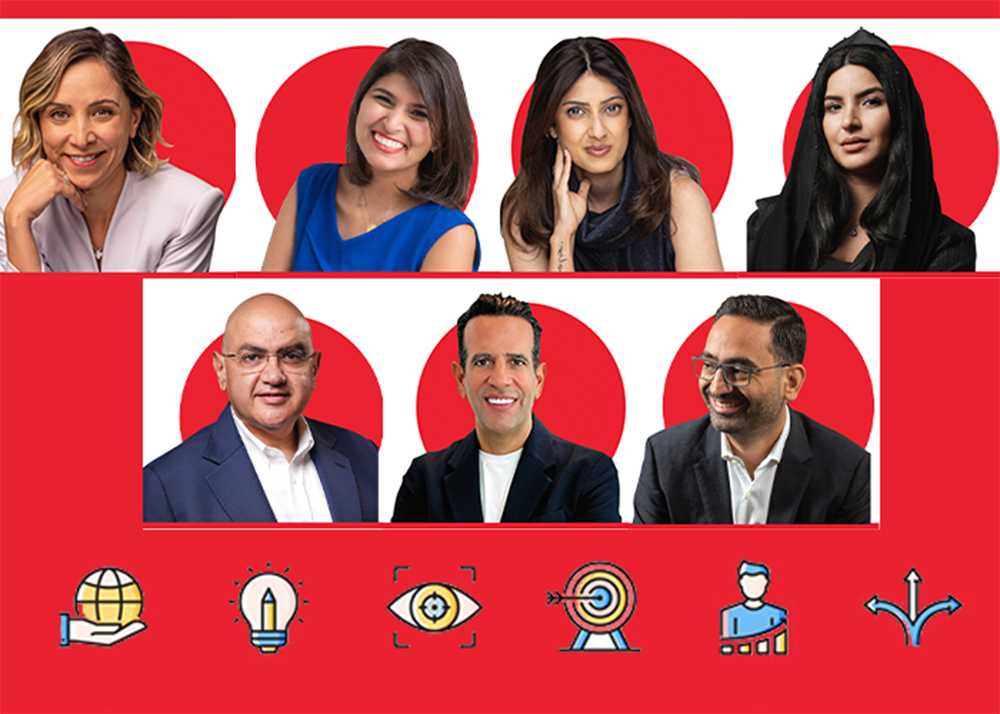
 From top left, clockwise, Property Finder's Sevgi Gur; Kraft Heinz's Passant El Ghannam; GEMS Education's Suad Merchant; Mastercard's Reem Al Shammasi; dentsu MENA's Ramzy Abouchacra; Horizon Holding's Mazen Jawad; and IMPACT BBDO's Ghassan Kassabji.
A strange paradox has been normalised at the heart of the brand-agency partnership landscape in the Middle East. Brands claim that they want sharper thinking, strategic consumer insights, stronger distinctiveness, larger share of voice, tangible returns on investment and creative work that connects with communities long after campaigns end. Yet, current pitch systems and the processes used to choose agency partners are rarely consistent with these claimed objectives – often prioritising line items, hourly breakdowns, short-term savings and tidy-looking pitches. Where does the fault lie?
On one hand, marketers agree that procurement teams are under pressure to cut costs, often resulting in commoditised and transactional relationships. They also concede the need to address deficient briefs, overweighted technical pitches, unclear objectives and metrics of success, vague evaluation criteria, dearth of feedback, shifting goalposts, price-based decision making, intellectual property infringements and lack of trust and transparency in the overall pitching process.
On the other hand, agency leaders concur that there’s a need for greater transparency about the actual team working on the account; to bridge the gap between pitch performance and final outcomes; and to reach a consensus on price and payment expectations – rather than running the rat race to the lowest cost.

These frustrations – often moved to the back burner to ensure business continuity – still simmer and occasionally boil over when demands move from difficult to the ludicrous.
Campaign Middle East speaks to several industry leaders, questioning the structure of procurement and pitching processes that push people towards untenable partnerships. The discussion also evaluates win-win alternatives.
Within this feature, leaders call for better judgement, not less rigour. They say that the issue is not whether commercial discipline belongs in the room; it is whether the industry is still measuring the right things, in the right way and with the right North Star.
Contributing to this conversation are:
- Reema Al Shammasi, Vice President Marketing and Communications – West Arabia, Mastercard EEMEA,
- Passant El Ghannam, Chief Marketing Officer – Middle East and Africa, Kraft Heinz,
- Suad Merchant, Chief Marketing Officer, GEMS Education,
- Sevgi Gur, Chief Marketing Officer, Property Finder,
- Ghassan Kassabji, CEO – Dubai and Chief Growth Officer – MENA, IMPACT BBDO,
- Mazen Jawad, CEO, Horizon Holdings, and
- Ramzy Abouchacra, President – Media Practice, dentsu MENA
The framework gap: useful guardrails, outdated yardsticks
The conversation starts on common ground: leaders agree that financial discipline and accountability have very real value.
However, problems arise when a buying model designed to curb overspending is treated as the primary lens for assessing value.
Marketers and agency leaders explain that although price matters, it should not be the main – or only – deciding factor. Instead, they call for better judgement and evaluation based on scale, strategic thinking, creativity and long-term value.

Ghassan Kassabji, Chief Executive Officer – Dubai and Chief Growth Officer – MENA, IMPACT BBDO, says, “Most procurement frameworks are stuck in the past. They focus on cost control, efficiencies and risk management – not on evaluating strategic thinking or creativity. They miss what drives business and brand growth. When ideas are measured only by hours and rates, the results become predictable.”
He adds, “The real issue is lack of proper evaluation. The good news is that the tools to measure outcomes rather than inputs already exist. The frameworks have not caught up with them. Until procurement starts pricing outcomes, we will keep focusing on cost while claiming to value growth.”
However, this requires client-agency partnerships to evolve. Rather than dismissing the role of commercial oversight, leaders argue that procurement teams must also be held accountable to the same long-term objectives as the marketing teams.

Ramzy Abouchacra, President – Media Practice, dentsu MENA, says, “Procurement teams play an essential role in ensuring discipline, accountability and responsible investment. That contribution is critical and has strengthened the industry in many ways. At the same time, marketing is not a commodity. This means that the real challenge lies in how success is defined within procurement frameworks. When procurement is aligned to delivering growth and commercial outcomes rather than just cost efficiency, the conversation shifts. It becomes less about the cheapest option and more about the most effective one.”
He adds, “The real questions should be: What are we buying for? Are we investing in the right talent to support transformation? Are we accessing differentiated capabilities, tools and data? Are we securing high-quality inventory that can genuinely convert? And, more importantly, are procurement teams measured on savings alone, or should they also be held accountable for business outcomes?”
Leaders also explain how this current obsession with cost-cutting is encouraging unsustainable practices and is hurting an industry already struggling with high competition and low margins.
Abouchacra reveals, “We are seeing cases where agencies enter pitches at zero fees. This may win in the short term, but it raises important questions about long-term delivery, quality and sustainability.”

Addressing the issue from a brand’s perspective, Passant El Ghannam, Chief Marketing Officer – Middle East and Africa, Kraft Heinz, agrees on the need for better evaluation criteria. She advises clients to first focus on value over cost, and then structure the pitch fairly based on agency scale.
El Ghannam says, “I’ve been fortunate. Our procurement lead in the Middle East and Africa (MEA) region genuinely understands the value of intangibles. He’s a partnership builder, not a cost-cutter. He negotiates intelligently with the agencies we shortlist rather than forcing decisions on us purely on price.”
She adds, “But even with the right mindset, that framework fails if the pitch isn’t set up correctly. You can’t invite agencies of wildly different scales and then complain about cost comparability. Apples-to-apples shortlisting is a client responsibility and a prerequisite for fair evaluation.”
Marketers also share words of caution: If the buying logic stays old while the market keeps moving, the work will flatten. What gets measured, after all, tends to shape what gets made – and vice versa. The path to a solution starts from strategic internal alignment.
Suad Merchant, Chief Marketing Officer, GEMS Education, says, “Procurement frameworks in our region have traditionally played an important role in driving efficiency and financial discipline, particularly in high-growth environments. However, marketing today operates very differently.”
The marketing function is no longer just about producing ads, campaigns or materials quickly and cheaply. It is no longer about gaming the numbers on reach, engagement and impressions. Today, the effectiveness of marketing is being closely monitored for brand outcomes – from awareness and sentiment to brand equity and loyalty. Marketing is also being held accountable for real business results such as customer acquisition, customer retention, sales and financial growth.

Merchant adds, “As marketing evolves, there is a clear need for procurement models to evolve alongside it, shifting from evaluating cost to assessing long-term impact, strategic alignment and brand value. This is less about changing procurement and more about aligning all functions to the reality of modern marketing as a growth driver.”
Reiterating the need for the pitch process to evolve from price discovery to capability discovery and outcome discovery to drive growth, Abouchacra suggests an alternative.
He says, “A more effective model would focus on three areas. First, outcome-based evaluation: the key questions should not only be ‘what does this cost?’ but also ‘can this partner deliver business results at this level of investment?’. Second, clarity on talent and capability: clients should have full visibility on who is working on their business, the level of expertise they are accessing, and the tools and products being deployed. Third, more practical and staged approaches: instead of large speculative pitches, there is value in pilots or phased engagements that demonstrate real performance.”
From pitch theatre to real partnerships
Apart from the practice of cost-cutting, the current selection ritual also raises its own concerns. Leaders describe a system that rewards polish under pressure rather than the qualities that matter once the contract is signed.

Reema Al Shammasi, Vice President – Marketing and Communications – West Arabia, Mastercard EEMEA (Eastern Europe, Middle East and Africa), says, “The traditional pitch process is over‑engineered, under‑informed and misaligned with how great work is produced. Too often, agencies are judged based on speculative ideas created under artificial timelines, with limited context and no access to real constraints.”
To solve this problem, Al Shammasi suggests a better selection process. She says, “Place strategic thinking and problem‑framing above ‘big idea’ theatrics; assess how agencies collaborate, challenge assumptions and adapt – not just how they present; include working sessions; and, finally, evaluate teams, not logos – who will do the work matters more than which agency brand is chosen. In short, clients should evaluate fit, thinking quality and working chemistry over performance theatre.”
Emphasising this notion, El Ghannam adds that the real measure of the right fit is not who can put on the best show during the selection process, but who can work in step with the client once the day-to-day pressure begins.
She says, “The pitch isn’t an exam; it’s a compatibility test – and compatibility requires both sides to show up fully. Marketing teams need to be just as invested as the agency. This requires proper briefing, tissue sessions and open doors for questions and workshops. What we should be testing is how we work together: strategy alignment, tone of voice and ways of working. Otherwise, so much gets lost between what is said, what is heard and what is done. The pitch is where you find that out early.”
Leaders also suggest starting the selection ritual with clearer intent because not every business challenge needs the same solution, partner or approach. When the brief matches the actual need, the process gets closer to the truth.
Merchant says, “The pitch model needs to reflect the complexity and maturity of the brands and the region. Not every organisation requires the same type of agency – nor does it need the same type of solution. The starting point for any marketer when selecting an agency partner or supplier should be clearly defined, grounded in return on investment, agility, experience, value orientation and, most importantly, shared values that define the work ethic between partners. The focus should shift from volume to precision: fewer agencies and more relevant partners selected based on where the business is in its lifecycle and what it is trying to achieve.”
This targeted approach also indirectly tackles another prevalent problem in the selection process, where brands are caught ‘window shopping’, and agencies put on a carefully orchestrated performance to avoid wasting time and paid resources on unpaid showmanship.
Kassabji asserts this point with a fair comparison. In his view, no other advisory discipline is routinely asked to hand over so much strategic thinking or technical output for free.
He says, “Architectural firms are never asked to create full blueprints without being paid. Yet, agencies are often expected to deliver complete ideas and strategic thinking for free, with no guarantee of winning the work. We should move from speculative pitching to selecting agencies based on their capabilities. A single idea made under pressure is not the best measure of future performance. Proven track records in thinking, execution and connected intelligence across markets and disciplines are better criteria for evaluation. Working with fewer agencies, building deeper relationships and paying for strategic phases would make the process fairer and improve quality. The goal of the pitch process should not be to collect ideas, but to find partners who can offer brands a long-term advantage.”
Irrespective of the pitch objective, leaders agree that selection should be grounded in demonstrated effectiveness, expertise and experience – not theoretical outputs.
However, this too requires a selection process where both sides tackle the issue together and can be judged on the quality of that exchange.

Sevgi Gur, Chief Marketing Officer, Property Finder, says, “The traditional pitch has lost its relevance. It is time-consuming and impractical. The story told in the room rarely matches the reality of working together. We have all seen it: a brilliant pitch followed by a partnership that never quite delivers on its promise.”
When asked about a workable solution to overcome selection woes, she suggests shifting to ‘paid discovery’.
Gur says, “Clients can select two or three agencies, pay each a defined fee and let each agency work through the problem alongside the clients – in working sessions, not presentations. Each agency is evaluated on how they think, how they challenge the brief and how they collaborate. The task becomes a demonstration of cultural fluency. It fosters a genuine understanding of the brand and its consumers. Agencies can earn the relationship through the quality of this paid discovery process.”
Gur adds, “A pitch tests how well an agency pitches. ‘Paid discovery’ reveals how an agency thinks and partners. I believe that if we shift from performance to partnership, we can create better conditions for better work and, ultimately, better outcomes for brands, agencies and the people we are all trying to reach.”
Yet, while it’s important to understand how an agency thinks, it’s equally important to understand how the client approaches the partnership.
Leaders agree that relationships are rarely sustainable when one side does all the heavy lifting. The strongest partnership structures are built on foundations where clients and agencies share the responsibility to achieve brand and business outcomes.

Mazen Jawad, CEO, Horizon Holdings, says, “A successful pitch – one that leads to a strong relationship and tangible business results – requires genuine involvement from the client and the agency. It’s very difficult to build something meaningful if the agency is expected to carry the relationship alone or operate with limited engagement.”
Jawad adds, “The most successful and enjoyable pitches we’ve experienced were highly collaborative. They were built on strong human chemistry and a shared willingness to freely solve a business or marketing challenge. When that dynamic exists, the outcome is not just a better pitch, it’s also the foundation of a long term, productive partnership.”
Trust breaks when the pitch feel extractive
As the conversation progresses, one notion becomes clear: the pitch process must act as a controlled simulation of the working relationship.
This matters not only from a technical perspective – the ability to deliver on promised scope – but also from a trust perspective: alignment on culture, credibility and chemistry before the process is complete.
Leaders reveal that if potential partners are evasive, deflect questions or try to artfully dodge their way through technical gaps during the pitch, they are signalling how they will handle feedback or project failures later.
However, if an agency team questions the brief, openly admits what is outside their area of expertise and current capabilities, and identifies potential risks during a pitch, it builds credibility.
Similarly, if a client attempts to poach ideas and infringe on intellectual property, remains vague about scope and pricing, or refuses to compensate for weeks spent on highly technical and strategic solutions, agencies can – and must – push back, educate clients and correct the market instead of condoning negative practices.
Al Shammasi says, “Trust breaks down when pitching becomes a one‑sided extraction of intellectual capital. Repeated unpaid strategic work, vague feedback and recycled ideas across pitches have created understandable cynicism. To reset trust, the industry needs clearer norms: Be explicit about how ideas will – and will not – be used, in writing. Limit the number of agencies invited. Commit to a real intent to appoint. Provide meaningful feedback, not generic closure notes. Transparency is not about legal frameworks alone – it’s about professional respect and ethical behaviour.”
She adds, “Agency leaders have more power than they sometimes acknowledge. Beyond the basics, they can: push back on broken processes instead of normalising them; reframe success away from awards and toward measurable brand and business outcomes; invest in client education, helping marketers and procurement understand what good work requires; and build teams that balance creativity with commercial and cultural intelligence – not just craft.”
Leaders agree that the strongest partnerships are built when agencies are not treated as vendors, but as accountable business partners. However, this also means that agencies must be willing to walk away from relationships that undermine that standard.
Kassabji says, “Unpaid consulting is a real problem, but it can be fixed. Paying for strategy phases, setting clear boundaries for intellectual property and giving structured feedback help set expectations. Agencies should also be more disciplined about which opportunities they pursue. Not every pitch is worth the effort. Trust grows when both sides are selective and respect the process.”
El Ghannam brings the discussion about trust back to basic conduct. In a close-knit market, she argues, honesty about timing, money and decision rules is not a nice extra; it is the minimum standard for treating people properly.
She says, “This is fundamentally a question of integrity and fairness. We don’t have a standard policy of paying for pitches, but if a process runs long or cycles through multiple rounds without an award, we discuss compensation for time spent – especially if we don’t end up awarding the business. In a market as connected as the Middle East, relationships are everything and reputations travel fast.
El Ghannam adds, “I’m always in the camp of sharing real timelines, real budgets and real decision-making criteria upfront. That’s the baseline of respect.”
The answer, then, is not just legal protection but also clearer boundaries, clearer ownership and a more balanced exchange – right from the beginning. In other words, better systems but also better manners.
Gur says, “Yes, frameworks and schemes to protect pitch work have a role, and they exist for a reason in regions such as the US and Europe. As our region matures, we should consider implementing some checks on that front. But the second part is more important: better etiquette and clearer rules of engagement, established before a pitch even begins. Agencies should set the tone early – aligning with clients on how ideas will be treated before any work is shared. And senior marketers on the client side need to take ownership of how their pitch processes are run. Industry leaders have an opportunity to play a more active role in solving challenges that hurt both sides – and this is one of them.”

Better partnerships need honesty, not just chemistry
Most people in the industry know how to spot charm in a meeting. Agency leaders involved in the pitch process attempt to get brands onside to win the account, while passing on the day-to-day deliverables to others within the organisation. Meanwhile, brands dance to the same tune, squeezing out the most value they can from their investments.
The harder question is whether this tango translates into tangible shared outcomes. Several leaders argue that the best agency relationships are not built on charm or chemistry alone, but on candour, honesty and a deeper understanding of what the client is attempting to achieve.
El Ghannam says, “The best agencies act as your toughest team members. They don’t just know your brand; they also know your business as if it were their own. Stop optimising for renewal and start optimising for outcomes. I have no patience left for ‘yes sir’ account managers, or for strategists who don’t hold us accountable to the objective, or for creatives who don’t push us until we feel slightly uncomfortable. The worst outcome is reaching a destination simply because we said so. Agency leaders must give their teams a real voice, and clients must listen to it, because that’s what we’re paying for.”
However, this requires agencies to demonstrate genuine interest in their clients’ businesses, their consumers and the challenges that they are attempting to solve for consumers. Then, it requires developing knowledge, crucial insights and suggesting solutions with brutal honesty before starting work on the account.
Kassabji says, “A strong relationship is not just about delivering work but about making a real business impact. That requires understanding the client’s business objectives and commercial model, not just their communication needs. Agencies that can bring data-driven insight into how a brand is performing across markets, audiences and touchpoints are better positioned to have that conversation. Then, challenge unclear briefs, question unrealistic deadlines, and be open about what is needed to create great work. True partnership is about alignment, not just agreement. Agencies that build long-term trust are the ones that offer clarity, not just compliance.”
Gur adds, “It sounds simple. But it is rarer than it should be. My best agency partners were brutally honest. They were not there to please us; they were there to tell us things we could not see because we were too deep inside it. That kind of honesty is invaluable. A great agency is a springboard. They bring genuine curiosity about your consumers, a real understanding of your business model, and a continuous connection to the external world – new thinking, inspiration, provocation. Fundamentally, a good agency helps its client become better in their respective subject matter. That is real value and, sadly, it is quite rare.”
To fix this issue, Merchant calls for clarity, value and alignment of expectations from the outset.
She says, “The pitch process should not be just about capability, but also about shared thinking, cultural alignment and a deep understanding of the business and its customers. Very few partnerships truly achieve this level of synergy, but when they do, the outcomes are significantly stronger. Structuring the process to reflect this, through clearer scopes, defined ownership of ideas and, when appropriate, compensation for strategic work, creates a more balanced and sustainable ecosystem.”

The final warning before it all comes crashing down
In a game of Jenga, the layers at the top of the structure – to which each player contributes – are often the sturdiest but that comes at a cost: the ones below get increasingly weaker. That gradual erosion of brand value beneath the surface – while the industry focuses on short-term profits and vanity metrics at the top – is what industry leaders claim is happening within the marketing landscape. They caution that clients – and the agencies supporting them – are setting themselves up for a crash if things remain as they are.
What’s the status quo? The current demand seems to be for more speed and output while excuses are made downstream for the loss of brand identity, decline in customers and followers, and year-on-year drop in growth and commercial outcomes. What’s the bigger risk? Leaders warn of chronic burnout due to scope that doesn’t align with deadlines, loss of institutional knowledge due to attrition of top talent, homogenisation of creativity due to algorithmic conformity, and a dip in consumer trust due to staged authenticity.
Ghannam says, “If the status quo persists, we’ll have an industry of safe, forgettable work – built on broken briefs, exhausted teams and partnerships that optimise for survival over effectiveness.”
Merchant adds, “If we continue with the current approach, there is a real risk of commoditisation, where marketing becomes standardised, efficiency-led and disconnected from real business outcomes. For a region that is investing heavily in global positioning and differentiation, this would limit the true potential of brand building.”
Abouchacra warns, “If the current trajectory continues, the industry risks moving toward a model where cost outweighs value. This would lead to diluted talent, reduced investment in innovation, lower quality media environments and, ultimately, weaker business outcomes. This is not about blame. Procurement teams are doing their job. Clients are seeking efficiency. Agencies are responding to competitive pressure. But, collectively, there is a need to reset expectations.”
“The pitch process should not be just about capability, but also about shared thinking, cultural alignment and a deep understanding of the business and its customers.”
For most leaders, this requirement for a reset is not optional; it’s imperative, especially given that the new era of artificial intelligence (AI) has further exacerbated the need for strategic thinking, deeper insights, greater understanding and clearer differentiation.
Kassabji says, “Agencies that use AI just to work faster, instead of using it to think more deeply, will find that clients notice the difference over time. If things stay the same, our industry will become more efficient but less valuable. More output, less real effectiveness.”
Gur adds, “I do not think we have the option not to change. Whether we like it or not, AI is already redefining how this industry works. This is a tectonic shift – and no matter what, the industry will look fundamentally different in five years. The question is who will be ready. The uncomfortable truth is that most of the work is turning into a commodity. In the world we are moving into, task orientation and mediocre output will not be viable. There is no margin, literally or figuratively, for that any more. The non-negotiables are business understanding, consumer understanding, cultural fluency and financial literacy.”
Leaders reach a consensus that the need of the hour is for trustworthy and respectful relationships – with clients, consumers and communities.
Some leaders look to the past – when things felt better – and call for a return to long-term partnerships; others look to the future, calling for respect, responsibility and realistic promises to reshape an industry stuck in rigid procurement, pitching and pricing structures.
Jawad says, “Those of us who have been in the industry for more than two decades have seen the value of strong, long-term client-agency relationships. In those partnerships, agencies didn’t just execute, they also took real ownership of the brand and product – sometimes even pushing it further than the client expected. There’s an opportunity to bring this back by shifting from a process-driven pitch mindset to a relationship-driven one, from price-based competition to fair compensation, and from a cost-focused approach to one centred on business growth.”
Abouchacra agrees, saying that, “The most important question remains simple: can the work succeed at the price being agreed? The cheapest solution does not always convert, does not always build brands and does not always drive growth. A healthy industry is not built on the lowest cost; it is built on shared accountability for outcomes. When we align on growth instead of savings, we move from buying cheaper to buying smarter, and that is where real value is created.”
Before the conversation concludes, leaders share their parting messages – and there’s a common call to action within them: there’s room for improvement on all sides.
There’s a need for focused, committed partnerships rather than fragmented, shallow relationships.
Clients need to stop treating agencies transactionally – like replaceable vendors. Agencies must stop doing ‘whatever it takes’ to win and be honest when something is wrong.
Procurement must respect the value that each discipline brings to the table and must align with marketers on long-term brand and business outcomes, instead of only focusing on cost savings.
Abouchacra says, “Clients should continue to demand accountability, while ensuring that investment levels are sufficient to deliver success. Procurement should balance savings with a clear understanding of what is being bought, including talent, capability, and media quality. It should also be measured not only on the outcome of the pitch, but on the performance of the business after the appointment. Agencies must also take responsibility. If we do not respect the value of our own product, we cannot expect others to do so.”
Kassabji adds, “Clients should stop seeing agencies as interchangeable suppliers. Agencies should stop overpromising and underpricing. Procurement should stop applying industrial logic to a creative field. If we want a healthier market, we need to focus on creating value rather than cutting costs. Otherwise, we will optimise ourselves into irrelevance.”
Ghannam sums up the conversation, saying, “Clients must stop treating pitches as exams, and stop treating agencies as vendors. Show up to the process with the same energy you expect from the other side. Agencies must stop saying yes when they mean no. Your silence is not professionalism; it’s how bad work gets made. Procurement must stop pricing creativity like a commodity. The intangibles are not a nice-to-have; they’re where the value lives. Integrity, fairness and honest conversation aren’t ideals. They’re the baseline for a healthier market.”
Strip away the tension, and everything that industry leaders are asking for is quite simple. Treat the pitch process with the seriousness it deserves. Don’t be tricked into believing that the cheapest option is the right one. Choose compatibility, truth and technical capabilities over performance theatre, charm and chemistry.
The way forward is not idealistic; it is practical. Better briefs. Fewer players. Fairer pitches. Clearer ownership of ideas. Realistic investment. And, above all, more honesty on all sides about what outcomes are required. The competitive advantage no longer lies in squeezing partners on scope and cost; it comes from choosing better, trusting more deeply and valuing the talent, judgement, experience and collaboration that drive long-term growth.