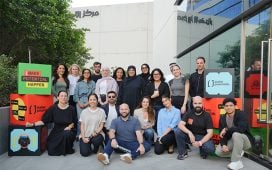
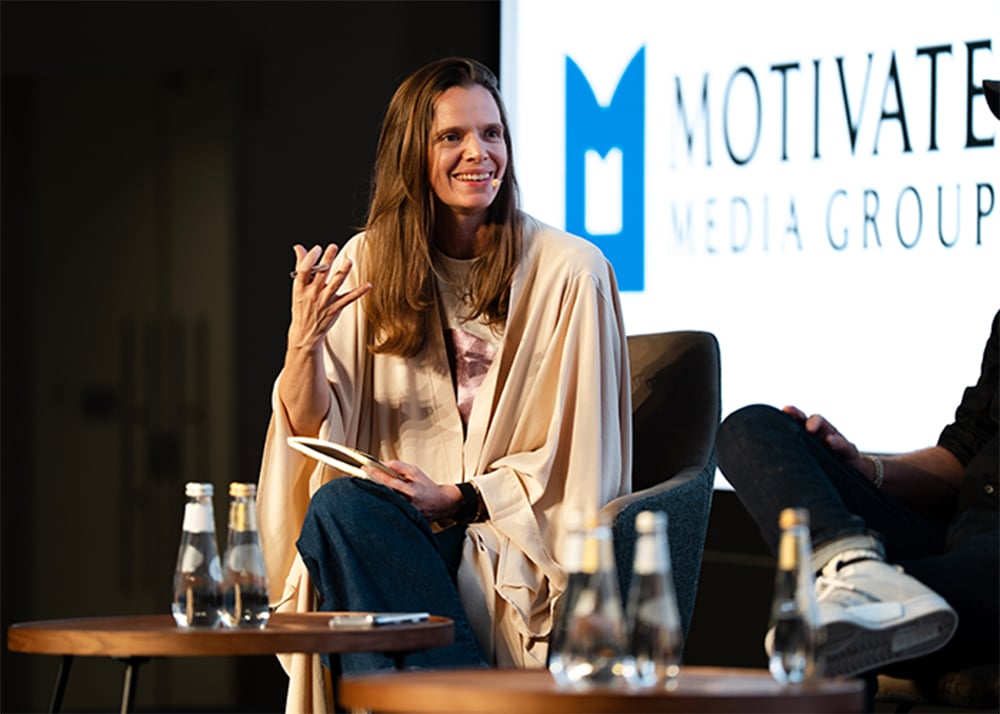
 “I think a CCO is more on a level where one is spending a lot of time strategising,” said SRMG LABS Chief Creative Officer Fadi Mroue (second from the right).
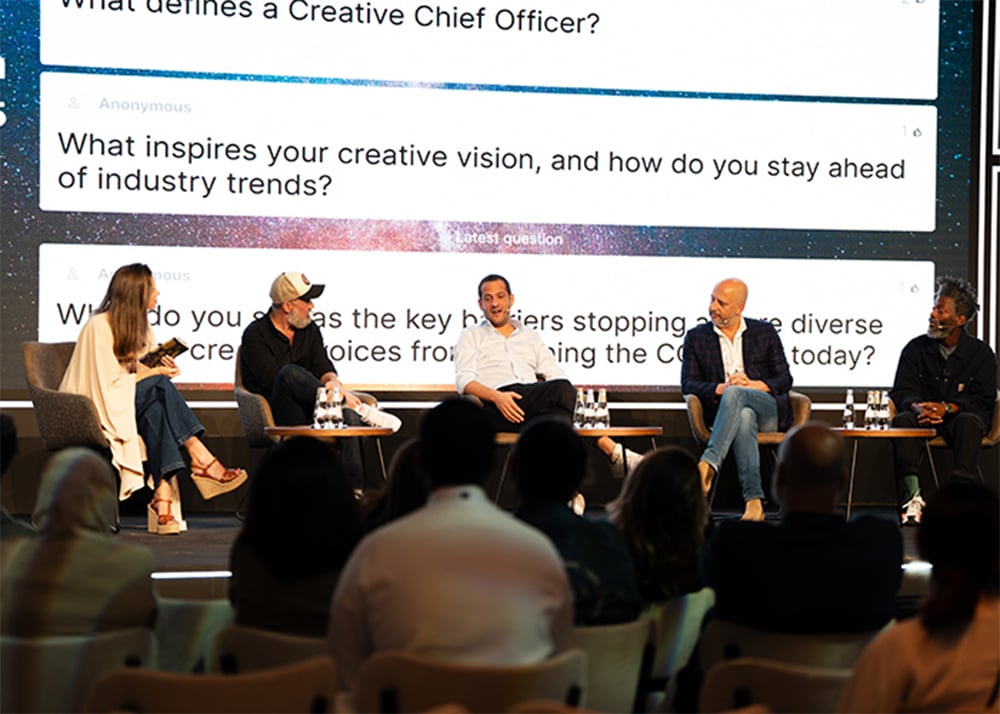
Curiosity, collaboration and culture combined with everything that makes people connect on a human level – including emotion, empathy and empowered teams – were discussed during the ‘CCOs Unplugged: Ask Me Anything’ panel on creativity at Athar Festival, which was held at JAX District in the heart of Riyadh, Saudi Arabia on 21 and 22 October 2025.
The panel, moderated by Lucy Harvey, Chief Growth Officer – MENAT, Burson, featured four chief creative officers (CCOs):
- Alexander Schill, Global Chief Creative Officer, Serviceplan Group;
- Taj Reid, Global Chief Creative Officer, Burson;
- Fadi Mroue, Chief Creative Officer; SRMG Labs; and
- Paul Banham, Chief Creative Officer, MullenLowe MENA.
The panellists agreed that human connection is returning as the core currency of the creative industry, even as new technologies recalibrate the pace, scale and reach of creative work. They spoke of the need to listen more than dictate, to design processes as diligently as outcomes, and to anchor creative output in empathy and real world impact.
They also discussed the changing role of a CCO from a solitary creative genius to a leader orchestrating and empowering a chorus of voices. They explained how this shapes a people-first and productive creative economy.
The CCOs insisted that creativity must be led with a human touch rather than just experimenting with the score of possibilities made conceivable by tech advancements. When done right, a human approach can drive commerce as reliably as it can drive culture.
The conversations also doubled up as a practical playbook on how to cultivate, lead and scale creative teams in the age of artificial intelligence. The CCOs argued for ‘uber-creativity’ – a mode of collaboration that invites input from every corner of an organisation – and for a culture where fear gives way to curiosity and feedback. Here’s a look at how the panel played out on the Strategic Stage at Athar Festival.
‘‘Create spaces where the team feels that they can share and do anything … If you don’t do that, you run the risk of someone possibly not sharing an idea that could actually change the world.”
Creativity built on curiosity and collaboration
Creativity is not always a spark that appears out of thin air, but a muscle that is built when it is trained, acted upon and channeled toward meaningful outcomes.
Reid framed this plainly, saying, “Creativity is all about curiosity; I think it’s curiosity in action. It must be used consistently to connect with people in a deep way – and that can be so powerful and important. I am fortunate to work with a great team at Burson that unleashes curiosity in a way that makes brands fall in love with their audiences, and audiences fall in love with brands, and that’s what excites me the most.”
Leaders agreed that curiosity is not merely a must-have attribute for creatives, but also is a must-have vehicle for authentic engagement. It fuels campaigns by recognising, resonating with and reflecting real people.
Schill said, “While the rest of the world is busy discussing artificial intelligence (AI), I want to take a stand for humanity, because I strongly believe that creativity is all about human connections. AI may help us move from doing the work to designing the work, but if we don’t understand what makes humans behave or think in a certain way, we’ll be asking AI the wrong questions and receive the wrong answers.”
He added, “This is why collaboration is critical. At Serviceplan Group, we call that ‘uber-creativity’, which means listening to voices coming from every angle and perspective, from everyone present in the room and from every culture, and across different disciplines. Only if we get together and actually listen to each other will we arrive at a good and solid solution. This, in my perspective, is not only good advice for businesses, but even in life. We have to understand that no single individual can solve all society’s problems, and that’s why we must always fall back on collaboration and human togetherness.”
Reid agreed, reminding the creative audience at Athar Festival to invite feedback and protect spaces for ideas to evolve.
He said, “As a CCO, it is my role to create spaces where the team feels that they can share and do anything – a space where we’ll work on implementing ideas together. If you don’t do that, you run the risk of someone possibly not sharing an idea that could actually change the world. We need to always be open to others’ ideas, open to feedback on our ideas, and open to creating a space of safety and vulnerability.”
“The magic of creativity lies in the exchange. Sometimes, when it’s just a one-way broadcast, whether it’s in a small room or in a large hall, where people are trying to crack a code, it fails to be as magical as when there’s an exchange. The deliverables are important, but the relationships that we build in those moments of exchange are equally important – because that’s what sparks creativity,” Reid added.
The creativity trajectory of Saudi Arabia – and what it means for the region
The conversation also delved into the powerful creative momentum witnessed in Saudi Arabia.
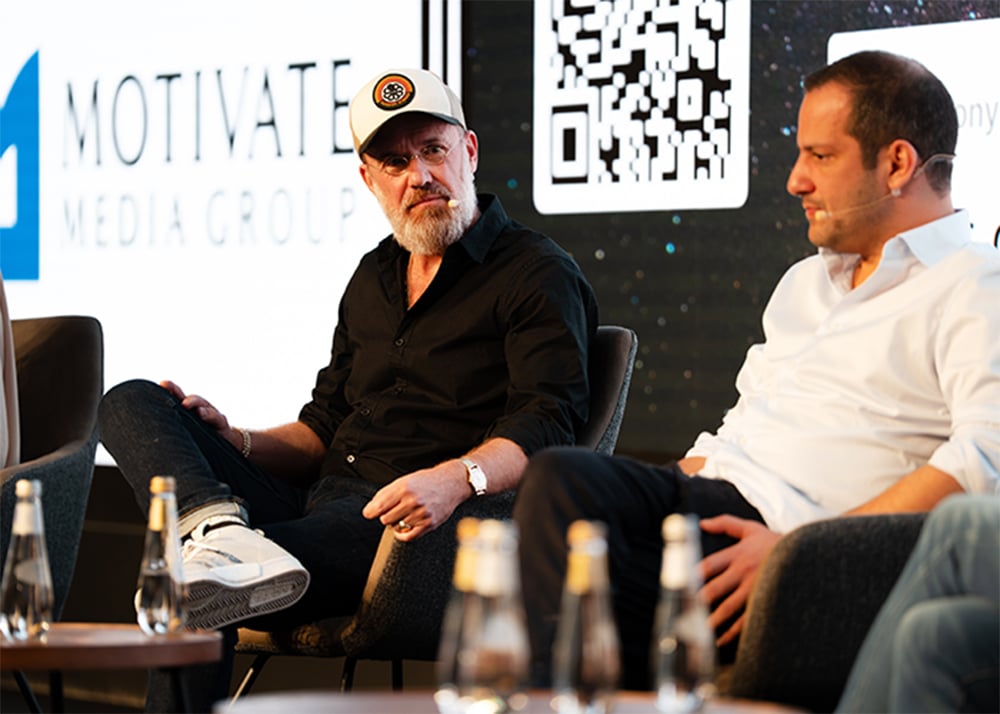
Pointing to the rapid evolution of creativity in tandem with the ‘speed of culture’ in the Kingdom, as well as its recognition on the global stage, Mroue said, “Saudi Arabia won its first Gold Lion at the Cannes Lions International Festival of Creativity in 2018. To put that into perspective, more than 60 years after Cannes Lions was founded, Saudi Arabia won its first Gold. Five years later, in 2023, Saudi Arabia won its first Grand Prix at Cannes Lions. Within the next two years, Saudi Arabia led the Middle East at Cannes, claiming the most Lions in the MENA region. We’re not talking about a growth trajectory that is merely sloping gradually; we’re talking about a trajectory that’s taking off and soaring.”
Building on this discussion, Banham complimented the region for having an appetite for risk and rapid growth.
He shared how Saudi Arabia and the UAE are no longer competing merely on the regional leaderboard, but also on the global stage. He added that this is made possible because leaders see ‘risk’ connect directly to creative effectiveness and business outcomes.
Banham said, “This region has built that sense of open-mindedness to take risks. My teams and I still love the challenge of a blank sheet of paper in the morning, and by the end of the day, you’ve got several different solutions to different briefs and challenges. The creative solutions that stand out are those that, despite the associated risks, elicit the three magic words from the client: ‘We’ll make this’. This usually happens when you’ve got a good enough piece of creative work that you can uphold not only from a business point of view, but also from a creative effectiveness perspective.”
‘‘The role of a CCO is more than creating the idea; it’s more about creating the team that can spark the right idea. So, a CCO must build the right environment to have the right people in the right room.”
The evolving role of a CCO
The panellists took a step back to assess how the role and expectations of a chief creative officer have changed.
Schill said, “About 15 or 20 years ago, there was one creative in the room. That creative brought the magic and was expected to be the master of everything. Today, this has changed. We have – and need – a group of creatives, because the world is complex, and has complex problems. It takes a group of people from different backgrounds, upbringings, perspectives, genders and cultures to understand that even a problem has different facets. We can’t expect a one-size-fits all solution from one creative individual anymore. So, the solution must arrive from collaboration and truly listening to each other. The role of the CCO must change accordingly.”
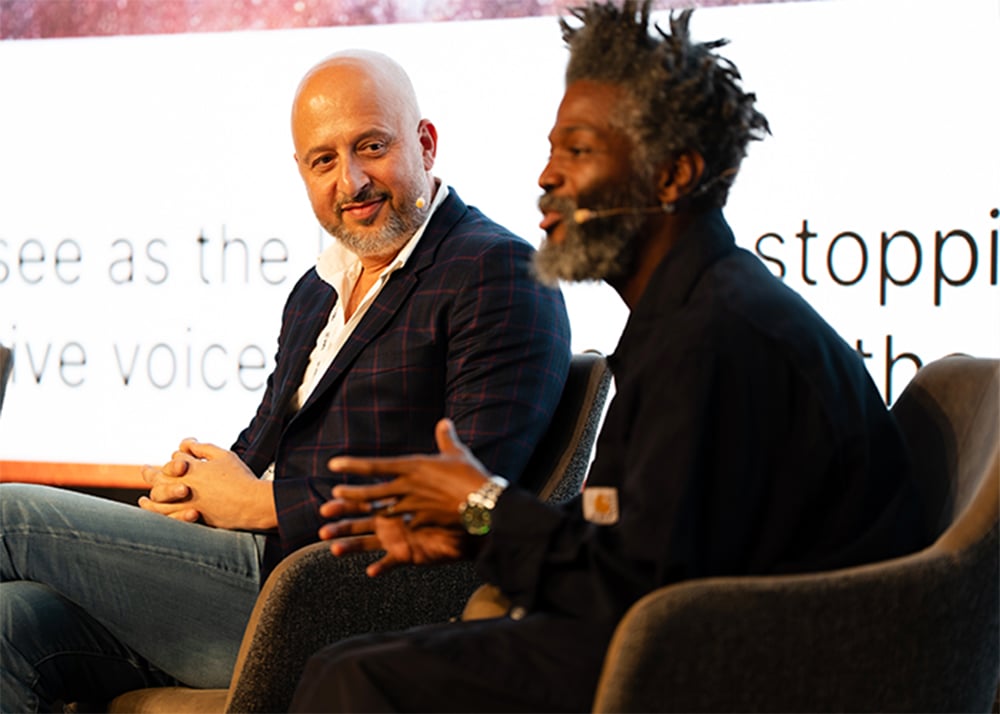
Adding to the discussion, Reid explained how the role of a CCO has moved from being the chief ‘creative’ officer to being a chief ‘clarity’ officer and a chief ‘collaborative’ officer. He takes the example of American hip hop collective Wu-Tang Clan, which produces music in a way that allows each of its members to “be fully themselves”.
Reid said, “The role of a CCO now, more than ever, is to provide clarity and energy. I’m not talking about just positive energy, but that kind of energy that can move things forward and pave a path to success. I see the CCO as a leader who is not held responsible for the idea but, instead, builds the culture for everyone else to feel safe and to thrive – and finds the best way to give those ideas the legs to go the distance.”
The discussion also unveiled how CCOs are increasingly involved in strategising and empowering their teams with empathy to voice their creative ideas rather than being hands-on with the creative process.
Mroue explained, “I think a CCO is more on a level where one is spending a lot of time strategising. The truth is that magic or that feeling you get when you spark an idea, when you’re an art director, or when you’re a copywriter, you tend to lose some of that when you become a CCO.”
Schill said, “The role of a CCO is more than creating the idea; it’s more about creating the team that can spark the right idea. So, a CCO must build the right environment to have the right people in the right room. These creatives can then discuss their opinions and arrive at the right idea for the client. If the team cannot come to a consensus or arrive at a mutually agreeable arrangement, there needs to be one final, experienced person who guides the decision – and that will be the CCO.”
He added, “I think one of the main challenges is understanding empathy. Sometimes we forget that everything in life is about empathy. You must understand who’s in the room, who is sitting across the table and who you’re trying to solve the problem for – and this starts with how teams are set up internally.”
Sharing a personal anecdote, Banham explained how it was to “feel heard” 15 years ago, and how that’s shaped his perception of his role as CCO now.
Banham explained, “I’m old enough to remember being in a creative department in 1999 and 2000, where the CCO was fundamentally out of reach. We used to take our concepts to the creative directors, and we’d try and buy them a beverage to get them to put our ideas at the top of the pile. I always felt like I just wanted to know whether I was right or wrong, or why my idea was selected or not selected, so I could improve and do better. So, now, as a CCO, I try my best to find bits of time to sit with everyone. It’s difficult. We’re all so busy, but it’s important. Whether it’s the intern or the ECD or the middleweight team, it doesn’t matter; I try my best to take five minutes a day to talk to people and offer feedback.”
The earliest creative output: the first spark
An attendee at Athar Festival made the most of the ‘Ask Me Anything’ panel, raising the question: “Do you remember your first creative output?”
This set the tone for the rest of the discussion. The CCOs dug deep and shared deeply personal stories from decades past, revealing their enduring love for the craft.
Banham recalled a formative moment from a design agency, where a handmade invitation for a Test cricket event proved that a simple, well-structured idea could outlive corporate polish.
He shared, “I was in a small design agency, and someone told me that the CEO is going to watch a Test cricket match and needed an invite to send out to all of his clients. I could have just created a postcard and put a picture of the Test match or The Oval stadium, but I was playing with paper mechanics to design at the time, so I die-cut the stumps in a way that when you opened the invite, the stumps stood up. That was actually my first one. And I still have it in my old portfolio today.”
Mroue’s creative origin story got the audience laughing out loud because of its audacity and honesty.
He revealed, “My first creative output was before my professional career kicked off. I was about 14 years old, and United Colors of Benetton ads were all the rage. I thought I came up with a fantastic idea, and decided that I was going to sell it to Benetton. At the time, I didn’t know anything about advertising agencies. So, I picked up the Yellow Pages and I found ‘advertising agencies’, started calling them and sharing my idea for Benetton. Nobody responded to me, but after all these years, I still think it’s a fantastic idea.”
Alexander Schill recalled his early shift from copywriting to leadership roles.
He said, “I started off as a copywriter. For the first three years of my career, I was only writing copy, which was great. I loved playing around with words and sentences. I still remember the words of my first copy that was accepted and broadcasted – it was for a Mercedes Benz with the gull wing.”
Reid turned back the clock to his early days of fidgeting around with a console, the creative process of creating a video game, and the sentiments around bringing it to life with his family.
He shared, “I was eight. I got an Apple IIc computer, and I was teaching myself BASIC. My mum took me to the library, where I would get all these books from which I could copy code to create little images and games. I remember that there was a little game Worm I was trying to create while waiting for my dad to come home. The idea was to try and finish coding a new game, so when dad came home I’d ask him to check out the game. I failed repeatedly. I remember feeling so defeated, and then finally asked my mum to step in. We dug in and found where the bug was. I still remember the joy of being able to show someone outside of the creative process, what we created after a stretch of frustration – and that was so epic. To be honest, this is a core memory because of all that time I spent hanging out with mum. What was my lesson here? A lot of the best ideas take time, and we fail, but that’s OK. People often see the product, but don’t realise the beauty is often in the memories made along the journey. There’s a reason that’s one of my favourite memories.”
Sources of inspiration
The final question of the ‘CCOs Unplugged: Ask Me Anything’ panel ended the discussion on a rather philosophical note. An attendee asked: What inspires your creative vision?
Sharing a quote from one of his mentors, advertising veteran Judy John, Reid said that he is constantly inspired by a deep sense of gratitude.
“Every day when we wake up, we’re one idea away from changing the world. It feels really big, and sometimes abstract, but I recognise that I’m so grateful to be in a position of privilege to be paid to come up with ideas to solve problems every day, and open up opportunities for diversity on teams, and to champion change, and to mentor people, and to be intentional in making good decisions – I think this is deeply inspiring. This is why I like showing up – even when I’m tired or when it feels like things are falling apart. I tell myself – just keep showing up,” Reid said.
Banham quoted another advertising veteran, Sir John Hegarty, explaining the beauty of “doing my best thinking when I’m not thinking”.
Banham said, “I am inspired by being voraciously interested in everything. Not just naturally interested. Not only by art and culture, but also by getting off my phone for a little bit. For example, once we get a brief, and once we do all the research, and once we’ve looked at it from every angle, once we’ve listened to all the perspectives on it, once we’ve covered our tables in post-it notes, it’s good to take time off to just sit back and think. And just like that, some idea will walk into my brain and say, ‘Hello! How about this.’ There’s beauty in half thoughts, and little insights, letting go, and then watching ideas come to life.”
Explaining how he’s inspired by the speed of creativity in San Francisco startup culture, Mroue said, “People in San Francisco are just doing things. They’re one-day sprints, instead of two-three-week periods. Usually, they’re very young – even in their 20s. They ideate and implement like they have nothing to lose. As a result, they’re just constantly building things that are changing the world.”
Closing out the discussion, Schill shared that he is inspired by ‘creativity as a superpower’.
Schill said, “Even if I look beyond the business and the industry, creativity is probably the strongest weapon that we have. I believe we can change anything in the world through creativity. A single post can change the behaviour of thousands of people – probably even more than a politician’s speech can. That’s the power that even a junior copywriter wields. If we define ourselves as creatives, we must remind ourselves that through creative thinking, we can solve problems constantly, and we can truly change the world. There’s nothing else quite as inspirational as that.”
All in all, three overarching themes crystallise the conversation on creativity. First, curiosity has always been, and remains the lifeblood of creativity – not AI.
The second is the recalibration of leadership: The CCO is no longer a solitary thunderbolt of creativity, but an orchestrator who unlocks creativity through collaboration and by offering power to every voice in the room.
The final piece is a future built on purpose, inspiration and the knowledge that creatives hold the power to not only reflect consumer sentiment, but also shape the world.