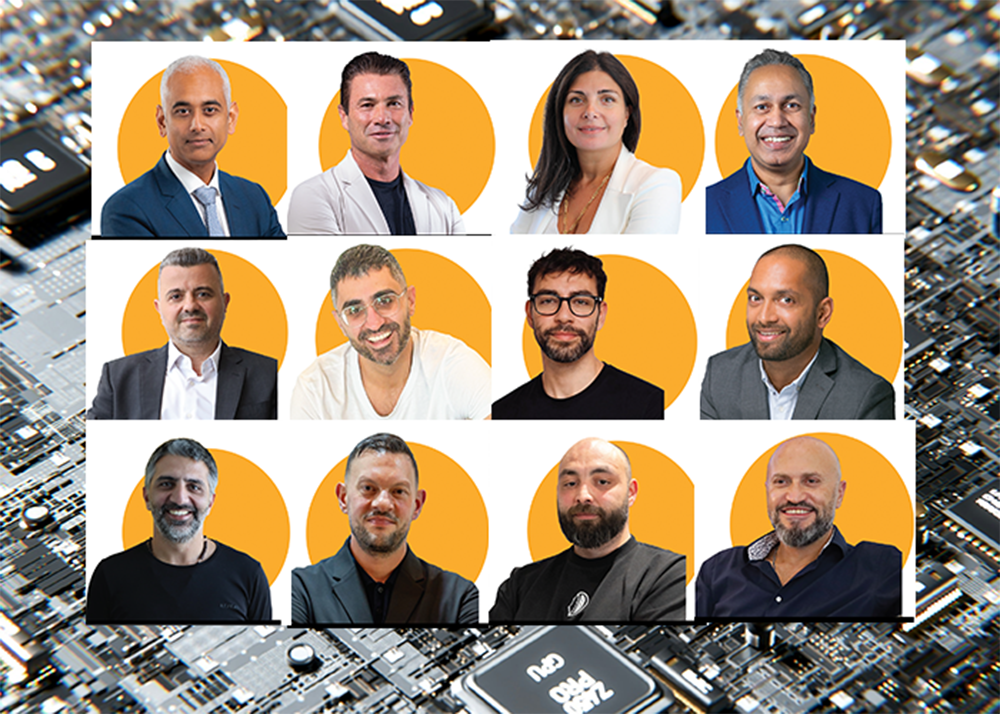
 Top row, from left, Kiran Haslam, Chief Marketing Officer, Diriyah Company; Tareq Amin, CEO, HUMAIN; Dr. Hoda Daou, Managing Director, Annalect MENA; and Faheem Ahamed, Group Chief Marketing and Communications Officer, G42. Second row, from left, Joe Lahham, Managing Director, TBWA\RAAD; Mario Soufia, Regional Managing Director – Growth and Marketing, WPP Media MENA; Elie Bassel, Business Lead, Digitas; and Alex Jena, Chief Strategy Officer, dentsu MENAT. Third row, from left, Elias Aziz, Head of PMO, VML MENA; Andreas Frangeskides, Global Data and Technology Lead, HAVAS Middle East; Ryan Fletcher, Regional Head of Data and Technology, Initiative MENAT; and Roy Aftimos, CEO, C2 Comms.
Let’s get the artificial intelligence (AI) fundamentals out of the way before the deep dive: What comes to mind when “AI-augmented marketing” is spoken out loud? If the words speed, scale and shortcuts are the unspoken mental response, it’s time to pause.
The problem with speed is that it’s not quite the same as direction. Unless there’s a course correction, many marketers in the Middle East might accelerate away from intended outcomes. Think of AI as a quad-turbo V12 engine dropped into an old car. Sure, it might speed up for a bit, but the chassis will still rattle; the steering will drift; and the shifty dashboard will still navigate to the wrong exit – only faster.
The problem with scale is that the ground is shaking – geopolitically, socio-culturally and financially. And skyscrapers built over swamps will sway. Unless the foundations are firmed up, weak workflows are weeded out, and education and experimentation are engineered into organisational culture, scaling the skyscraper might not be the best idea.
The problem with shortcuts is that they shift risk from visible effort – or a lack of it – to invisible consequences. A team that saves time by skipping governance, data discipline and human oversight is handing over the cockpit to a system it cannot fully explain, audit or troubleshoot. Poor data and inconsistent taxonomies get scaled, not solved. Biased and context-blind outputs become repeatable. Confidence gets replaced by complacency.
Campaign Middle East speaks to several marketers, technology experts and agency leaders about the application of AI beyond speed, scale, shortcuts, generative content and efficiencies. Without mincing words, these leaders call for the industry to put in the real work to leverage AI correctly: as a stress test rather than as a shiny add-on. This includes rebuilding operational workflows, aligning leadership intent with day-to-day realities, and treating reporting and measurement as cornerstones of marketing culture.
The real questions are whether there’s clarity of purpose in the application of AI; whether humans – clients, customers and creatives – remain at the heart of AI-augmented marketing; and whether the use of AI in specific contexts offer a strategic advantage, leading to results over theatre.
Contributing to this conversation are:
- Kiran Haslam, Chief Marketing Officer, Diriyah Company
- Faheem Ahamed, Group Chief Marketing and Communications Officer, G42
- Tareq Amin, CEO, HUMAIN
- Dr. Hoda Daou, Managing Director, Annalect MENA
- Joe Lahham, Managing Director, TBWA\RAAD
- Mario Soufia, Regional Managing Director – Growth and Marketing, WPP Media MENA
- Elie Bassel, Business Lead, Digitas
- Andreas Frangeskides, Global Data and Technology Lead, HAVAS Middle East
- Alex Jena, Chief Strategy Officer, dentsu MENAT
- Elias Aziz, Head of PMO, VML MENA
- Ryan Fletcher, Regional Head of Data and Technology, Initiative MENAT
- Roy Aftimos, CEO, C2 Comms

Barriers to unlocking AI value: Structures and systems, not software
Before discussing transformative ways in which AI can be leveraged, marketers and industry leaders reveal key challenges preventing people from tapping into the full potential of AI-augmented marketing. Several leaders describe the central challenge as structural and organisational, not technological or computational.
Garbage in, garbage out
They call for the industry to develop a deeper understanding of how intelligence flows and how to harmonise fragmented data before complaining about lack of AI budgets.

G42’s Faheem Ahamed says, “The biggest barrier is structural. Most organisations are applying AI to isolated tasks within a fragmented marketing system: optimising content here and automating media there – without rethinking how intelligence flows end-to-end. Data is episodic, learning loops are slow and decisions are still shaped by handoffs rather than insight. Until marketing is redesigned as a continuous intelligence system rather than a sequence of campaigns, AI’s true value will remain constrained.”
Offering a similar diagnosis, TBWA\RAAD’s Joe Lahham adds, “The real barrier to AI-led marketing isn’t capability; it’s organisational inertia. AI exposes inefficiencies that many companies have learned to live with: fragmented data, siloed teams, slow decision-making and legacy KPIs built around outputs instead of outcomes.”
C2 Comms’ Roy Aftimos drives the case further, saying, “Leaders are distracted by the wrong problems. They’re chasing budgets for new tools while ignoring foundational rot. Your AI is only as good as the data it’s built on, and most companies are running on data that’s fragmented, siloed and dirty. It’s garbage in, garbage out. And right now, they’re investing billions to get garbage out faster.”
“Don’t confuse acceleration with progress. technology will keep moving faster with AI, automation and data. But speed alone doesn’t create value.” – Joe Lahham
AI literacy and an opportunity to redesign workflows
The chorus on the problem statements continues: AI is being introduced into operating models that were never designed to support it, and legacy systems that were never designed to work with each other.

Digitas’ Elie Bassel explains, “One can’t run an exponential AI strategy on a linear organisation. Most leaders think they’re adopting AI when they’re only speeding up small tasks. They produce more marketing assets without real progress because approvals, escalations and decision-making stay the same.”
Leaders state that the time has come to re-route workflows and redesign systems before plugging in AI solutions.

WPP Media MENA’s Mario Soufia adds to the conversation, saying, “Many leaders still look at AI as if it’s a tool that they must purchase and use. Instead, leaders must look at AI as an end-to-end workflow redesign across intelligence, strategy, planning, content, activation, production and measurement.”
Aftimos adds, “Stop treating AI as a software update. It’s a fundamental redesign of how work gets done. You must restructure workflows at three levels: the individual (the node), the connections between teams (the edge), and the entire system (the network). Don’t just layer AI on top of a broken process.”
Marketers also call for better AI literacy at the leadership level, the need to move beyond legacy mindsets, and to unlock ways to realise the true value of AI.

HUMAIN’s Tareq Amin says, “Too many leaders treat AI as a buzzword instead of a strategic advantage, so it gets underfunded and deprioritised. They don’t truly understand where AI delivers value or how to measure its return on investment (ROI), and they fear losing control or authenticity. Complacency also holds them back, as they believe their current methods are good enough. Without AI literacy at the top, organisations can’t set clear goals or invest wisely.”
Diriyah Company’s Kiran Haslam adds, “For organisations of significant size and scale, the challenge isn’t just keeping up, it’s ensuring that adoption delivers real, tangible value. The key is not to fear the speed of AI but to build the agility, partnerships, and culture needed to harness it effectively.”
HAVAS Middle East’s Andreas Frangeskides says, “There is a shortage of leaders who can translate AI into commercial outcomes. There’s a risk-averse mindset driven by short-term performance pressure. As a result, AI becomes something to test cautiously rather than commit to with intent.”
Calling for more confidence over caution, dentsu MENAT’s Alex Jena adds, “Can we trust a self-optimised media plan? Have AI models been trained on accurate data? Are synthetic plugs adequate to cover the inevitable gaps in data sets? Does a rendered human, or even the family pet on the sofa feel convincingly real? Confidence tends to follow when experimentation is paired with structure, clear safeguards and a responsible framework that defines how generative AI is tested and applied in real client and operational environments.”

Frangeskides explains how most organisations already have access to models, platforms and automation capabilities that would have been unthinkable just a few years ago, but goes on to reveal that “meaningful impact remains uneven; so does literacy; so does the real understanding of where AI actually creates value across the operational chain of command.”
These insights echo findings of a recent Salesforce study, which reveals that 43 per cent of marketers have not embraced AI – and are reluctant to do so – because they’re struggling to see real value from its use in the short term.
Initiative MENAT’s Ryan Fletcher explains, “Leaders who expect instant outcomes often lose momentum too early. They should instead treat early friction as the cost of building long-term capability. This space moves so fast that the ‘perfect solution’ today will be outdated tomorrow – hands-on learning beats endless planning. We should also avoid underestimating the time and effort required to become truly AI-native. Transformation isn’t linear. Things will break, assumptions will fail, and you’ll hit messy integration realities. That’s normal.”
“Leaders are distracted by the wrong problems. They’re chasing budgets for new tools while ignoring foundational rot.” – Roy Aftimos
Leadership gaps and addressing the need for alignment
The Salesforce study also shows 70 per cent of marketing professionals calling out their employers for not providing them with AI training. This pivots the discussion from existing skills gaps and literacy gaps to also highlight leadership gaps.
Aftimos says, “The barrier to AI adoption isn’t the technology. It’s the mindset. It’s the talent. It’s the training. It’s the failure of leadership to build a bridge from today’s workflows to tomorrow’s workflows. We have teams of people staring at the most powerful tools ever created, and we haven’t shown them how to use them safely, let alone strategically. That’s not a skills gap. That’s a leadership gap.”
This gap widens further due to the lack of alignment between leadership, teams and tech specialists.

Annalect MENA’s Dr. Hoda Daou explains, “Leaders are accountable for growth, efficiency and outcomes. Teams on the ground are focused on execution and understandably concerned about how automation might change their roles. Technology specialists often sit in the middle, capable of building powerful solutions but speaking a language that doesn’t always translate into the wider business context. This is why we need alignment.”

VML MENA’s Elias Aziz agrees with the need to bridge the skills gap but also points to technical and financial problems that need to be fixed.
Wrapping up the initial phase of the discussion neatly, Aziz says, “On the human side, there is a clear shortage of AI-ready talent and resistance to changing established ways of working. Technically, poor data quality and complex legacy stacks slow progress. Financially, fragmented tools increase cost and risk.”
Breaking barriers: Shared mindsets and structural changes
Just as the dawn of the printing press revamped news completely, from products and processes to people – requiring manual scribes to upskill to typesetters and proofreaders; and town criers to upskill to correspondents, journalists and early marketers – AI adoption is expected to overhaul marketing and advertising as we know it.
A fundamental shift in how marketing operates
To derive true value, leaders will need to embrace the fact that AI is not a new plug-and-play technology for current marketing roles and functions. Instead, it is reshaping the foundational infrastructure of marketing operations.
What does this new era of marketing look like? It institutes a shift from seemingly separate and specialised roles – such as technical data analytics, creative execution, and high-level strategy – to hybrid roles that requires cross-functional knowledge and expertise.
G42’s Ahamed visualises the future of marketing as an integrated, connected operating model that learns continuously because information flows seamlessly across closely linked marketing functions. This is a significant departure from marketing as a series of one-off campaigns.
Ahamed explains, “The industry needs to shift from campaign-centric execution to intelligence-centric architecture. That means connecting research, strategy, creativity, activation, testing and reputation into a single, learning system where every action informs the next decision.”

Lahham adds, “Agencies need to redesign their value proposition, shifting from asset creation to intelligence, orchestration and measurable business impact. That means upskilling creatives and strategists in AI fluency, not just hiring technical specialists. It also requires new commercial models that reward effectiveness and optimisation, not volume. Agencies should build integrated teams where data, creative, media, and tech operate as one system.”
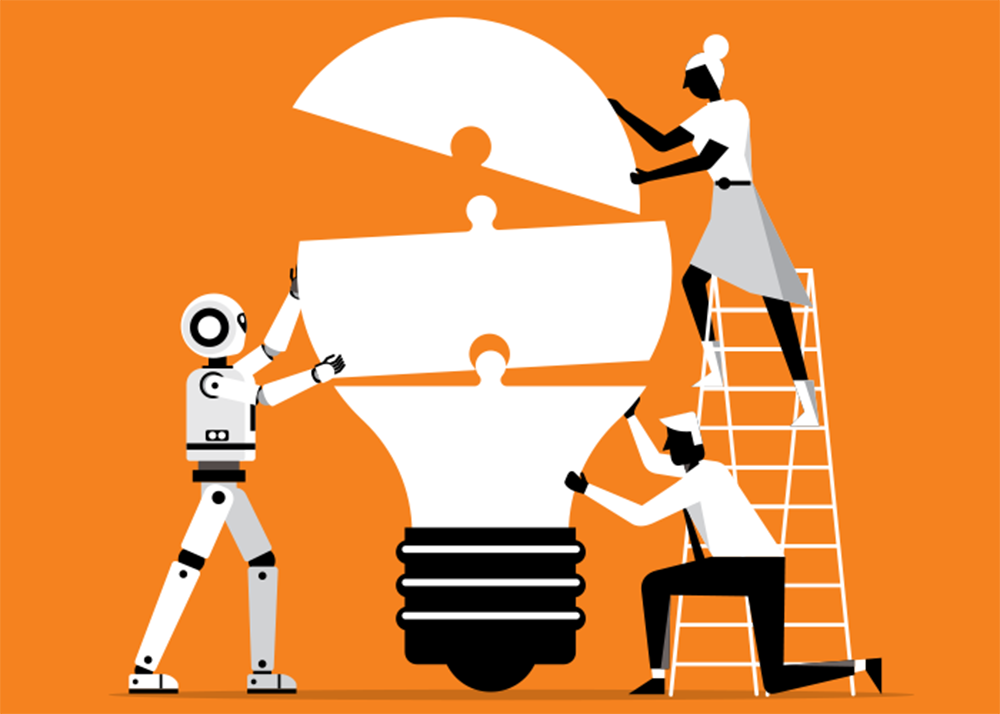
On the flip side, several leaders also explain why organisations must stop operating like a box of jumbled puzzle pieces. For the beauty of AI to be seen, the puzzle pieces must be put together through linked workflows, shared mindsets, common business goals, and roles that bridge strategy, technology and execution.
Soufia says, “Start with a shared operating system mindset. Make sure that the workflows you’d like to reimagine are clear with governance, safety and accountability baked in from day one.”
Daou adds, “It starts with getting everyone to speak the same language, which is not easy. For AI strategies to work, everyone needs to be aligned. Leaders must be clear on outcomes they want to achieve, and teams closest to the work should help shape how those outcomes are delivered.”
“There is a clear shortage of AI-ready talent and resistance to changing established ways of working.”
The case for upskilling and building cross-functional teams
Knowledge becomes particularly important given the context of the current MarTech landscape, which is awash with products and tools that all claim to offer similar solutions.

Jena explains, “Education is still the biggest lever. What we should aim to collectively achieve is a stronger culture of evaluative literacy; an understanding not just of how to use these tools, but how to pressure-test them to see what makes a specific solution truly unique. Without this collective shift, we risk a total homogenisation of strategy. If every brand is chasing the same audiences using the same suite of planning signals and off-the-shelf models, the potential of AI is neutralised.”
Taking this notion a step further, Aftimos says he believes that organisations should not only offer paths to upskilling, but also incentivise it. This removes the barrier of fear – the fear of unlearning and relearning; the fear of being replaced; and the fear of looking incompetent.

Aftimos says, “Make training mandatory. Celebrate AI proficiency as sophistication, not a shortcut, with programmes that fast-track talent who master these tools. You share the upside. If AI is creating efficiency, you offer productivity bonuses, training royalties, and career guarantees that channel those gains into reskilling. You position AI as a tool for growth, not just contraction. When people see that technology is expanding the business, the fear of replacement becomes the opportunity for advancement.”
Done right, this will result in the development of cross-functional squads that enable each other rather than getting in each other’s way.
Frangeskides says, “Organisations must invest in roles that bridge strategy, technology and execution. Data security teams should enable responsible speed, not act as a brake on progress. Most critically, leaders must be willing to retire legacy thinking and systems that don’t support adaptive decision-making.”
Soufia adds, “Build cross-functional squads across different areas of the business and accelerate use cases so that you are moving from pilots to production with clear and measurable KPIs. Finally, it’s your people who will benefit from this transformation, so make sure you invest in upskilling everyone, not only a handful or ‘transformation champions’.”
Beyond the barriers: Advice for marketers kickstarting their AI journeys
The right approach to implementing AI doesn’t begin with hiring ‘AI experts’, adding an AI line item to job descriptions, investing in proprietary tools that may or may not fit, or setting aside a public relations budget for a stop-gap narrative on ‘AI-driven’ organisations.
It begins with resolving to change how work gets done, with clear goals, clear intent, clear ownership and clear rules.
The end goal is not, and should never be, automation for its own sake, but a more capable marketing organisation – one that moves faster, makes better decisions, protects brand integrity and uses AI to amplify people rather than replace them. Haslam and Ahamed suggest starting from these primary principles. Rather than focusing on toolsets, they advise focusing on why AI is being implemented, what it should improve for people and what must remain human-led.
They share a belief that marketing effectiveness depends on judgement, empathy and brand meaning – elements that AI can support, but not own.

Haslam says, “My mantra always is: don’t run before you can walk when it comes to digital technology. Take a step back and make sure what we are doing is going to help people and enhance the human experience. It is, after all, what drives our human-centric, people-first approach in building our walkable city in Diriyah.”
Ahamed adds, “Start with intent, not tools. Rather than asking what AI tools are best for marketing, ask how marketing can be relevant in an AI-native society. Be clear about which decisions AI should augment and which must remain human-led. Establish guardrails around explainability, data provenance and brand governance early, especially as systems move from recommendation to action. A phased approach works best: assist, simulate and then act – with the human in the loop at every stage.”
For marketers beginning their AI journeys, Amin and Frangeskides insist on clarity of progression through the phased approach to adoption.
Amin says, “I’d advise a roadmap built on clarity, discipline and breakthrough outcomes. Start with the future you want to create by asking: What revenue, growth or market leadership are you aiming for? Then, launch a high-velocity pilot that proves value fast, powered by clean data and hard KPIs.
He adds, “Amplify your workforce. AI should supercharge creativity, speed and decision-making. Next, scale aggressively with repeatable systems, training and AI-first operating models, ensuring leadership is aligned and accountable. AI is rapidly becoming the core engine of modern marketing, so it must be integrated and managed as a foundational capability.”
Frangeskides adds, “If an organisation cannot clearly explain what an AI system is allowed to do and why, it is not ready to deploy it. The strongest organisations move through three stages. First, augmentation, where AI assists humans with insight, speed and consistency. Second, automation, where decision logic is codified and systems begin to optimise within defined parameters. Only then does agency emerge, with AI systems that are able to act, learn and adapt autonomously within clear boundaries. Skip these steps and trust erodes quickly.”
Expanding on the phased approach, Aftimos adds, “Don’t boil the ocean. Start small. Pick one repetitive, time consuming task and experiment with AI assistance. Don’t worry about perfect prompts or a comprehensive rollout. Just prove you can create value in one corner of the business. Focus on a clear pain point with a measurable ROI. Then, pilot: expand to proven use cases such as content optimisation, campaign productivity and audience targeting. This is where you build a dual-track measurement dashboard. Keep your core efficiency metrics but start tracking relationship metrics alongside them. Establish your baseline so you can prove the uplift. Finally, scale: this is where you move from improving tasks to redesigning workflows. You take the learnings from your pilots and synchronise AI adoption across interconnected teams. This isn’t about giving everyone a licence, it’s about ensuring that when one team gets faster, they aren’t creating a bottleneck for another.”
However, in this approach to implementing AI tools, leaders also suggest guardrails – clean data practices, security, measurement and the ability to challenge outputs rather than being forced to accept them blindly due to a lack of knowledge.

Fletcher says, “Have a north star. You need clarity on what will change operationally: what decisions get made faster, what work gets automated, and how success will be measured – and that’s enough to begin with. The key guardrails are data governance, security and human-in-the-loop control. The biggest failure mode is blindly trusting outputs and never questioning the model or the process. AI should enrich human decision-making, not replace it. Trust is earned through testing against benchmarks and iterating until the system performs reliably in the real world.”
Bassel adds, “Set guardrails upfront: autonomy boundaries, evaluation thresholds, and human handoffs. Run monthly reviews to reassess external shifts such as models and competitors, and reassess internal performance such as usage and quality.”
A parting message to the industry
Before the conversation concludes, the panel of industry leaders are asked to share practical takeaways. They explain that the era of experimentation without proof is ending. If AI is being introduced into marketing systems, it must be governed, measured and tied to real outcomes. It’s also time to stop using AI as a shortcut, a pathway to mediocrity, a crutch for laziness, and a means to flatten creativity.
Here are their final thoughts, shared as a quick-fire round-up:
Kiran Haslam, Chief Marketing Officer, Diriyah Company: “AI as a tool I am comfortable with, but I believe we must ensure there is not an unnecessary reliance on AI tools that can rob human beings of the ability to learn, think for themselves and be fully rounded independent contributors to the human experience. Make sure you create culturally appropriate, nuanced content that reflects the unique identity of your brand like we do at Diriyah. When technology supports that level of specificity and care, the result is work that is not only innovative, but genuinely powerful and relevant.”
Tareq Amin, CEO, HUMAIN: “Stop chasing AI as a trend. Start building AI as your new operating system. AI isn’t hype, but a capability you must integrate into each layer of your strategy, your team and your customer experience. The brands that win will be the ones that use AI to amplify human creativity, not replace it. The industry must invest heavily in AI literacy, upskilling and experimentation today, in order to prepare for the future instead of surrendering to it.”
Mario Soufia, Regional Managing Director – Growth and Marketing, WPP Media MENA: “Stop asking, ‘What can AI do?’ and start asking ‘What should we automate that can make people and brands better?’. Move past the conversation of whether we should or shouldn’t use AI. Get an answer to that question and start building. Treat AI as a new layer of your marketing systems and make sure it’s governed, measurable and designed around workflows that your people and your brands care about. Ultimate success will come when you engineer a system that brings everyone together, not add to silos. Once you’re properly kicked off, measure improvements in speed, quality and decisioning, and continuously improve.”
Dr. Hoda Daou, Managing Director, Annalect MENA: “Keep people at the centre. Whether it’s AI or any other transformation, there must be a clear purpose behind it. Outcomes matter, but those outcomes need to make sense to everyone involved, not just in terms of performance uplift or operational efficiency, but also in how people grow, develop and feel empowered in their roles. With the current capabilities of agentic AI, it’s natural that concerns are growing around its use and what it means for careers. The responsibility sits with leaders to be clear about intent.”
Joe Lahham, Managing Director, TBWA\RAAD: “Don’t confuse acceleration with progress. Technology will keep moving faster with AI, automation, and data. But speed alone doesn’t create value. Clarity does. Judgement does. Courage does. Our job isn’t to chase every tool or trend; it’s to design systems where creativity, intelligence and business ambition work together. AI should amplify human thinking, not replace it. If we stay obsessed with outcomes over optics, substance over noise, and long-term value over short-term hype, we won’t just adapt to change, we’ll lead it.”
Ryan Fletcher, Regional Head of Data and Technology, Initiative MENAT: “Be brave, be practical, and bring your people with you. There is no single ‘correct’ AI playbook; it’s a process of building what’s right for your organisation at that moment, learning from reality, and scaling what works. The industry also needs to raise its statistical literacy: the next era will reward those who understand foundational concepts such as regression, significance, and incrementality, because AI without measurement discipline is just fast guessing. And remember that while everyone asks for a faster horse, the job is to solve real problems.”
Roy Aftimos, CEO, C2 Comms: “Stop piloting. Start proving. The experimental phase is over. 2025 was for discovery. 2026 is for accountability. The C-suite is no longer impressed by AI experiments, they’re demanding AI-driven efficiency and they’re expecting headcount reductions to follow. AI won’t replace marketers. But marketers who can’t prove their value will be replaced by those who can. The noise is about the technology. The meaningful conversation is about the metrics. If you can’t measure it, you can’t defend it. And if you can’t defend it, then your budget, your team and your job are on the line.”
Elias Aziz, Head of PMO, VML MENA: “The most important shift the marketing industry must make is from artificial intelligence to augmented intelligence. AI’s real value is not in replacing talent but in amplifying it. By automating repetitive tasks, marketers regain time for empathy, creativity and strategic thinking. The future of marketing is not about adopting more tools but about creating organisations where human insight and machine intelligence collaborate seamlessly to deliver exceptional outcomes.”
Andreas Frangeskides, Global Data and Technology Lead, HAVAS Middle East: “Ultimately, AI will never fix unclear thinking, poor data or misaligned incentives. It will expose them faster. The real opportunity for marketing leaders is not to become more technologically sophisticated, but more honest. Honest about how decisions are made. Honest about what should be automated. Honest about where human judgement still matters. My final thoughts? The organisations that win will not be those that adopt AI fastest, coolest or flashiest in design, but those that redesign themselves thoughtfully enough to deserve it.”
Alex Jena, Chief Strategy Officer, dentsu MENAT: “Your strategy should obsess over distinction. Be brutally clear on where the real white space lies and which audiences genuinely move the needle for growth. AI is a powerful tool, but it’s ultimately a magnifier. Feed it a generic strategy and it will simply help you get to mediocrity faster. Create a universally understood definition of distinction, a benchmark that everyone can reiterate. When we have that clarity of judgement, we stop chasing every shiny new tool and start identifying the specific AI and automated solutions that unlock real growth. In summary, don’t let the tech dictate your direction. Use your strategy to define the logic and then use AI to give that logic the scale, speed and impact it deserves.”
All in all, industry leaders describe AI not as a single breakthrough, but as a stress test for marketing organisations. If there are cracks in the organisation, they will show – and when the floodgates open, the dam will burst. It’s just a matter of time.
The alternative is to stitch siloed systems, weld broken workflows, build integrated roles and cross-functional teams, and ensure continuous upskilling as part of organisational culture. Then roll out an AI roadmap across three simple stages: addressing a specific challenge with intent, low-risk experimentation, and scaled deployment based on proven value. The guardrails for AI adoption remain: informed-human-in-the-loop oversight, ethical and bias reviews. Establish a baseline to monitor uplift, track and evaluate AI performance, and know where to draw autonomy boundaries.
The new era of marketing will not be defined by artificial intelligence, but by augmented intelligence: AI navigating while riding shotgun with humans firmly in the driver’s seat.