Magix, Morocco’s leading laundry brand and part of the Mutandis Group, has revealed details about its Ramadan 2026 campaign, which was carried out in partnership with Casablanca’s Brainbow Agency, and released in the form of a brand film and a five-episode unscripted, social experiment.
Celebrating its 20th anniversary in Moroccan households, Magix gave the agency a mandate to celebrate what made 20 years possible: the everyday values that hold a relationship together, including trust, reliability, daily presence and generosity.
The strategic bet held in a single sentence: “Don’t celebrate a milestone, celebrate the values that made it possible.”
The brand didn’t want a self-congratulatory campaign; it wanted to make those values publicly visible and emotionally felt.
Consumer insights that shaped the campaign strategy for Magix
Two insights shaped the strategy of the campaign.
First, Moroccan consumers had already built a genuine emotional relationship with Magix over two decades. The brand didn’t need to create affection; it needed to reflect it back.
Second, Ramadan is the single highest-engagement cultural moment in Morocco. This means: it is a period when emotional content travels fastest and deepest.
As such, the strategic question became: “What is the most emotionally honest thing the brand can put on screen during Ramadan that connects to what it actually stands for?”
The answer came from a single word.
In Moroccan Arabic, العشرة (L3chra) describes a feeling, a message, which has no equivalent in English or French: the deep, unspoken bond between people built on trust, generosity and loyalty accumulated over time.
This is not friendship in the Western sense, and it doesn’t quite translate to family either. It colloquially refers to the person people call at two in the morning without explanation; those who show up without asking why.
For Magix, this wasn’t a marketing abstraction. It defined the actual relationship that the brand had built with Moroccan households over 20 years.
Rollout of the unconventional Magix campaign
The creative and digital strategy, concept, and the end-to-end production was carried out by Brainbow Agency, Casablanca. The campaign ran across two complementary arms.
On television, a brand film celebrated Magix’s 20 years, tied to a consumer prize mechanism, offering rewards to buyers.
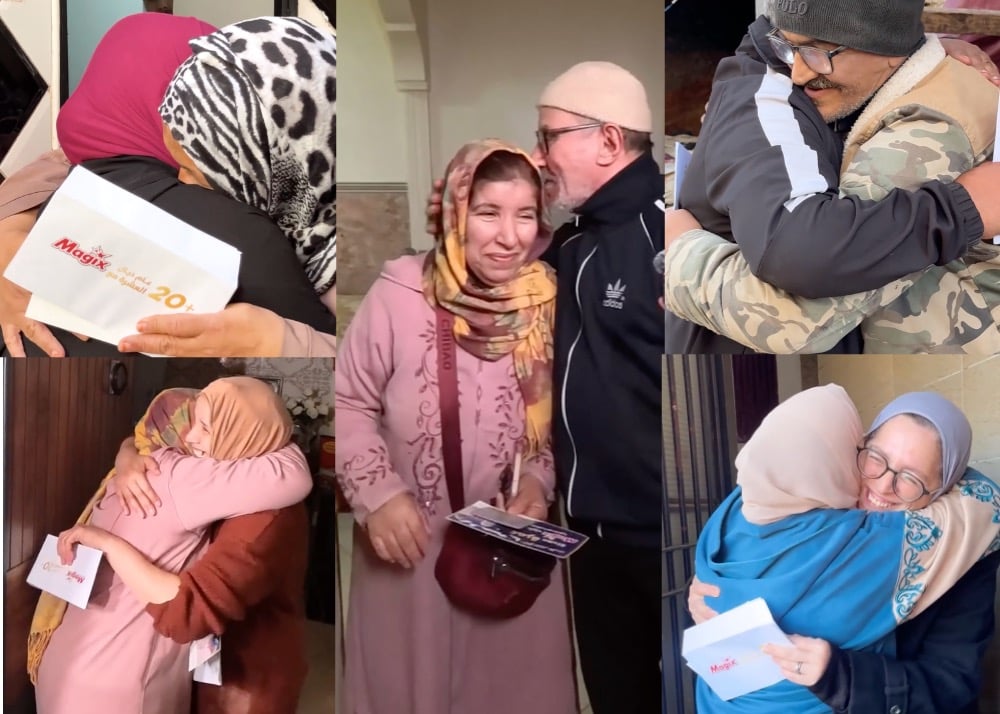
On digital, a social experiment format brought the concept of L3chra to life in real time.
The digital arm was the core of the campaign: five episodes released weekly across Facebook, Instagram and TikTok throughout Ramadan 2026 (February 19 to March 19).
Each episode was three- to five-minutes long. It was shot in the streets of Casablanca with real passers-by, and released as a standalone story that also built into a four-week narrative arc.
Television established reach and brand legitimacy. Digital was chosen for its ability to carry serialised emotional content at scale, with the comment section as an extension of the experience itself, a space where the audience could react, recognise themselves, and share their own stories of العشرة.
The social experiment format was a deliberate creative choice to ensure authenticity: while scripted emotional content is common in Ramadan advertising, unscripted, live reactions are rare.
The risk was real. Participants could have said no, reactions could have been flat. But that risk was precisely what made the content credible when the reactions came.
The primary target audience for the campaign was Moroccan women, heads of household, aged 25 to 55. This audience was considered the core Magix consumer and the most emotionally engaged segment on social media during Ramadan. The secondary audience was the broader Moroccan digital public, reached through organic amplification across community pages.
The campaign ran for four weeks, aligned with Ramadan 2026. One episode released per week, February 19 to March 19, 2026. The TV component ran in parallel throughout the same period.
The beauty of the unscripted campaign was that there were no celebrities or paid influencers. The participants were ordinary Moroccans stopped in the street. This was a strategic choice: the credibility of the content depended entirely on the fact that the people on screen were real, unscripted and unselected for their looks or following.
The organic influencer effect came after release.
Several Moroccan public figures and verified creators commented publicly on the episodes, including a verified influencer with a significant following who wrote simply “habiit, I loved it,” generating hundreds of likes. The content earned its influencer validation rather than buying it.
Success of the campaign
The campaign defined success along three dimensions:
- Emotional resonance – were people moved enough to comment, share and call someone after watching?
- Sustained engagement – did interest grow or decay across the five episodes?, and
- Earned amplification – did the content travel beyond its paid perimeter?
All three were achieved.
The campaign witnessed 125.2 million cumulative views across the five episodes, of which 27 million were entirely organic. It also garnered 2.5 million interactions, and engagement grew with every episode rather than declining.
More than 50 Moroccan community pages organically relayed the content without any sponsorship arrangement.
The initial target was 66 million views. The final performance came in 89 per cent above target.
Why the Magix campaign did it differently – and why it matters
In a region where Ramadan content is saturated with branded entertainment on the theme of generosity, العشرة stands out for three reasons.
Cultural specificity as the engine of scale: The campaign builds on a value only Moroccans can name. And yet the human truth it captures, the simple question of whether you can count on someone with no notice, resonates universally. It demonstrates that reaching scale doesn’t require cultural dilution. The opposite: audiences engage most deeply with content that is unapologetically local.
Performance through authentic emotion: The campaign generated 125.2 million cumulative views, of which 27 million were entirely organic, meaning 22 per cent of the total performance was earned rather than bought. A meaningful share of distribution was carried by community pages and organic sharing. What travels here aren’t impressions. They are emotions. And in emerging markets, content rooted both culturally and emotionally can reach scale without proportional spend.
Serialised engagement in short form: The five-episode structure created a narrative arc the audience followed for four weeks. Engagement grew with every episode, an upward performance curve that contradicts the standard decay pattern of branded content. The format turned a laundry brand into appointment viewing.
CREDITS:
Client: Magix, part of Mutandis Group
Agency: Brainbow Agency, Casablanca
Country: Morocco
Campaign: Ramadan 2026 | Brand film and social experiment format across five episodes