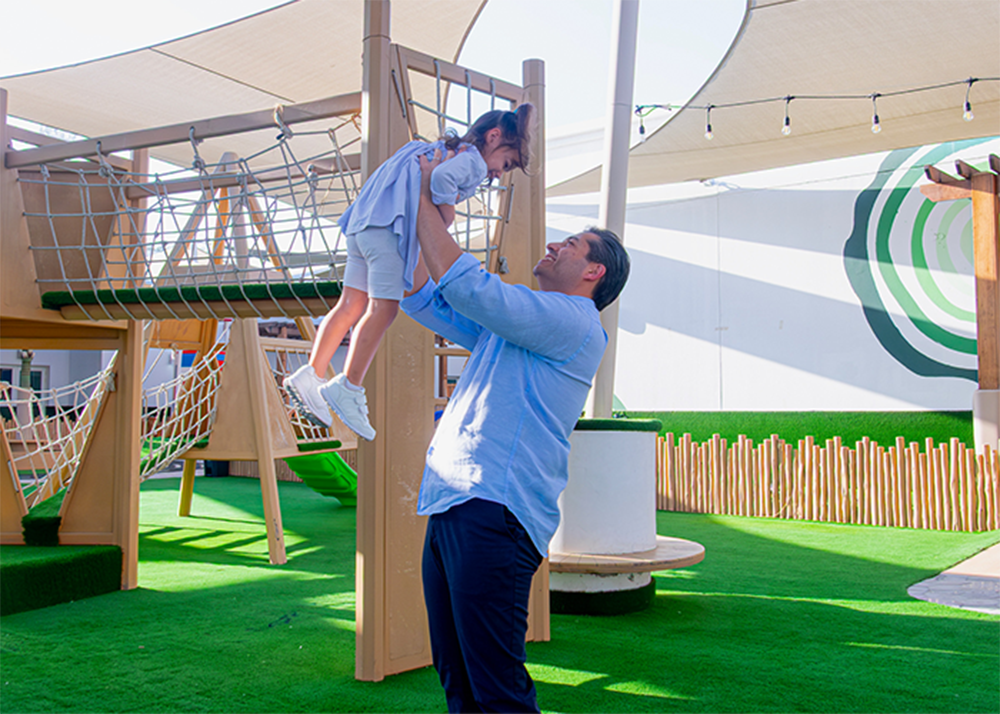
 Fares Hamade, Group Director – Marketing and Parent Relations, Kids First Group, with his daughter.
Since 2010, I worked in FMCG between Procter & Gamble and Nestlé. I had the privilege of building brands that sit in the most intimate spaces of family life – Pampers and Nido among them. FMCG teaches you discipline. It teaches you about brand and business growth through positioning, segmentation, distribution and trust. It teaches you about consumers and shoppers being more than just a target demographic on a marketing plan.
In 2018, we tragically lost our first son, and something changed in me. It was a painful awakening that made me question not just how I show up for my family and at work, but why. When my son and daughter later came into our lives, post Covid, I wanted them to see that their father using his abilities and energy to serve a bigger purpose, beyond climbing the corporate ladder, but contributing to something with a higher purpose.
That is what led me to move from FMCG, an industry I knew well, into Early Childhood Education with Kids First Group (KFG), now part of Taaleem. Today, I sit on the ExCom and lead marketing and parent relations at group level across two countries and 40 centres. Early childhood education is one of the most under-valued and overlook niche fields in the MENA region. It is also one of the most sensitive and highly involved categories, with the highest consequences at stake.
For marketers and agencies, here is the uncomfortable truth: nurseries and schools are also brands, whether they choose to behave like brands or not.
Parents are buying trust, identity, and future educational security. The decision-making cycle is emotional, yes, but it is also carefully considered. Location, curriculum, teacher qualifications, affiliations, languages, peer group and pathway to school – this is portfolio management and purchase decision- tree that actually means something.
In FMCG, if you cannot answer in one sentence what your brand is and who is your consumer, you will lose and competition will win. The same applies to nurseries. “Good education” is not a unique sell proposition. Parents want to know: Is this Montessori? Reggio-inspired? IB-aligned? Academic? Play-based? Premium? Community-led? Without clarity, you are just another commodity or worse even worse, a mere transactional service.
In FMCG, distribution is the name of the game. In education, location is king. A strong brand and concept in the wrong community will fail. Growth comes as a combination of multiple levers including strategic marketing spends, expansion plans, demographic data, and capacity modelling.
At Kids First Group, we operate almost 38 early childhood education centres across UAE and Qatar, under multiple nursery brands, tiers, communities and curriculums. This is no different from managing a house of brands at P&G or Nestle. Each brand must have a clear purpose, position and role within the portfolio, with a long-term, clearly defined communication strategy and integrated commercial plan.
Pampers built decades of equity by delivering consistent quality. Education demands the same, but the stakes are even higher. A poor product experience in FMCG costs you repeat purchase. A poor experience in early years education costs you reputation within the parent community. Word of mouth is not just another marketing pillar; it is the heartbeat of growth.
Parenthood has changed how I make decisions, it has made me more accountable. When I look at a marketing plan, or a new nursery launch, I ask myself: would I choose this for my own daughter? That lens sharpens standards. It forces long-term thinking over short-term wins.
There is also a broader shift happening. We are seeing senior leaders from FMCG move into education. Education is becoming a growth category that requires professional brand stewardship, data-driven operations, and sophisticated parent engagement strategies. It can no longer run purely as a local service business. It must operate as an ecosystem.
For agencies, this represents opportunity. Early childhood education requires brand platforms, community building, CRM sophistication, and content strategies that balance aspiration with authenticity.
The audience is digitally savvy, over-whelmed, time-poor, and emotionally invested. They expect the same clarity and experience they receive from leading consumer brands.
That is why over the past six months, I have taken KFG through a marketing transformation journey — sharpening our brand architecture, strengthening our data backbone, and redefining how we engage parents across every touchpoint.
A key step in that journey has been appointing a new agency partner who understands that education is not a seasonal campaign business, but a long-term trust business. I am pleased to share that as of February 2026, we are working with the team at Assembly – a partner equally passionate about this industry and aligned with our ambition to elevate early childhood education marketing to the standards it deserves.
The difference, ultimately, is this: in education, the product is a human outcome.
If my children ever ask me what I do, I want to tell them that I used everything I learned in those 15 years in FMCG to help build environments where other children can thrive. That marketing is not just about selling more units, but about shaping choices that influence families and communities.
For our industry, perhaps the question is not whether education needs marketing expertise. It is whether marketing is ready to take education as seriously as it deserves.
By Fares Hamade, Group Director – Marketing and Parent Relations, Kids First Group