 Image provided and used for illustrative purposes only.
 On 8 April 2026, LEGO was named the world’s most reputable company for the fourth consecutive year, topping the Global RepTrak 100.
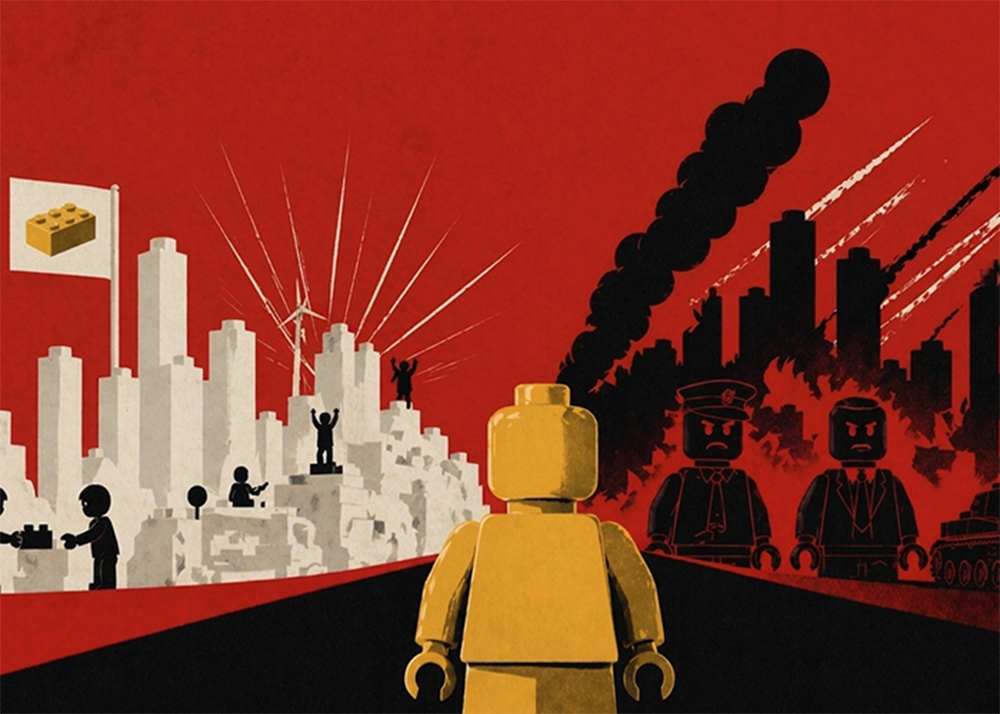
That same week, a state-linked studio began releasing the latest in its ongoing AI-generated series depicting LEGO-like minifigures reenacting situations from geopolitical conflicts rendered in a visual language that every child, and most adults, on earth immediately recognises as belonging to that same most trusted brand on the planet.
Both things are true simultaneously and sitting with that tension is, I think, one of the more important things marketers should be doing right now. because what is happening to LEGO is not just a brand story. It is a warning about something most of our industry has not fully processed yet.
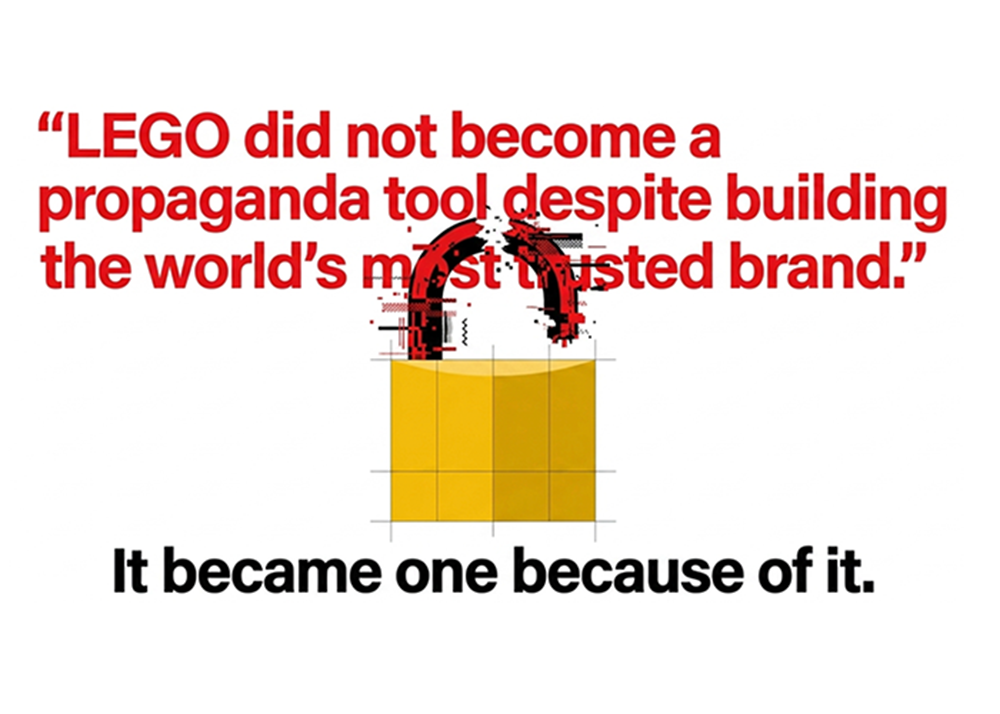
Why LEGO? The answer is more interesting than you think
The first question worth asking seriously is why LEGO specifically, because there are thousands of globally recognised brands and a sophisticated state-linked influence operation could have chosen the visual language of any of them.
Universal recognition is part of the answer, but it is not the full answer. McDonald’s and Nike are equally universal and neither of them was chosen.
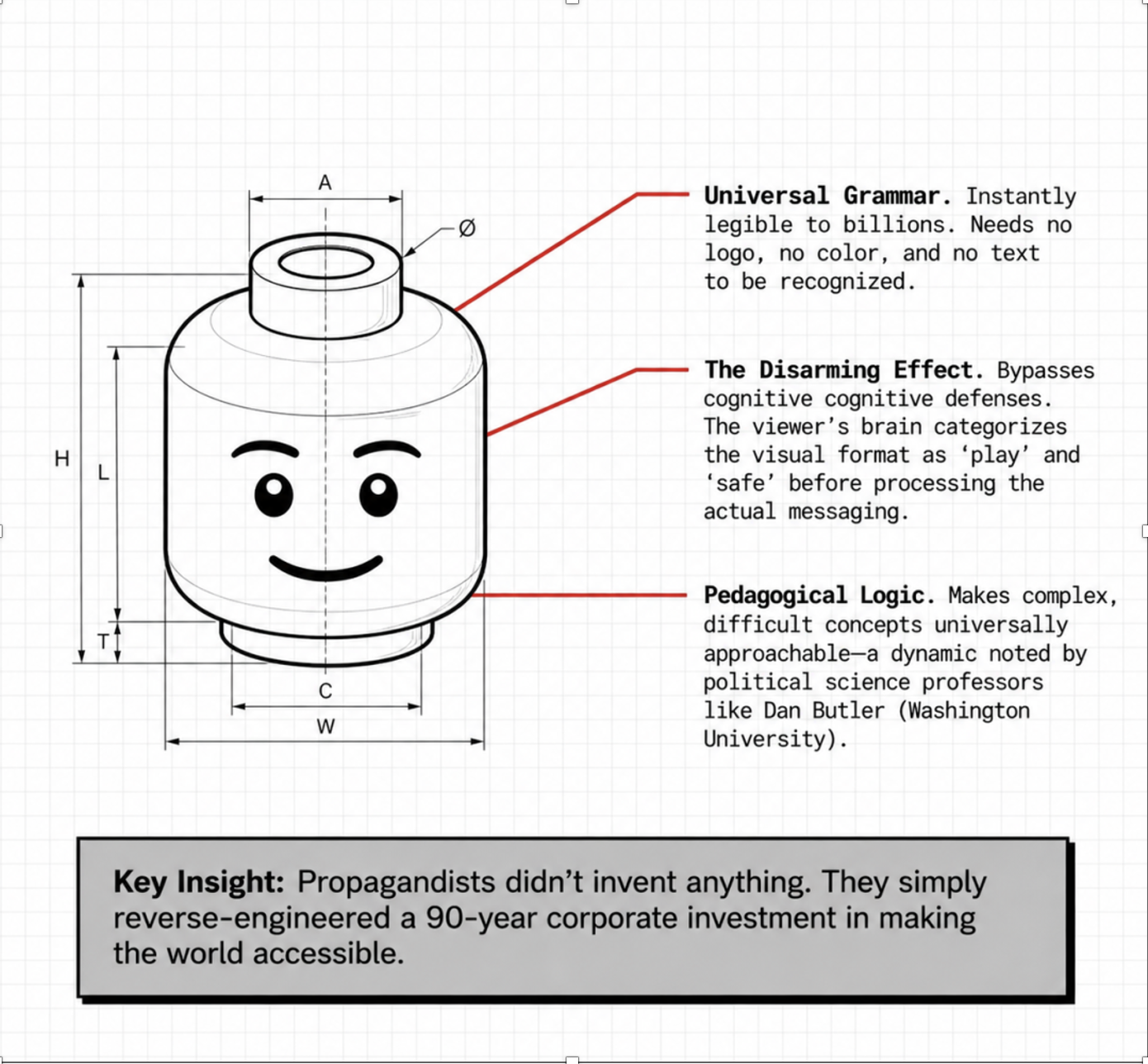
What LEGO has that almost no other brand possesses is something marketers call distinctive brand assets and brand codes and LEGO has built more of them more deeply than almost any brand in history. The primary-colour bricks, the minifigure form, the stud-and-tube connection system, the precise proportions of a LEGO head, etc. each of these is so deeply embedded in global visual memory that even without a logo, without a colour, without any text at all, everyone on earth knows this is LEGO.
That is an extraordinarily rare achievement that most brands spend decades trying to build one or two codes that are truly ownable. LEGO has an entire visual grammar that is instantly legible to billions of people across every culture, every language and every generation alive today.
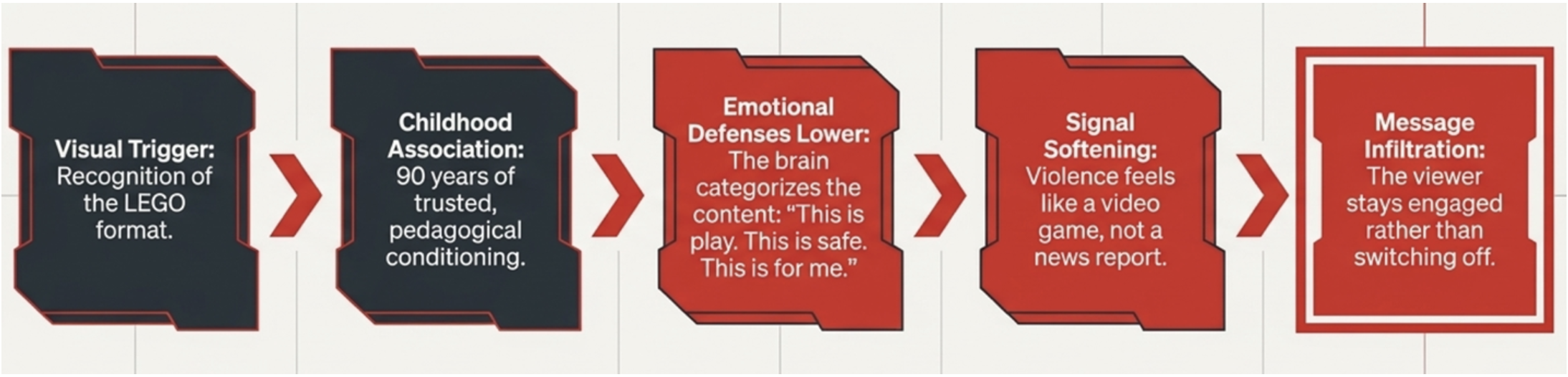
Those brand codes also carry an emotional charge that most visual identities simply do not have, which is what I would describe as a disarming effect: the ability to make the brain categorise content as safe before it has had any chance to process what the content actually contains.
When something appears in LEGO, the viewer’s first instinct is not scepticism or defensiveness but the same instinct they have had since childhood: this is play, this is safe, this is for me, and the emotional defenses come down before the messaging has even begun.
There is a reason lawyers use toy models and diagrams when explaining complex scenarios to juries, and why doctors use plastic anatomical models with children. Simplifying complex or difficult ideas through a familiar, non-threatening form does not just make things easier to understand, it lowers the resistance to receiving them.
Dan Butler, a political science professor at Washington University who actually uses LEGO in his teaching, explained this with useful bluntness: the same reason it works in education is the reason actors would use it for propaganda, because people like LEGO and will tune in to watch LEGO-based films, and that is the entire strategic logic of the operation in one sentence.
And here is the part that I find genuinely fascinating as a marketer: LEGO has spent ninety years building and perfecting exactly this quality. The company’s entire philosophy is built on the idea that play is the most powerful mode of learning, that complex ideas become accessible and memorable when you engage with them through the right medium, and that the LEGO format can make almost any concept approachable for almost anyone. These propaganda studios did not invent anything new here.
They simply applied LEGO’s own pedagogical logic to a different kind of content and found, perhaps not surprisingly, that it worked exactly as intended, because the format LEGO built to help children understand the world turned out to be extraordinarily effective at helping adults absorb a political argument without their usual resistance.
The creators behind these videos operate under the name Explosive News, later rebranded as Explosive Media, a relatively new digital outfit that only gained traction once it pivoted into AI-generated LEGO-style content.
They describe themselves as a small, anonymous, student-led media team with a background in social activism, producing videos independently and at speed, often turning around a two-minute clip in under twenty-four hours using AI tools. That claim of independence, however, sits in a grey zone.
Their content has been amplified by state-linked outlets and in some cases appears to have been commissioned or at least circulated through official channels, which makes it difficult to separate grassroots creativity from coordinated narrative shaping.
What is clear is that this is not a loose collection of amateurs. It is a tight, digitally fluent unit that understands Western internet culture, meme logic and distribution mechanics well enough to manufacture global reach at scale, while maintaining just enough ambiguity around who they are to keep the operation both effective and deniable.
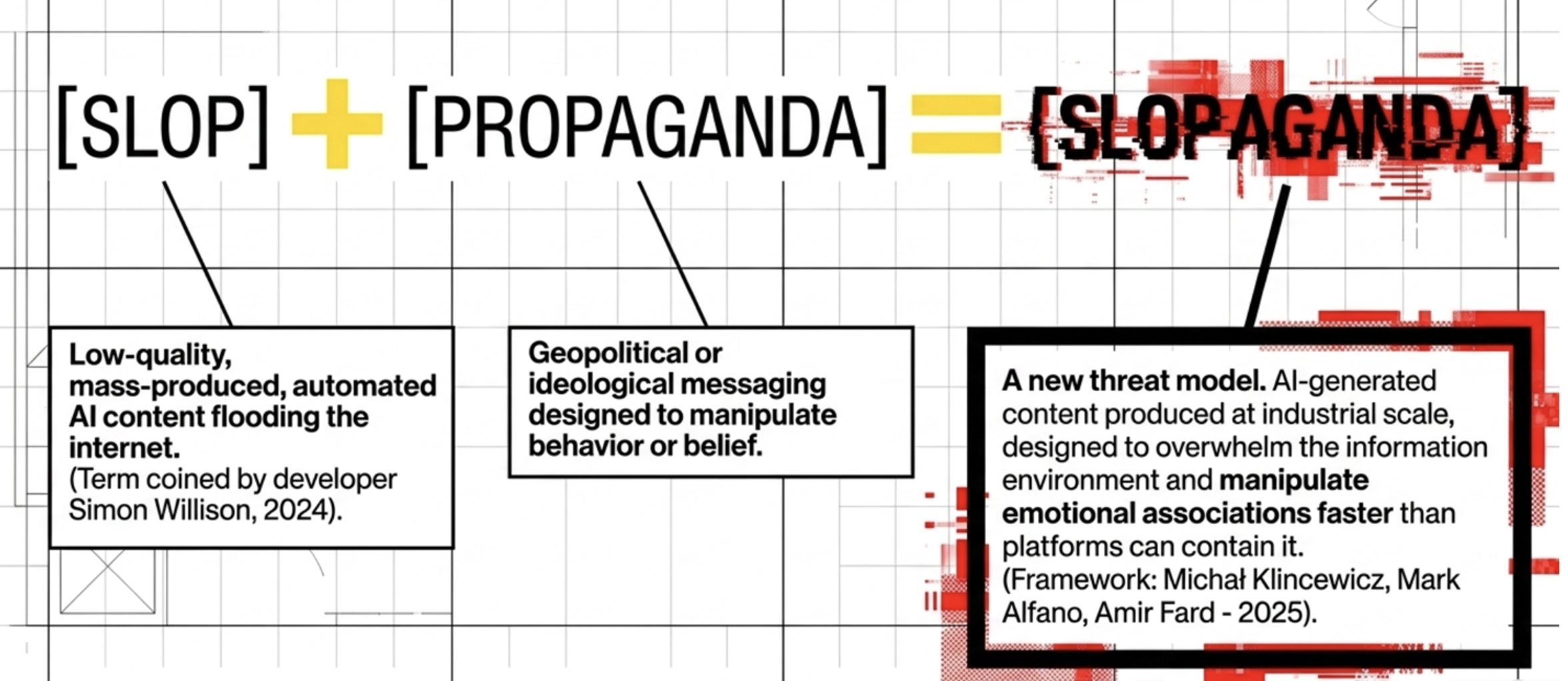
Researchers have a wonderfully precise term for this model: slopaganda, and I have to say I genuinely love it for capturing something that previously had no name.
The word was coined by philosopher Michał Klincewicz of Tilburg University, together with colleagues Mark Alfano and Amir Fard, in a 2025 academic paper titled Slopaganda: The Interaction Between Propaganda and Generative AI. It combines two terms: slop, itself a 2024 coinage by developer Simon Willison to describe the wave of low-quality, mass-produced AI content flooding the internet and propaganda, which needs no introduction.
Put them together and you get a word that describes exactly what LEGO is dealing with: AI-generated content produced at industrial scale, designed not necessarily to be believed literally but to overwhelm the information environment, manipulate emotional associations and spread faster than any platform or legal team can contain it.
The brilliance of the term is that it does not dress the phenomenon up in clinical language. It calls it what it is: cheap, fast and deliberately messy by design. Unlike traditional propaganda, which aimed for credibility and production value, slopaganda thrives on volume and speed precisely because credibility is no longer the point.
The production cost is so low it can be sustained almost indefinitely, with the upload-and-reupload cycle meaning removal is nearly futile, since each account taken down is replaced by several more before the traffic even registers the gap.
What we are witnessing is not brand misuse, but a new kind of arbitrage that we don’t have a the right rules for. Someone else is extracting value from decades of investment, without paying for it, without asking for it, and without any obligation to protect it.
The uncomfortable truth about brand equity
I have spent most of my career building brand equity for organisations that understood its value.
At MetLife in specific the principle where trust and safety was critical it was was always the same: build trust over time, invest in the right areas to build credibility, protect the brand’s emotional territory. That accumulated equity will work for you commercially in ways that are hard to fully measure but impossible to ignore. I still believe that logic is sound even as the LEGO situation reveals how incomplete it turns out to be.
What it does reveal is a vulnerability that the conventional brand equity model was not built to account for. The model assumes that equity is something you deploy, that you are always the actor in the story of your own brand, built for a world where the threats to a brand are things the brand itself has done: a bad product, a tone-deaf campaign, a mishandled crisis, where the playbook for all of those situations starts in the same place, which is acknowledge, correct, rebuild, with the brand always as the subject acting on its own situation.
What LEGO is experiencing is something categorically different. The brand did not choose any of this. It did not take a side, issue a statement, or brief an agency.
It simply woke up one morning as the face of a geopolitical propaganda operation it had absolutely nothing to do with. There is no playbook for that because the like a lot of pages in crisis communications, there is always that one page which is left blank because you can’t forecast some of these scenarios. It makes is tricker where the brand did nothing and still cannot control the narrative.
Here is what actually makes this so interesting from a marketing perspective: the qualities that made LEGO a target, universal recognition, deep emotional associations, a visual identity so distinctive it is instantly legible in any context, are the exact same qualities every brand in the world is actively trying to build. They were part of a conversation organically and who would not want that.
We spend our entire careers trying to build brands that are impossible to ignore and impossible to misidentify. LEGO achieved that better than almost anyone in the history of consumer branding.
The result, in an age of AI-generated content produced at scale, is that its most valuable asset became available to anyone who wanted to use it.
What is happening to LEGO is that same principle operating in reverse and at a scale and speed that the original framework never anticipated: the equity is not being borrowed to build something, it is being borrowed to destroy something. The brand whose equity is being used has no mechanism to stop it.
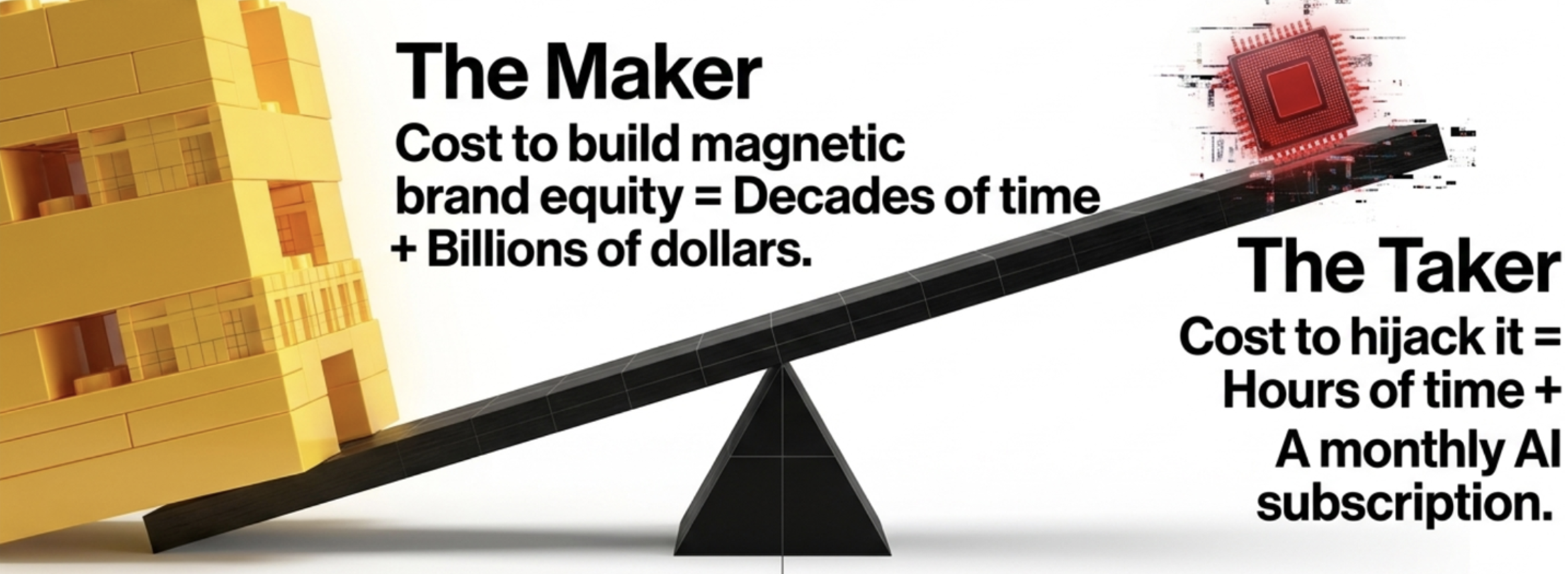
We have spent years talking about brand control as if it were something real. Clearly it was always conditional, and it just took AI to expose how fragile that control actually was. And the economics of it all tell us this shift is not always just a creative shift. The cost of building a brand is still measured in decades but the cost of hijacking it is now measured in hours.
This has happened before LEGO, just never quite like this
LEGO is not the first brand to be dragged somewhere it never chose to go, and what makes its situation distinctive is the combination of scale, speed and political intent, but the underlying phenomenon has precedents worth understanding because they reveal both what LEGO is dealing with and why this particular episode is genuinely different from anything that came before.
Academic researchers who study brand crises have developed a useful framework for thinking about this. A 2021 paper published in PMC introduced two distinct categories of externally created brand damage: brand infection, where a brand suffers because of its association with another brand or actor that has transgressed (think of BP’s oil spill in the Gulf of Mexico and what it did to all oil & gas companies), and brand contamination, where an environmental event pulls a brand into damage it played no role in creating (think of COVID-19 or Brexit and how it impacted every company out there).
What LEGO is experiencing sits in a third space that the framework gestures at but does not fully name, something closer to brand appropriation, where a brand’s visual identity is consciously selected and deployed as a vehicle by an external actor with no association or proximity to the brand required, simply because the brand’s equity makes it the most efficient available tool, so that the brand is not infected by something nearby but borrowed wholesale by something entirely outside its world.
The closest structural parallel in my recent memory is P&G’s experience with Tide Pods. When P&G launched the product in 2012, they had invested heavily in making the pods visually distinctive, with bright candy-like colors and a compact form that made them appealing and easy to use,and that visual investment was entirely sound brand thinking.
By 2017 and into 2018, those same visual qualities had turned the pods into the centrepiece of the Tide Pod Challenge, a viral social media trend where teenagers filmed themselves biting into the toxic detergent capsules for shock value and online notoriety.
P&G found itself in a public health crisis not because of anything it had done wrong but because the very qualities it had invested in creating made the product an irresistible vehicle for consumer behaviour it could not have predicted and would never have endorsed. Poison control centers reported hundreds of exposure cases, YouTube and Facebook scrambled to remove videos, and P&G deployed Rob Gronkowski in a safety campaign while working with platforms to suppress the content.
The brand recovered commercially and most people now look back on the episode as a strange cultural footnote rather than a lasting brand association, but the episode left a recognition behind it that the more visually distinctive and culturally embedded a brand makes itself, the more useful it becomes as raw material for other people’s agendas.
What connects the cases is a pattern that the conventional brand risk playbook was not designed to handle. In each case the brand’s most carefully built qualities, Tide’s appealing visual design, LEGO’s disarming innocence, became the specific reason the brand was chosen as a vehicle for something it never sanctioned, which means the strength of the brand equity is not incidental to the risk but is the source of it.
And in each case the brand’s tools for managing its own narrative, legal enforcement, platform lobbying, content moderation requests, proved to be fundamentally mismatched to the speed and scale of what it was trying to contain.
What is different about LEGO’s situation is the intentionality, the scale and the production infrastructure behind it. The Tide Pod Challenge was consumer chaos, amusing and dangerous but organic and leaderless. What is being deployed against LEGO is a state-linked, professionally produced, continuously updated content operation (to date) that has generated hundreds of millions of impressions across dozens of platforms simultaneously.
The slopaganda model, AI-generated content produced at near-zero cost and uploaded faster than platforms can remove it, means this is not a campaign that will run out of momentum on its own but an ongoing infrastructure that simply keeps producing.
Brand equity was always something you build. AI has made it something others can borrow at almost no cost, without asking, and faster than you can respond.
How far this actually travelled
One argument available to anyone who wants to downplay the risk is that this content lived primarily in social media feeds and did not really cross into mainstream cultural consciousness, and I would have been more sympathetic to that argument before Coachella which more than 125,000 people attend per day.
During a performance at the festival a few days ago, the lead singer of The Strokes addressed the crowd directly to say that he wanted to pull up his laptop and show one of the LEGO videos because they had more facts than local news, but that they kept getting deleted by platforms and governments alike, and the audience responded.
That is one of the largest cultural events in the US, and someone on that stage chose in the middle of a performance to reference propaganda videos by name, which is a different category of exposure from TikTok virality entirely.
When content starts being referenced from stages at major cultural events, it has escaped the algorithm and entered general cultural conversation, at which point it does not need any more views to spread because it travels through people describing it to other people.
That means the LEGO association reaches audiences who have never actually watched the videos, and the content flood strategy that Barr identified, effective as it may be at controlling what appears in search results, has limited reach against that kind of word-of-mouth diffusion.
Will LEGO walk away from conflict?
Here is the question I keep getting asked since this story broke, and it is worth addressing directly: does LEGO make toys that could be associated with conflict in the first place, and given what is happening, will it now reconsider them?
The answer, when you actually look at the data, reveals a genuine irony at the heart of this whole situation. LEGO has maintained a formal, written policy since at least 2010 explicitly stating that the basic aim is to avoid realistic weapons and military equipment that children may recognise from hot spots around the world, and to refrain from showing violent or frightening situations when communicating about LEGO products.
The company has a strict standing rule against producing sets that feature real military vehicles currently in use. It excludes warfare or war vehicles in any modern or present-day situation from its LEGO Ideas platform entirely, and it has held this position so firmly that when it accidentally released a LEGO Technic V-22 Osprey in 2020, a tiltrotor aircraft used exclusively by the US and Japanese militaries, it pulled the set from shelves within days after protests from peace groups.
The sets that exist within LEGO’s catalog that carry any conflict-adjacent content, the Star Wars franchise, the medieval castle themes, the pirate sets, the Indiana Jones historical sets, are all carefully wrapped in fantasy, science fiction, or historical distance.
The company has gone so far, at various points in its history, as to avoid grey-colored bricks entirely because grey is the obvious colour for building military hardware.
And yet, here we are amid satire and slopaganda. A brand that has spent decades constructing perhaps the most deliberate and documented policy of any toy company in the world against any association with real-world conflict is now the most recognisable face of a live geopolitical conflicts on social media.
A University of Canterbury study found that almost 30 percent of LEGO sets include at least one weapon brick, but these are overwhelmingly fantasy weapons, medieval swords and pirate cannons, not modern arsenals, and the distinction matters. There is no tank in LEGO’s official catalog that looks like the tanks being built in the region right now. There is no fighter jet that resembles the ones whose strikes are being depicted in the propaganda.
The irony is complete: the brand most aggressively targeted by war imagery is also the brand that has most aggressively tried to stay out of war’s way.
The question of whether LEGO will pivot to something safer is almost unanswerable because there is genuinely not much left to pivot away from. The more pressing question is whether having the cleanest possible product policy is actually sufficient protection in a world where the brand’s visual language can be deployed regardless of what the brand itself chooses to make. Considering when your entire brand premise is around getting creative, play and personal imagination.
What this should mean for every brand leader
I want to be honest about something upfront: I do not think LEGO is going to suffer a permanent commercial wound from this, because the brand’s foundations are too strong, its audience relationships too deep, and the commercial results too resilient to suggest otherwise, and I am not writing this as a crisis alert for LEGO specifically.
I am writing it because the dynamic this episode exposes is not unique to LEGO but is the first high-visibility demonstration of a risk that exists for any brand that has done its job well.
LEGO is perhaps the purest example of a magnetic brand that has ever existed: its visual codes are so embedded in global culture that its identity travels freely through the world without any distribution effort from the brand itself. That is an extraordinary commercial achievement.
It is also, as this situation demonstrates, an extraordinary exposure. The conditions that made LEGO magnetically iconic, universal recognition, strong emotional associations, a visually distinctive identity that functions as a global language, are the conditions every serious brand-building program is designed to create.
The implication is that we may all be building the same vulnerability, and most of our risk frameworks have not caught up with that reality yet.
By Ahmed El Gamal, Executive Director of Marketing