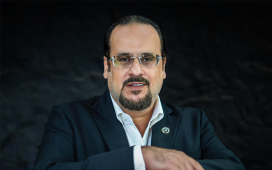
On the latest episode of Campaign Middle East’s On The Record podcast, Andrew Gregory, Marketing Director, Ford MENA, reveals success that can be unlocked from working towards shared outcomes instead of working within silos. He positions Ford’s response — specifically the ‘Ready. Set. Ford‘ brand platform — as the connective tissue that harmonises OEM (original equipment manufacturer) strategy and distributor execution, designed to translate legacy strengths into contemporary relevance.
This video interview unpacks how that translation happens: through clarity of shared outcomes, disciplined measurement, agility in operations, emotional storytelling and a relentless focus on trust, incrementality and customer experience.
Across the conversation, Gregory accelerates automotive marketing far beyond the traditional, linear sales funnel and unveils a complex dashboard where speed, alignment and empowered consumers determine whether a brand simply survives or actually wins.
He highlights the heritage, product pedigree, quality and scale of the Ford brand, and explains how each of these only shine when they are committed to customer-centricity. If the competitive market were compared with a track and field event, Gregory explains why brands must be both endurance athletes and sprinters: ready for long-term brand-building while equipped to react instantaneously to tactical threats.
“Brands that win are the ones that make complex decisions easier for the customer.”
Pointing to one of the most seismic shifts within the market in terms of consumer behaviour, Gregory says, “The first thing I’d point out is that the customer journey isn’t linear anymore. There are so many different sources of information. You’ve got online; you’ve got YouTube; you’ve got video reviews – all these different sources allow customers the opportunity to understand about 80 per cent to 90 per cent of what they need even before they go down to a showroom. So, these customers are very well informed.”
He adds, “I think the second that is important to consider is that people are looking for confidence, not just features. So, what that effectively means is that while automotives out there offer a plethora of tech, customers are looking to understand whether you are satisfying their need. What confidence are you giving that customer after the after the sale? How are you really taking care of them? What does the customer experience journey look like? Focusing on those aspirational areas are what differentiates OEMs and helps them win.”
From this diagnosis follow three strategic imperatives.
First, speed and agility: markets move fast, and the ability to make quick decisions — whether to pivot creative, reallocate inventory or respond to a competitive launch — matters. Andrew stresses that reactive capabilities aren’t enough, explaining how marketers cannot survive by merely analysing why something failed after the fact.
Second, alignment across stakeholders: in a distributor model such as what Ford MENA has, the OEM must set clear guidelines and work towards shared outcomes while distributors execute with localised insight.
Gregory explains, “Good really looks like a concise story told many ways, but with one shared outcome,” adding that shared metrics and roles reduce the “gaps between message and reality.”
Third, measurement discipline: incrementality is harder in a noisy, promotion-heavy environment, so separating short-term activation from long-term brand creation requires rigorous testing and a blend of metrics — attention, reach and engagement for immediacy; brand health for downstream sales and longevity.
“The vehicle is not the hero, it is the customer.”
Trust emerges as a central thematic anchor. In an environment where new entrants offer shiny tech and large ad spends, trust is a durable differentiator that legacy brands can leverage.
Gregory explains that the right route to standing out is not defensive conservatism; it’s authenticity and service: “The vehicle is not the hero, it is the customer,” he declares, emphasising that Ford’s narrative positions cars as enablers of aspirations — whether for family utility, performance thrills or everyday adventure.
This customer-first orientation underpins their three strategic pillars — build, thrill and adventure — which map product portfolios to distinct emotional and functional customer needs. The pillars allow Ford to cascade halo benefits — from motorsport and performance engineering — into mass-market credibility while maintaining relevance across diverse customer segments.
Operationally, Gregory lays out practical priorities: a unified brand platform such as Ready. Set. Ford to ensure consistent storytelling across OEM and distributor touchpoints; the establishment of feedback loops so distributors that act as the “voice of the customer”; and a framework for channel-level testing to isolate campaign effects from market-level volatility.
He argues that marketing must be measured not only by short-term leads or showroom footfall, but by quality leads, CRM performance and ultimately lifetime customer value. The goal is to create consistency with enough discipline to allow scale — so that campaigns can be compared, refined and amplified without being drowned out by promotional seasonalities.
All in all, Gregory’s view of modern automotive marketing is both realistic and optimistic: the landscape is complicated, but the levers that matter are timeless — trust, clarity of purpose and relentless focus on the customer experience. How the playbook must evolve is highlighted in tempo and translation: faster operational decision-making, greater distributor alignment, and clearer, emotionally resonant storytelling that positions the vehicle as an enabler of life, not the protagonist.
For marketers steeped in brand stewardship, the lesson is simple but rigorous: be paranoid enough to out-innovate competitors, yet disciplined enough to build consistent equity over time.
As Gregory puts it, “the brands that win are the ones that make complex decisions easier for the customer.”
Watch the full video here to catch all the in-depth insights.
CREDITS:
Guest: Andrew Gregory, Marketing Director, Ford MENA
Host: Anup Oommen, Editor, Campaign Middle East
Production: Surajit Dutta, Content Production Manager, Motivate Media Group
Videography: Mark Mathew, Creative Content Producer, Motivate Media Group
Studio: Ekaterina Shirshova, Creative Content Producer, Motivate Media Group
Editing: John Melencion, Content Producer, Motivate Media Group