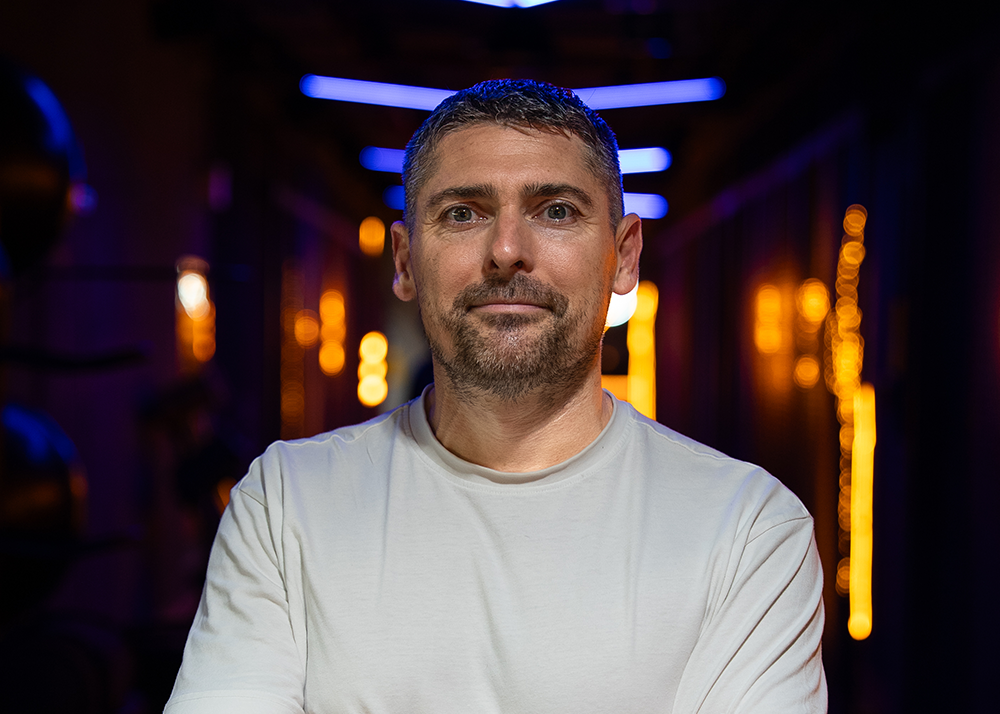
 Rory McEntee, Chief Marketing Officer, GymNation.
 Last June, I wrote a piece on artificial intelligence (AI) that caused what can only be described as a collective aneurysm in the creative industry. Ad people. Copywriters. Creative directors. Agency founders. They all came for me with a level of fury usually reserved for people who put pineapple on pizza.
It sparked a number of counter-pieces. LinkedIn lit up. Someone – and I’m paraphrasing here – told me my muscle mass and bank account joke was proof AI had already lobotomised me. A copywriter who’d clearly had a long day informed me he’d cancelled his GymNation membership and was sleeping better than ever.
Here’s the thing though. A year on, I wasn’t just right about AI in creative. I didn’t go far enough.
Let’s start with the numbers, since everyone loves numbers
88 per cent of marketers are now using AI daily. 93 per cent say they create content faster with it. Not experimenting with it. Not running a “pilot.” Daily. Fast.
But here’s the stat that will make every agency finance director choke on their coffee: 39 per cent of CMOs plan to cut agency budgets in the next cycle. Not some. Not a few curious ones. Nearly half the marketing leaders in the room. And the average payback on AI investment is now 4.2 months, down from 7.8 months in 2024.
For context, I have never, in 20 years of briefing agencies, seen a retained agency deliver positive ROI within four months of engagement. You’re lucky if you’ve found your font preferences by then.
What we’ve actually built with AI
When I wrote the original article, the honest criticism was that I was talking in abstractions. Bold claims, cute examples, not much substance.
So let me be specific. Just not too specific as I’m not giving away free consultancy here.
In the past twelve months at GymNation, we’ve built and deployed AI systems across nearly every marketing function that used to require an external agency relationship. On SEO, we publish content across multiple markets daily without a brief or a retainer.
On paid ads, we generate and test hundreds of creative variants simultaneously across every platform. On competitor intelligence, we know what every rival is running before their own teams do.
We have an AI press office now too. It drafts releases tailored by outlet type – the same story lands differently in a consumer title versus trade press, a broadsheet versus a tabloid. It maintains a live journalist database, tracks recent bylines, and identifies who’s actually been covering fitness or retail or whatever the angle is. Outreach goes directly from me, in my voice, referencing something specific about that journalist’s recent work.
This isn’t a creative experiment. This is infrastructure.
And no, not every agency is this replaceable. But most of the agencies most companies are using? Absolutely they are. 53 per cent of agency owners now agree that AI poses a credible threat to their business model, up from 44 per cent just a year earlier. That’s the industry talking about itself. I didn’t make that up.
On the backlash
“You had the wrong agencies, mate.”
Maybe. Probably, even, in some cases. But that’s rather the point, isn’t it? The agency market is enormous and largely undifferentiated, and the probability of landing the exceptional one versus the expensive-but-mediocre one has always been low. AI doesn’t require you to get lucky.
“AI is trained on stolen creative work.”
This is a legitimate ethical debate and I’m not going to dismiss it. But it is a separate conversation from whether AI is effective. The two things are not mutually exclusive positions, and conflating them doesn’t make either argument stronger.
“What about the strategic stuff AI can’t do?”
Fair. I’ve always said this. The original article said this. AI provides the starting point. The fast, broad, often surprisingly clever starting point. The human – ideally a senior, experienced one, not a room full of account managers – refines, elevates, and makes it sing. What AI has killed is not creativity. It’s the billable hours wrapped around creativity that were never really about creativity.
“AI-generated creative gets down ranked on Meta and TikTok now.”
Meta, TikTok, and Google have quietly down-ranked obvious AI creative in their 2026 ranking updates. This is real, and it matters. Which is exactly why we use AI to generate the volume and humans to curate, adapt, and elevate what goes live. The answer to AI creative being detectable is not to abandon AI – it’s to use it better.
The part nobody wants to admit
When I wrote the first article, I was talking about replacing a creative agency. One relationship. One function.
I was thinking too small.
The past year has shown that what’s actually changing is the entire agency model. Not just creative. PR. Paid media. SEO. Research. Analytics. Competitor intelligence. Content. Each of these had a corresponding agency or consultancy relationship. Each of them has been partially or substantially replaced – not with lower quality, but with higher speed, higher volume, and radically lower cost.
Marketers now save an average of 6.1 hours per week using AI, with senior practitioners saving 8–10 hours. That’s not efficiency. That’s a structural change in what a small, senior marketing team can output.
So, what did I get wrong about AI?
One thing.
I probably underestimated how much the transition requires investment – in time, in learning, in building systems that actually work. The agencies who’ve survived this year are the ones who adopted a hybrid model: AI handles research, synthesis, and formatting while humans focus on original analysis and brand voice.
The ones who pretended it wasn’t happening lost clients and staff simultaneously.
The same is true on the client side. You can’t just subscribe to ChatGPT, prompt it like a magic wand, and declare victory. My AI stack took months to build properly. The briefs, the workflows, the automations, the quality control – all of it required real senior thinking. It’s ongoing and still does.
AI doesn’t replace good judgment. It makes good judgment considerably more leveraged.
The bottom line
A year ago I asked a question and took some flak for it: do you actually need an expensive retained agency, or have you just never seriously questioned the model?
The data says the answer is increasingly no. The CMOs agree. The agencies themselves are nervous. The tools are better than they were. The playbook exists.
I’m still sleeping fine. I’m sleeping better, actually. The Oura ring agrees.
By Rory McEntee, Chief Marketing Officer, GymNation.