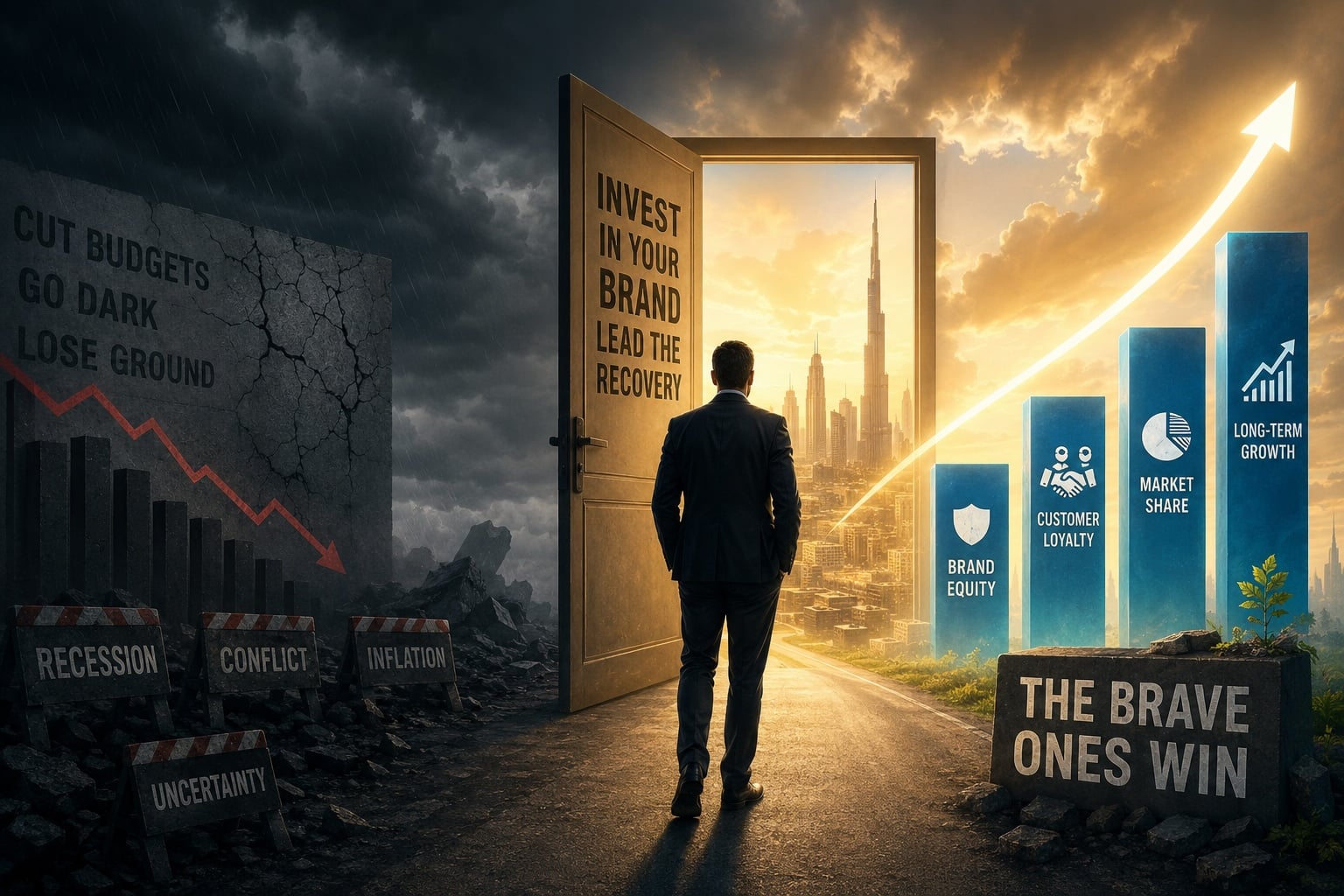
Every time a crisis hits, a recession, a regional conflict, a pandemic, an economic shock, the same reflex plays out on spending across boardrooms in Dubai, Riyadh, Cairo, and everywhere else. Someone says: “Let’s pause the marketing budget.” It feels rational. It feels responsible. It is, in almost every measurable way, the wrong call.
I have spent enough years in this industry to watch brands make this mistake and pay for it. Not immediately, because the short-term P&L can actually look better when you go dark, but a year later, two years later, when the recovery arrives and they find themselves invisible in a marketplace that moved on without them.
What the evidence has always told us on ad spending
McGraw-Hill Research tracked 600 companies through the US recession of 1981 to 1982. Those that maintained or increased their advertising spend recorded 275 per cent sales growth by 1985. Those that cut managed just 19 per cent over the same period. That is not a marginal difference, it is an entirely different business trajectory, triggered by one strategic decision made under pressure.
The IPA’s research adds another layer: when a brand cuts its budget, residual brand equity from previous investment creates a deceptively flattering short-term picture. Profitability can tick up briefly. That is the trap. The long-term damage to brand strength and customer loyalty is real, cumulative, and only becomes visible when competitors who kept spending start taking your customers.
According to WARC, brands that boosted ad spend during recessions gained 1.6 percentage points in market share within the first two years of recovery, compared to just 0.7 for those who cut ad spend.
This connects directly to share of voice. For every 10 points of excess share of voice a brand holds, it gains approximately 0.6 points of extra market share per year. When competitors retreat, your share of voice grows automatically, even if you simply hold spend flat. The 2008 recession saw overall ad expenditure fall 13 per cent, which meant brands that stayed present enjoyed 3.5 times more brand visibility than the norm. The opportunity is not hypothetical. It is structural.
The brands that refused to flinch
The proof exists across nearly a century of downturns. Brands such as Kellogg’s, Toyota, Hyundai, Amazon, and Procter & Gamble each faced a major economic crisis, depression, oil shock, financial collapse, pandemic, and chose to maintain or increase investment while the rest of the market retreated.
In every case, they emerged with stronger market positions, greater brand equity, and competitive advantages that took their rivals years, in some cases decades, to close.
What they had in common was not unlimited budgets. It was the discipline to see a crisis as a window, not a wall, and the strategic clarity to adapt their message to what consumers were actually feeling, rather than simply staying loud.
Empathy, reassurance, and tangible value resonate during hard times in ways that aspirational messaging cannot.

The MENA reality on ad spending
Our region has had its own stress tests: the 2009 financial crisis, COVID-19, regional conflict, and persistent inflationary pressure across multiple markets. The response has too often followed the same pattern seen globally. An IAB GCC survey in April 2020 found that 48 per cent of regional advertisers had already cut budgets by up to 30 per cent, and 20 per cent had simply paused all advertising.
Against that backdrop, the brands that stayed visible, particularly in telecoms, e-commerce, and digital services, disproportionately captured the shift in consumer behaviour that defined those years.
Internet advertising spend in MENA grew from $4.4b in 2020 to a projected $7.9b by 2024. The brands that leaned into that shift built audiences that are now loyal. The brands that went dark handed those audiences to someone else.
Three things to do differently with spending
First, shift the conversation from cost to investment. Marketing in a downturn is not a luxury, it is the mechanism by which you protect and grow your market position when the competitive field is at its most open.
Every competitor that cuts is giving you their share of voice.
Second, adapt the message, not just the medium. What people need to hear during a crisis is different from what works in stable times. Brands that get this right often permanently shift consumer perception in their favour.
Third, protect long-term brand investment over short-term performance marketing. The instinct in a downturn is to shift entirely to performance channels because the numbers are immediate and defensible. The problem is that performance marketing without brand equity is a short game. The brands that emerge strongest invest in both. The brands people remember after a crisis are the ones they saw during it.
The Middle East is not short of ambition. What it needs, in moments like these, is the discipline to back that ambition with continued investment, even when every instinct says otherwise. The evidence is a century old, and it has never pointed in a different direction.
Hani Aldajani, General Manager, Horizon FCB Saudi Arabia.