Markets across the region have navigated a period of uncertainty. But if history has taught us anything, it’s that recovery – when it comes – moves fast. And the brands that positioned themselves before the window opened are the ones that capture it.
Marketing leaders across all verticals are asking the same question right now: how do we manage our presence through this, and how do we come out of it ready to grow?
Project Agora is a media company helping marketers achieve performance on the open web, working with clients right now, to help them prepare for the day after by leveraging trusted media and native formats.
The pause before the surge
When stability returns to the region, it doesn’t just restore confidence – it triggers pent-up demand. Travel intent returns. Real estate enquiries resurface. Airline searches spike. What changes most, though, is the emotional context of those searches: people want to know a destination is open and welcoming, a product or experience available and worth it.
That is not a performance problem. That is a trust problem.
And trust isn’t rebuilt through social media volume or retargeting banners. It’s rebuilt through the environments people associate with credibility – premium editorial, long-trusted publishers, and media that signals quality by proximity. The creative needs the appropriate media environment to perform.
How environment and format impact trust
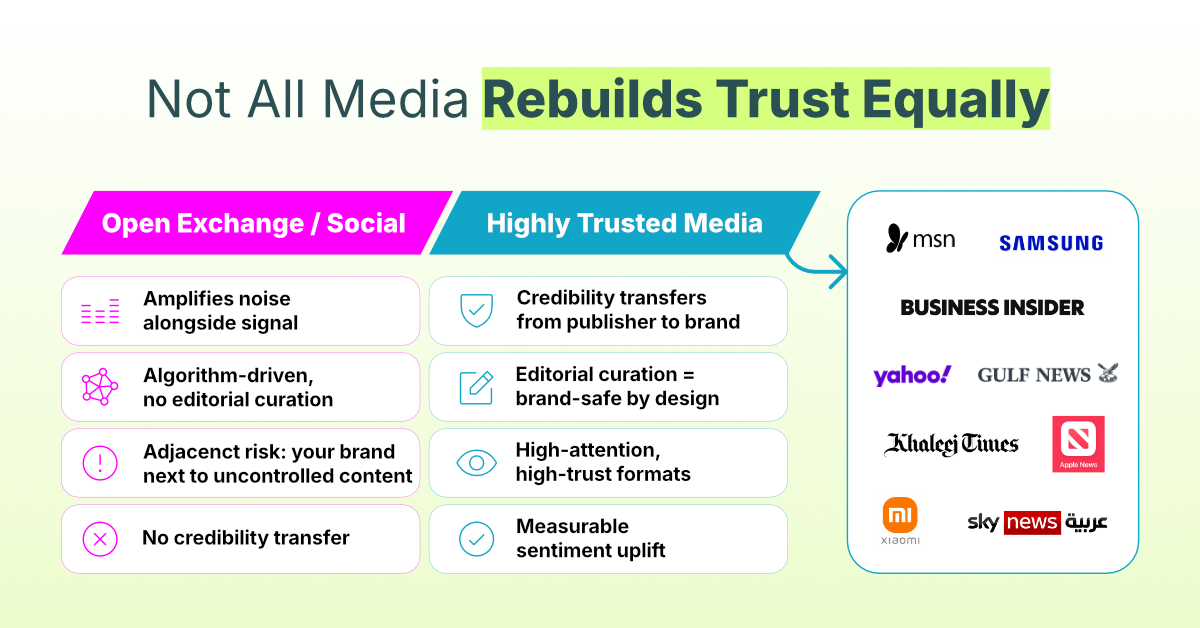
Not all media and formats rebuild trust equally. Social platforms amplify noise alongside signal, and the algorithm does not distinguish between sentiment types when serving content. Programmatic inventory may place your brand next to content you cannot control, and in a period of market uncertainty, adjacency risk is real.
But a native placement within a trusted environment like a leading publication, email or the news app of a major OEM, sends a different message: “we are confident enough to show up here, and we have something worth saying”.
A banner would never have the same effect as a native placement on BBC, Le Figaro, The Indian Express, Gulf News, Yahoo email, Apples News, Samsung News or Xiaomi, just to name a few examples from the Project Agora network.

The key difference lies in the relationship between the advertising experience and the publishing environment.
“Native advertising is different from typical display advertising in the sense that native ads blend into the environment by incorporating the design, tone, and flow of the publication itself. This allows for a multiplier effect wherein the placement itself is infused with the publisher’s or OEM’s credibility, thus creating a third-party endorsement experience”, says Sajin Seethi, Sales Director MENA at Project Agora.
Consumers do not see a native ad placement as an advertisement in and of itself, existing independent of the publishing environment. They see it as a message being delivered in a medium they have personally chosen to follow, thereby leveraging the credibility that the publisher possesses in its own right. This is not a superficial difference. For industries like for example tourism, travel, and real estate – where reputation and aspiration are crucial factors in making decisions – that integration may spell the difference between visibility and persuasion.
According to a June 2025 The Trade Desk study:
- 85 per cent of consumers said premium media environments increase trust in advertisers
- Ads in premium media were 50 per cent more effective at improving advertiser perception
- Premium placements drove 40 per cent higher purchase intent compared to lower-quality environments
“The argument for native advertising within trusted media environments in recovery scenarios goes beyond brand safety. Evidence consistently shows that brand recall, sentiment association, and purchase intent all outperform when the surrounding content environment is credible – versus open exchange or social-only buys. The ad speaks with the voice and the authority of the context”, shared Nikos Komninos, Managing Director of Project Agora.

A phased approach to re-entry
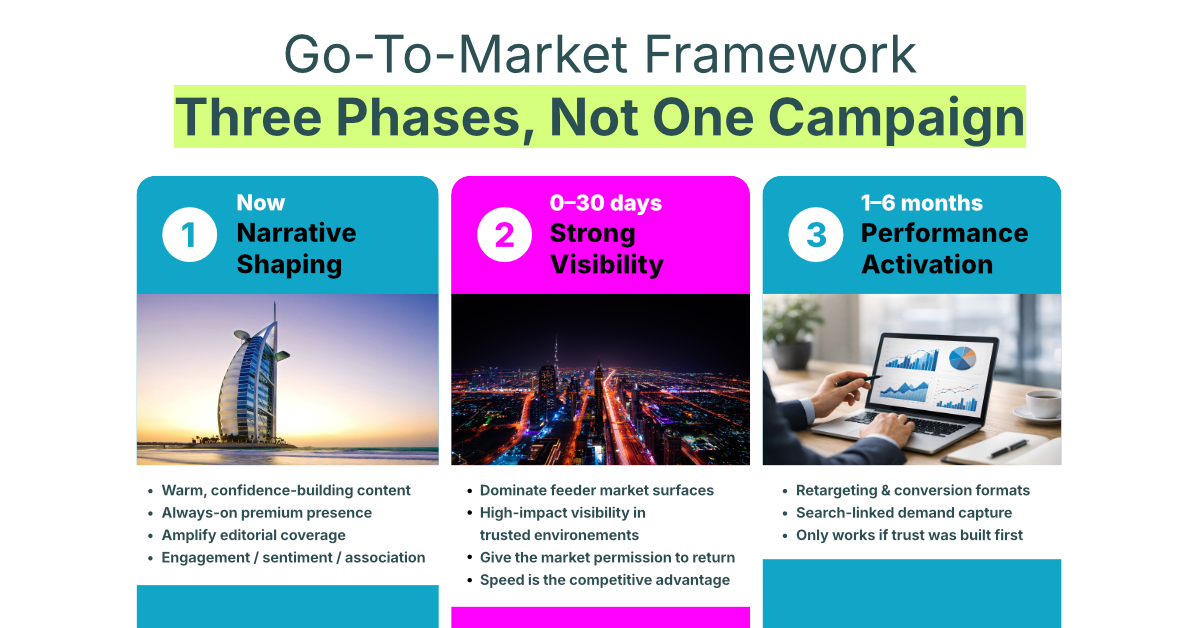
The brands that earn genuine loyalty during a recovery window are the ones that never fully left. Not with aggressive performance campaigns – that would be the wrong read of the moment. But with content that is warm, confident, and human.
This kind of always-on brand presence during uncertainty does something that no recovery campaign can replicate: it makes the brand feel like it was with people during a difficult moment, not absent from it.
Presence during uncertainty is what earns the right to perform during recovery. The challenge during the recovery window is structurally the same for most verticals: you must shift perception before you can drive conversion.
Recovery advertising does not work on a single timeline. The smart approach operates in three gears, each with different objectives, different channel mixes, and different success metrics.
Final takeaways on advertising recovery
The window between uncertainty and recovery is narrower than it looks from the inside of it. Brands that plan now, position in trusted environments now, and think in phases will capture a disproportionate share of the recovery curve. Those who wait for certainty will find the best shelf positions already taken.
The day after is now.
The question is not whether recovery is coming. It is whether your brand is positioned to lead it or to follow it.
By the Project Agora team.