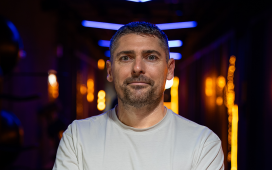
On the latest episode of Campaign Middle East’s On The Record podcast, Marwa Kaabour, Group Marketing and Corporate Communications Director, Al Masaood, discusses the correlation between brand values and business impact, the importance of an culture-driven organisation, and the significance of employee experience in driving customer experience and long-term business outcomes.
In an era when data points and return-on-investment (ROI) often dominate conversations, there’s a growing recognition that the heart of successful brands beats with something more profound: genuine human connection.
The marketing world is experiencing a transformative shift, moving beyond mere transactional relationships to understanding the deeper emotional and cultural dimensions that truly resonate with consumers and employees alike.
This paradigm shift is not just a trend but a fundamental reimagining of how businesses approach their core purpose. It’s about creating meaningful experiences, fostering authentic relationships, and recognising that the most powerful marketing strategies are those that align with human values and aspirations.
Through this candid conversation with Campaign Middle East, Kaabour unpacks the complex dynamics of modern marketing, corporate culture, and the critical role of human connection in an increasingly digital world.
She highlights the evolution of corporate social responsibility, tracing its journey from community-focused initiatives to comprehensive business impact strategies.
“If we look at brand indexes and brand desirability, there are very strong statistics that tell you that customers are looking for brands that have a positive impact on their lives,” Kaabour explains.
The conversation also delves into the tangible economic benefits of this approach. Citing recent studies, Kaabour shares compelling data: “A PwC study showed that consumers are willing to spend an average of 9.7 per cent more on sustainably produced or sourced goods or any similar brand that has a very positive impact on society and the environment.”
The discussion also taken an introspective turn when exploring internal corporate culture. Kaabour emphasised that modern organisations must look beyond traditional vision and mission statements.
“What really shapes a culture are two things: the experiences shared between employees and the behaviours prevailing amongst employee groups,” she says..
Particularly fascinating is her insight into generational shifts, especially regarding Gen Z’s workplace expectations.
“Gen Z’s place a very big importance on having friends at work. They don’t believe in silos. They are very welcoming of cross-functional work groups and prefer project-based tasks more than ongoing, mundane tasks,” Kaabour reveals.
While acknowledging the rise of AI and technological transformation, Kaabour remains optimistic about the human element.
She stresses that technology should facilitate, not replace, human interaction. “AI speaks our language, so it’s not coded anymore. I’m very positive about the future of work and marketing,” she says.
Her approach at Al Masaood demonstrates this philosophy practically. The organisation has empowered employees as brand ambassadors, providing training in public speaking and digital communication.
Their LinkedIn strategy, where 97 per cent of employees follow the company page, exemplifies a modern, inclusive approach to corporate communication.
The conversation also underscores a critical marketing truth: authentic human experiences remain paramount. Despite technological advancements, face-to-face interactions still drive significant conversions.
Kaabour notes that in their automotive business, showroom interactions still yield the highest conversion rates, with more 25 per cent of interactions resulting in sales.
“More than 70 per cent of our customers prefer human interactions,” she shares, highlighting that technology should enhance, not replace, genuine human connections.
All in all, Kaabour’s insights represent more than a marketing strategy; they reflect a holistic approach to business that recognises the intrinsic value of human relationships.
In an age of algorithms and artificial intelligence, the most successful brands will be those that follow a fundamental truth: business is, and always will be, about people.
The future of marketing isn’t about choosing between technology and humanity, but about creating a harmonious ecosystem where both can thrive, driving innovation, empathy and meaningful connections.
CREDITS:
Guest: Marwa Kaabour, Group Marketing and Corporate Communications Director, Al Masaood
Host: Anup Oommen, Editor, Campaign Middle East
Production: Surajit Dutta, Content Production Manager, Motivate Media Group
Videography: Mark Mathew, Creative Content Producer, Motivate Media Group
Studio: Ahmed Abdelwahab, Studio Manager, Motivate Media Group
Editing: John Melencion, Content Producer, Motivate Media Group