ServiceNow , an AI control tower for business reinvention, has highlighted the gap between the potential of AI and how service to consumers is being delivered in its new research titled The CX Shift: Customer Expectations in the AI Era.
The standout finding from the research is that citizens and residents across the UAE are collectively spending more than 83 million hours a year on hold, despite the improvements made possible by AI.
The research, conducted with ThoughtLab, surveyed 34,000 executives, service representatives and customers globally, including 1,335 respondents in the UAE.
The results reveal that poor customer service in the UAE costs every consumer the equivalent of 10.8 hours a year — more than a full working day — spent dealing with issues such as long wait times, repeating information or navigating slow systems.
Shakira Talbot, Group Vice President, CRM EMEA at ServiceNow, said, “Consumers across EMEA are losing entire working days to service experiences that should take minutes. The root cause isn’t a lack of AI investment — it’s that most CRM systems were built to record interactions, not resolve them. That’s the shift we’re driving: CRM as a system of action, not a system of record.”
While organisations are investing in AI, outdated systems are preventing many from turning those investments into the faster, smoother experiences customers expect.
Consumers are paying a hidden productivity tax
Across EMEA, the research found that consumer issues take an average of three to four days to resolve — even in sectors designed for speed, such as banking and telecommunications.
In manufacturing, resolution times stretch to nearly a full working week. Even in the technology sector, known to be early adopters of platforms and technology, less than one in five (18 per cent) customer service issues are resolved within an hour.
Close to half of consumers in the UAE (41 per cent) rate current customer service as average, poor or terrible. Meanwhile, 45 per cent of customers across the Emirates say they would switch to a competitor after a single poor or slow experience.
AI is gaining trust but empathy remains the gap
Almost two-thirds of UAE consumers (62 per cent) say AI has improved customer service. Half of those in the UAE (49 per cent) report gains in speed, efficiency, and convenience; and 60 per cent say AI has improved after-hours and 24/7 support. Yet speed alone is insufficient.
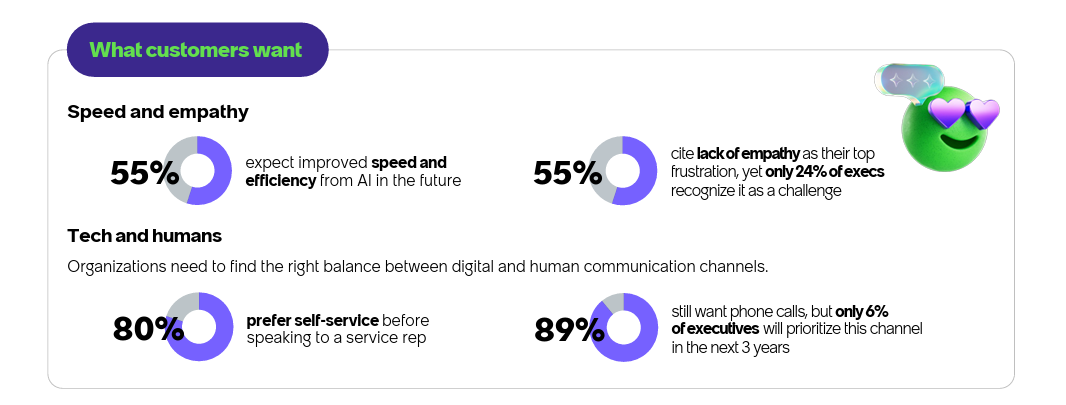
55 per cent of UAE consumers cite lack of empathy as a top frustration. Channel preferences play an important role in this gap: while 8 per cent of UAE consumers prefer phone support, 80 per cent attempt self-service first — but 47 per cent say current chatbots fail to understand their questions or concerns.
Talbot added, “Customers want to feel heard and resolved, not just routed. But that can’t happen when AI and human agents operate in different systems with different views of the customer. The organisations getting this right are the ones connecting their entire operation — front office to back office — on a single platform. That’s when CRM stops being a digital filing cabinet and starts being a revenue engine.”
The real bottleneck is the system behind the service
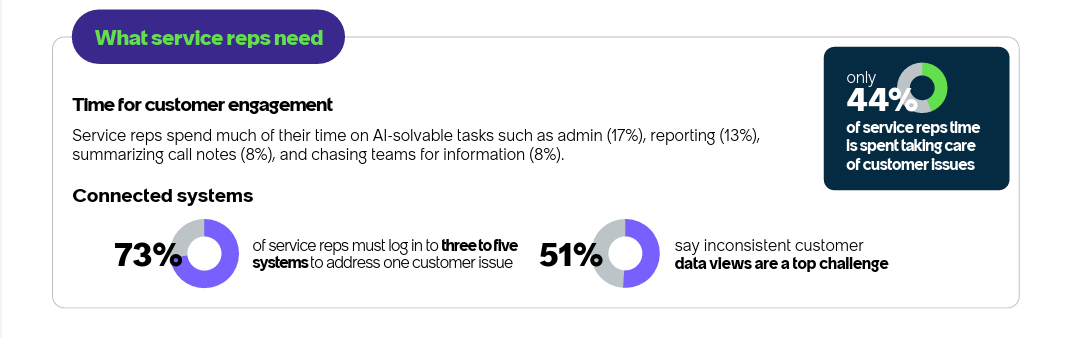
Service representatives are constrained by the environments they work in, slowed down by fragmented systems and processes. Agents in the UAE spend just 44 per cent of their working week on addressing customer issues.
That means the remainder is absorbed by administrative work, system-hopping and chasing information. In the UAE, 73 per cent of service representatives must log into three to five systems to resolve a single issue.
Information is also harder to access in this way, with more than half (51 per cent) of service agents in the Emirates citing inconsistent customer data as a major challenge.
Executives are misaligned with what consumers value
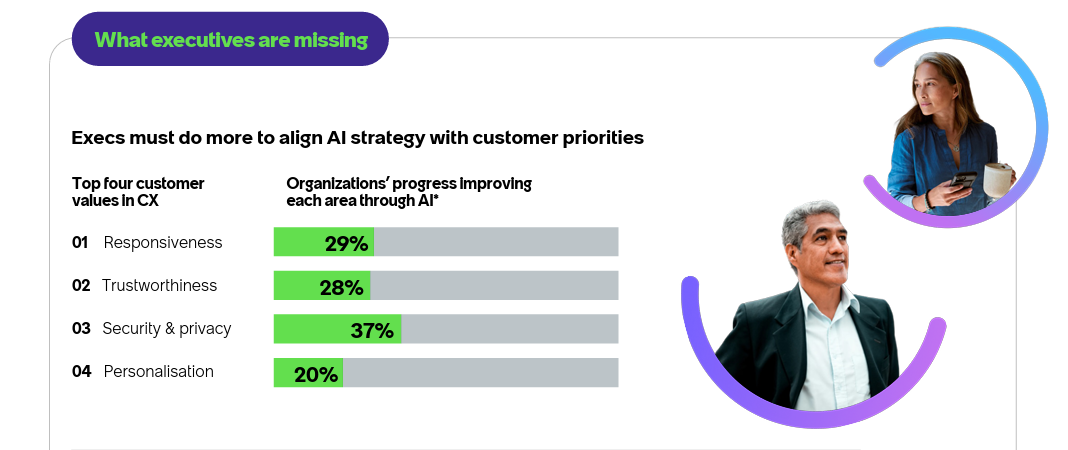
The research reveals a persistent perception gap between what customers want and where senior leaders are focused. Lack of empathy is a top UAE customer frustration (55 per cent), yet only 24 per cent of UAE executives prioritise it.
While half of customers (50 per cent) in the UAE are frustrated by being transferred between departments, 36 per cent of UAE executives recognise it as a significant issue.
AI must unify systems before it can transform service
At the root of these challenges is fragmentated systems that aren’t built for the CRM needs of today.
In the Emirates, fewer than half of organisations (46 per cent) have integrated data across silos into a single source of truth, while less than one in five (19 per cent) have enterprise-wide AI strategies that break down departmental barriers.
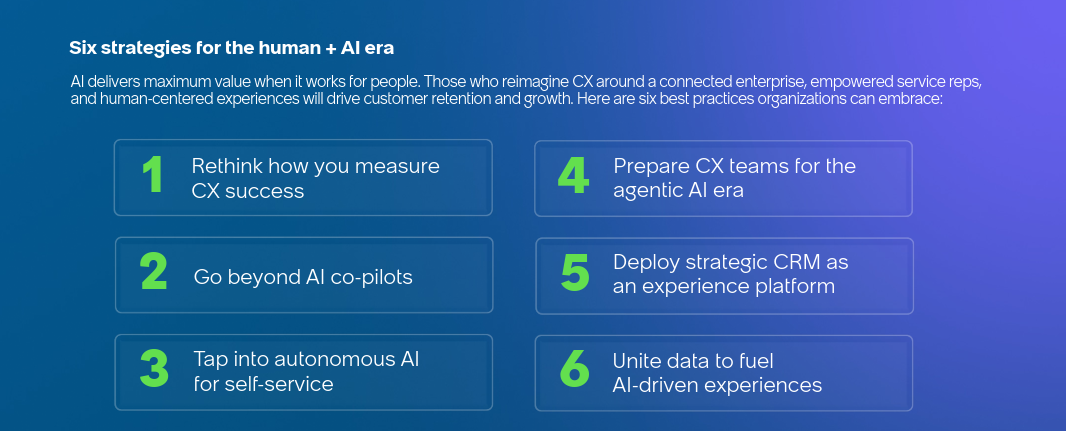
Closing the gap requires AI that unifies data, workflows, and teams — enabling CRM to evolve from a system of record into a system of action.
The research shows that when organisations connect service environments, they can free frontline teams to focus on empathy, clarity, and trust.
Without this shift, AI investments underperform, frontline teams remain constrained, and customers continue to bear the cost through slow, frustrating experiences.
This research was commissioned by ServiceNow in partnership with ThoughtLab, a leading thought leadership and economic research firm, and conducted in accordance with ISO 20252 standards.
Between September and October 2025, the study surveyed 27,250 customers, 3,515 customer service representatives, and 3,900 executives across 18 countries and eight industries.
In the EMEA region, this comprised 14,000 customers, 1,565 customer service representatives, and 1,770 executives across 11 markets: Austria, France, Germany, Ireland, Italy, the Kingdom of Saudi Arabia, the Netherlands, Spain, Sweden, the UAE and the United Kingdom.