Many football clubs have mascots. The thinking is rooted in something football already understands instinctively. Fans are widely recognised as the 12th player: the emotional engine behind the club, present in the stands, belonging to the game as much as anyone on the pitch. The mascot sits exactly halfway between. It is the bridge between the team and the supporters, between the brand and the community, between what happens in ninety minutes and everything the club needs to be for the other twenty-two and a half hours of the day.
Entertainment is everything now. Clubs are no longer just sports organisations. They are media platforms. And a media platform without a persistent, emotionally resonant character is leaving enormous value on the table.
With the 2026 World Cup weeks away — the largest in the tournament’s history, spanning the United States, Mexico and Canada — that argument has never felt more timely. And for the region, it carries particular weight.
Football is about to generate its biggest global audience moment in four years. New fans will be gained. New markets will emerge. And the clubs best positioned to capture that attention will not necessarily be the ones with the best squads. They will be the ones with the strongest identities beyond the final whistle.

FIFA has already signalled where the industry is heading. The 2026 mascots — Zayu the jaguar, Maple the moose, and Clutch the bald eagle — were built from the outset as playable characters in FIFA Heroes, a multi-platform video game launching alongside the tournament.
For the first time in World Cup history, the official mascots were designed not as promotional accessories but as media IP, with a commercial life built into the concept from day one. It is a small distinction that changes everything about how the characters are developed, deployed and sustained. It is also precisely what Dave has been arguing clubs need to understand at the institutional level.
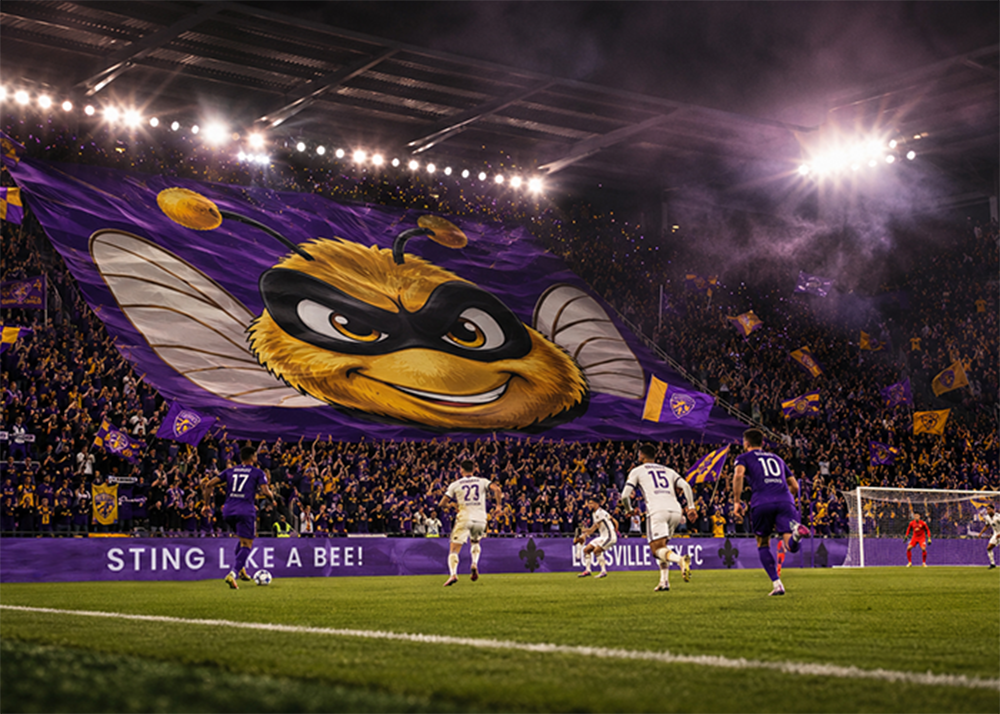
Our team’s most recent work makes the principle tangible. Working with Louisville City FC and Racing Louisville FC, they developed a mascot IP system built around one of the most powerful cultural assets the city possesses: Muhammad Ali.
The concept drew directly from Ali’s most famous line — float like a butterfly, sting like a bee. The result was Float and Sting — a butterfly and a bee, rooted in the personality and legacy of one of sport’s most iconic figures. Not designed as costume characters for matchday entertainment, but as expandable media identities with storytelling depth, cross-channel presence, and a cultural foundation genuine enough to sustain long-term fan relationships.
The mistake clubs make is treating the mascot as decoration. A great mascot is not a visual. It is a character with a world. And a character with a world can go anywhere — gaming, animation, social content, licensing, live experiences. That is what IP means in practice.
The lesson from Louisville is one the Middle East football market is well placed to act on. The most durable mascot IPs are never invented in a boardroom. They are excavated from genuine cultural identity; they belong to the community before they belong to the club. That is precisely what makes them last.
For clubs across the Gulf and the wider region, this conversation can no longer be deferred. Saudi Arabia’s investment in football has been well documented, but infrastructure is not identity. The clubs now attracting global talent and global attention face a harder question: how do you build fan relationships that outlast any individual player’s tenure?
Players transfer. Stars age. Sponsorships end. A well-built character IP does none of those things. It compounds — every piece of content, every gaming integration, every licensing deal adding to a cumulative asset the club owns outright and controls completely. The commercial logic is straightforward. But the emotional logic runs deeper: Football runs on belonging.
Fans do not consume clubs the way they consume films or music. They inherit them, argue about them, pass them down. A mascot that carries genuine cultural meaning can become one of the primary vehicles for that inheritance, particularly for younger audiences growing up in a world where character-led entertainment is the default language.
The 11.5th player has been standing at the edge of the pitch for decades, largely ignored. The clubs that start treating it as a business asset — not a costume, not a campaign, but a fully developed IP with its own story, its own presence and its own commercial life — will not just entertain their fans better. They will build something their competitors cannot easily replicate. That is what entertainment has always really been about.
By Dave Ansari, Founder and Business Strategist, Dream Farm Agency