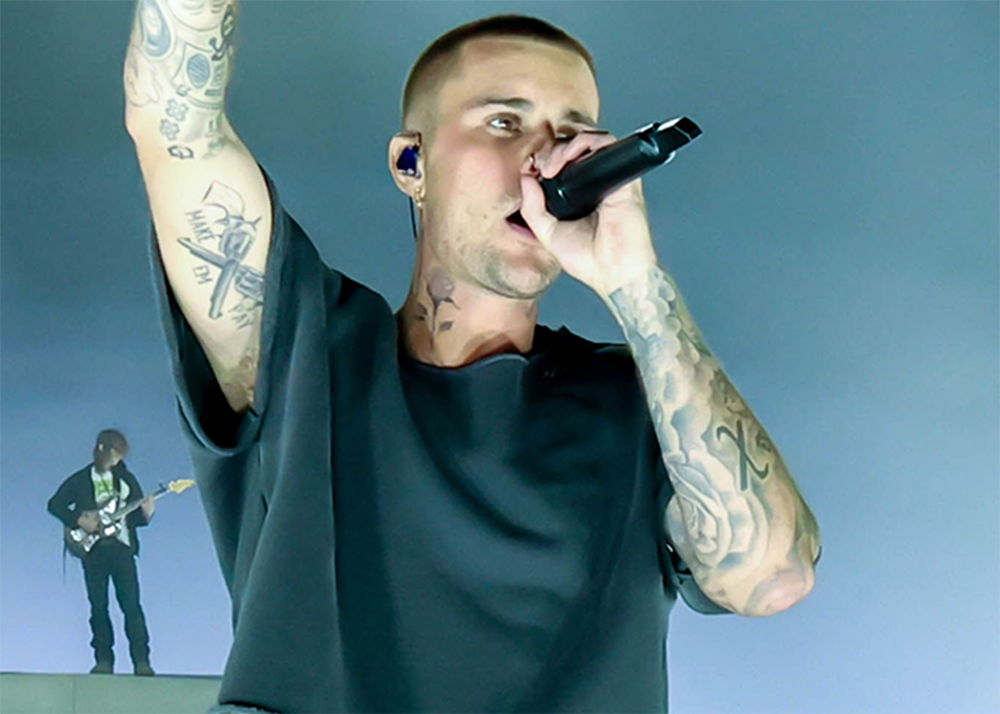
 Justin Bieber performs at Coachella 2026. Image used for illustrative purposes only.
I didn’t expect Justin Bieber’s performance at Coachella to be a branding lesson. But yet here we are. Because somewhere between the stripped back set-up, sunglasses, hoodie and what at first looked like a casual stroll through YouTube, Bieber achieved something that brands spend millions trying to manufacture.
Let’s be clear – this wasn’t low effort. The production, the planning … all of it was a clear creative choice. By leaning into something fragmented and minimal, Bieber created a sense of presence that many of the weekend’s more polished performances lacked. It also reintroduced the star with a new kind of vulnerability, far removed from his peak pop precision.
It was that lack of certainty that made the set so compelling, and so divisive. He subverted expectations in favour of something more human. And the reaction itself was the point. Crucially, it didn’t feel like it was trying to land with everyone. The nostalgia tapped into a shared cultural memory, blurring the line between artist and audience. And it resonated deeply with some precisely because it wasn’t designed for all.
In an era of overproduction and AI polish, Bieber might just have stumbled onto a blueprint that brands should be paying attention to. Bear with me…

In uncertain times, familiarity wins
Not long ago, Bieber’s career was said to be in crisis. And yet, instead of reinventing himself entirely, he leaned into something familiar. Something true. That’s often the instinct brands miss when they face pressure – especially relevant for brands during this period of uncertainty in the UAE – the natural reaction is to move quickly and loud.
But the stronger move is usually the opposite. In times of crisis, audiences don’t want a new version of you – they want reassurance in what they already trust. Going back to your core values and your essence isn’t a step backwards.
Authenticity is more powerful than polish
Perfection is everywhere, and people are craving realness. Overproduced brand experiences can often feel predictable. At Coachella, the most talked about set was the one that subverted expectations.
Imperfect, raw moments are seen as more trustworthy and human. Embracing authenticity, whatever that means for your brand, is the best way to forge deeper connections with your audience.
Why brands must know their audience
The debate sparked by Bieber’s set reveals not everyone ‘got it’. But that doesn’t actually matter. The ones that did connect with the performance, really connected with it. And that was enough.
For brands, the lesson is clear: you don’t need to chase universal appeal in order to have impact. In fact, zeroing in on your target audience often creates deeper, more meaningful engagement than trying to please everyone at once.
Simplicity stands out
In a world where everything is bigger, louder and brighter the instinct is to match this energy. But minimalism is a disruptive force. This is not the age of shouting as loud as possible to be heard, but the dawn of the quiet revolution.
A performer scrolling on a laptop on stage is more interesting, more culturally meaningful, than a complex, choreographed, 20-person dance routine.
Nostalgia is an asset for brands
Don’t overlook the memories and histories of your audience, nor your own legacy. By extension, stop chasing ‘what’s next’. Bieber looked backwards and made it feel refreshingly new. Sometimes brand relevance doesn’t come from reinvention but from reconnection. Bieber’s set worked because it left space for the audience to bring their own memories, context and emotion.
Bieber didn’t try to outdo the spectacle of Coachella. He didn’t compete for the biggest stage moment. Instead, he tapped into something much more powerful – familiarity. He gave his audience a version of himself they already loved. One that felt closer to the kid they grew up with than the polished global superstar.
In a media landscape defined by noise and polish, Bieber’s stripped-back performance stood out. By revisiting his past and embracing a minimalist, unforced aesthetic, he moved forwards into his next chapter in a way that felt refreshingly honest and true to him and his core fans.
Brands today are obsessed with evolution: new visual identities, new platforms, new campaigns. The pressure to constantly reinvent is relentless, because standing still feels like falling behind. But in the pursuit of ‘what’s next’, something often gets lost: what made people care in the first place.
By Danny Rollinson, Senior Account Manager, All About Brands