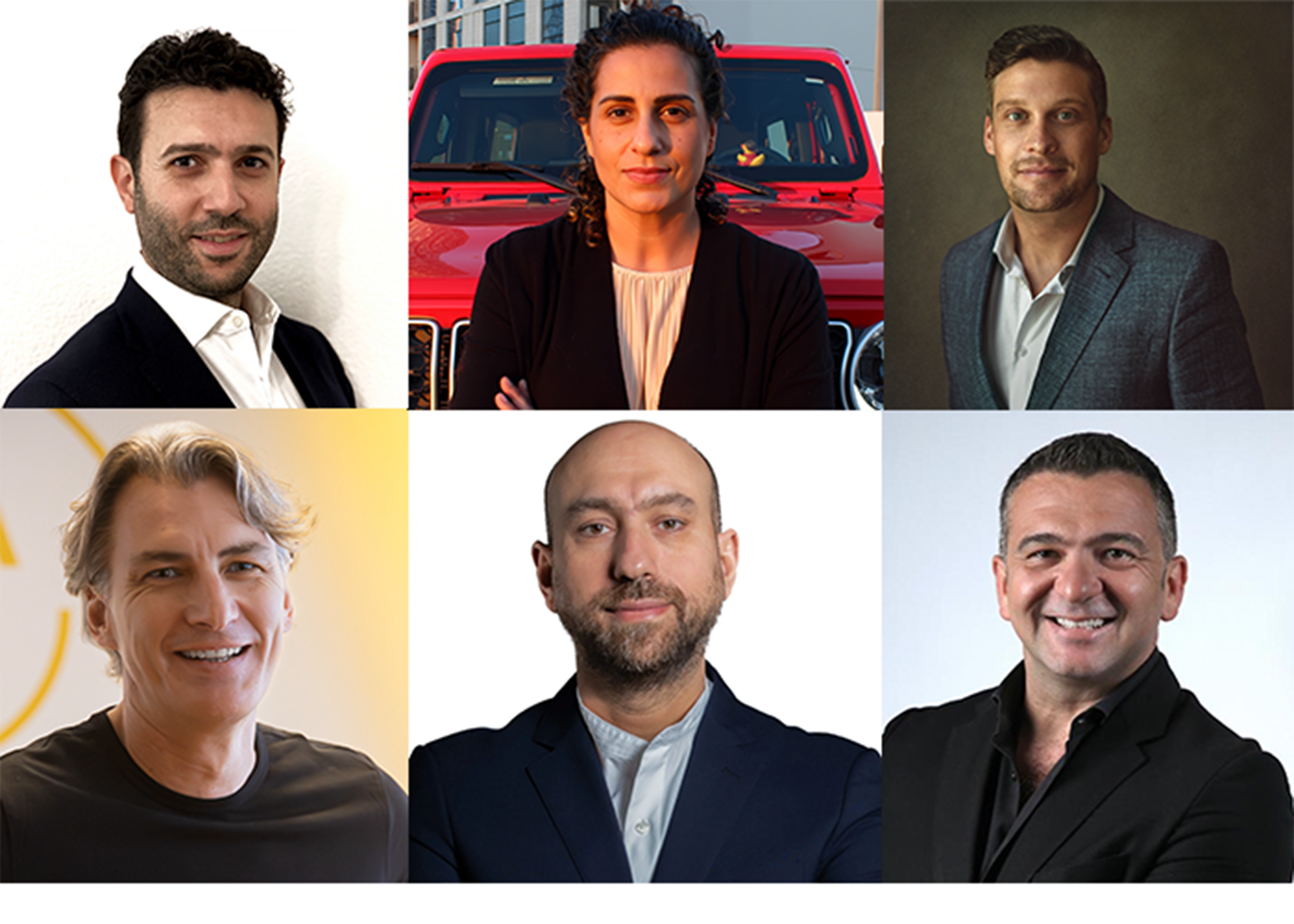
 From top left, clockwise, Nabil Sleiman, Head of Marketing Communications, Almarai; Yara Maroun, Head of Marketing Jeep, Stellantis Middle East; Stuart Randall, Business Director, One Team Stellantis/Publicis Middle East; Nabil Moutran, Founder & CEO, DIVISION; George Maktabi, Group CEO, Webedia Arabia Group; and Derek Green, Chief Creative Officer, TBWARAAD.
For a long time, gaming sat on many marketing plans like a tab left open in the browser: patient, promising and waiting for a ping, but not central to the day’s real work.
Over the past few months, that position has changed drastically in the Middle East.
Several in-game campaigns, branded virtual ecosystems, content integrations, product placements, streamer and creator casts, sponsorship deals, esports partnerships, and discounts and offers within carefully curated digital worlds have become living proof that gaming is no longer a novelty relegated to spare budgets.
Instead, gaming is rapidly growing into an investible space. Brands are moving budgets to virtual arenas where people have already dedicated their time, active attention and emotion. A recent PwC survey reveals more than 23.5 million gamers – approximately 67 per cent of the population – in Saudi Arabia, while another study by Dubai Media Inc and Livewire reveals 7.3 million gamers in the UAE.
However, the exponential increase of brand spend within gaming is not driven by one argument alone. While the audience numbers are hard to ignore in the region, the bigger case being made is about the quality of the encounter.
Gaming is also a space where people are actively moulding their identities. Brands that are winning in 2026 are those that are making themselves relevant and resonant in these defining moments of life.
Presence within gaming environments require framing far beyond billboards that people drive past. Gaming has become a place of belonging – where people gather, compete, unwind and, crucially for brands, connect with those who understand them in their safe space.
Campaign Middle East speaks to client-side marketers and agency leaders about gaming’s coming of age – when confidence, caution and creativity connect consumers with brands that show up in the right manner. But doing it perfectly will mean patience, practice, prevalence and a nuanced understanding of how purpose is communicated and profits are measured.
“Advertising on gaming is expected to grow twelvefold over the next decade. The train is moving”
From the quiet corner to owning the room
The first change is simple: scale has forced a rethink. But scale alone does not explain why gaming is now being discussed alongside more established media choices.
Industry leaders point to a wider shift in audience habits, institutional recognition, and the way brands create avenues for authentic conversations inside these environments.

Nabil Sleiman, Head of Marketing Communications, Almarai, says, “Gaming is no longer a nice-to-have. With gamers making up more than two-thirds of the Saudi population – and Riyadh hosting the 2025 Esports World Cup to 750 million viewers – the numbers have done the heavy lifting. What moved gaming closer to the core was exactly what happened with digital and social media before it: the audience became too large to ignore and the spend projections too serious to put off. Advertising on gaming is expected to grow twelvefold over the next decade. The train is moving.”
George Maktabi, Group CEO, Webedia Arabia Group, agrees with this notion, adding, “Gaming has firmly moved from experimental to strategic. Three shifts drove this. First, the numbers: Gaming is the world’s second largest entertainment community, trailing only football. Second, the industry’s understanding of gamers is maturing by experience. Third, there is a demographic reality that can no longer be ignored: brands must engage early with Gen Z and Gen Alpha. These are native gaming generations.”
Leaders also reveal that brands must take cognizance of how gaming audiences have changed. Gaming no longer attracts a niche demographic – it involves a mainstream, multi-generational and deeply engaged audience.
Brands are beginning to recognise that if they’re not present in gaming, they risk being absent from a significant and growing part of their customers’ lives.

Stuart Randall, Business Director, One Team Stellantis/Publicis Middle East, says, “Gaming has moved firmly beyond experimentation into a strategic channel within the regional mix. What’s changed is scale, but more importantly, attention quality. This fundamentally shifts its role versus traditional media, as gaming offers up deeply engaged audiences in environments where participation is active, not passive. From a defensibility standpoint, gaming competes on time spent, depth of interaction and first-party signal.”
Yet, the shift is not perfectly even. Some sectors are pressing ahead, while others are still treating gaming as an occasional outing rather than an established discipline. On one hand, the ambition is evident; on the other hand, the operating models are often found lacking.
Nabil Moutran, Founder & CEO, DIVISION, says, “The honest answer is that it depends enormously on the category. We’re seeing automotive, FMCG and luxury brands move gaming from the periphery towards genuine strategic consideration – and that shift is meaningful. These are sectors where audience connection, cultural credibility and immersive storytelling matter, and gaming delivers all three in ways that few other channels can match. That said, even among the more progressive brands, gaming is still too often treated as tactical and one-off rather than as a sustained channel with its own distinct role in the mix. The ambition is there; the infrastructure and commitment haven’t always caught up.”
“47 per cent of gamers are more likely to buy from a brand featured in their favourite game. 51 per cent game to disconnect, 21 per cent to destress, and 13 per cent to socialise. That last one reshaped our approach entirely – because it means gaming is not escapism; it’s connection.”
Belonging cannot be faked within gaming
If gaming has moved closer to the heart of the media mix, it has done so on its own terms. The executives repeatedly return to the same refrain: there is a world of difference between turning up and fitting in. A brand can buy visibility quickly, but it cannot buy acceptance overnight.

Yara Maroun, Head of Marketing Jeep, Stellantis Middle East, describes the principle in practical terms, “The most effective gaming integrations play a role and feel natural, not intrusive. Players value experiences that enhance gameplay rather than interrupt it. This thinking shaped Jeep Rescue Squad, where the brand became part of the game’s core narrative rather than a surface-level placement. Because the experience targeted Saudi players, every detail from the Arabised title – أهل الفزعة – to the selected streamer language was tailored to local culture. The goal was simple: create something that genuinely reflects both gaming culture and the energy of Saudi youth.”
Sleiman puts the same point more starkly: “Done right, it should show up consistently. Not four weeks of activation followed by six months of silence. Not showing up for Ramadan and back-to-school and then ghosting for the rest of the year. Authenticity means integrating into the daily life of the community, not interrupting it with a logo slap. It means building experiences that feel like “part of the game,” not promotions dropped into it. Gamers are a community – you either belong or you don’t. And belonging is earned through presence, not spend.”
The line between contribution and costume jewellery is thin. Several of the leaders suggest that the audience can detect imitation faster than many brands realise.

Derek Green, Chief Creative Officer, TBWA\RAAD, says, “Gamers have one of the strongest ‘BS’ radars in culture. They instantly know when a brand is pretending. Authenticity isn’t gamer slang, a streamer partnership or a few controller emojis. It’s contribution. The brands that succeed add something to the experience: a challenge, a tool, a new mechanic or a moment the community wants to engage with. The biggest mistake is treating gaming like just another media channel. When brands imitate the culture from the outside or interrupt the experience, it shows immediately. Do that and you’re not part of gaming culture. You’re just that brand the gaming community mocks.”
Moutran echoes these thoughts but shifts the focus from campaign craft to organisational mindset. He says, “Authenticity in gaming looks like commitment. Not a campaign. Not a moment. A sustained, consistent presence that signals to the community that your brand belongs there – rather than visiting for a quarter and leaving. The gaming community has an exceptionally well-calibrated radar for brands that are genuinely invested versus those that are extracting.”
There are also simple signals that tell people whether a brand has really understood the room.
One is whether the work feels native to the space. Another is whether the people inside that space embrace it rather than merely tolerate it.

Maktabi explains, “Authenticity in gaming starts with one shift: treating it as a culture to engage with, not a transactional channel. Brands that chase big numbers without adding value are immediately rejected by a selective and vocal community that will not stay silent about it. Real authenticity means showing up consistently and co-creating with specific communities rather than broadcasting at them. It is about co-creating communities and growing them. The clearest sign a brand understands gaming is when the community claims and endorses the work as their own.”
Randall sums it up nicely, pointing to two essentials – utility and respect.
He says, “Authenticity in gaming comes down to utility and respect for the player experience. It’s not about inserting brands into gaming spaces, but about contributing meaningfully to them. The clearest signal is when a brand understands gaming culture and it enhances gameplay, whether through mechanics, rewards or narrative integration – without disrupting immersion. In contrast, the biggest mistakes are surface-level executions: forced slang, irrelevant influencer partnerships or treating gaming like another media placement.”
“Avid gamers chase mastery, status and competition inside tight communities. Casual gamers are often there for connection and entertainment. Both are deeply engaged, but in very different ways. That insight changes everything.”
Why gaming holds up even when budgets get tighter
Every emerging channel looks exciting when money is available. But the real stress test comes when finance teams start sharpening pencils.
That is when gaming must prove it is not a decorative extra or a forced fit for future generations, but a well-thought-out strategy that puts brand money to work in ways that certain older habits don’t allow.
Sleiman frames the argument in terms of time and expectation, saying, “When a meaningful share of your audience spends 96 minutes a day gaming – the second-highest average globally – that is not a channel you can afford to step away from while staying on social media or out-of-home (OOH). Gamers are also among the most brand-conscious audiences out there.”
This notion is corroborated by recent research by Newzoo, which shows that 47 per cent of gamers are more likely to buy from a brand featured in their favourite game while 50 per cent of gamers confirmed that they discovered new brands while gaming.
Adding the context of communicating and connecting with audiences in trying times such as the ongoing crisis, Sleiman adds, “If your brand disappears from gaming during a downturn, the community notices – and it remembers. Presence is not just awareness; in gaming, it is credibility.”

Moutran shares the honest truth of how pressure often pushes marketers back towards familiar formats, even when those environments are delivering less depth than they once did.
He explains, “When budgets come under pressure, the instinct is to retreat to the familiar – social, linear, OOH – because they’re easier to justify through legacy frameworks. But gaming offers something those channels increasingly struggle to deliver, which is genuine attention. Dwell times are extraordinary compared with almost any other media environment, and that time is spent in an active, immersed mindset rather than a passive one.”
There is also a crucial challenge here that needs to be addressed, which highlights the way renowned industry brands choose to allocate spend.
If gaming is boxed off as a specialist line on a spreadsheet, it can look more expendable than it really is.
Maktabi explains, “The defensibility question assumes gaming is a separate line item. It shouldn’t be. Gaming spend is social spend. In fact, gamers are among the most active content creators and community builders online. It is also relevant as out-of-home: major gaming tournaments and brand activations fill arenas, generate street-level presence, and create the kind of cultural moments that billboards chase. The brands that treat gaming as an isolated channel will always struggle to justify it. Those who understand it as an amplifier across the entire mix be it social, physical and cultural will not.”
“Gaming is now the number one form of entertainment globally – bigger than music, bigger than film. And within that space, you find Gen Z and millennials not just playing, but socialising, self-expressing, and spending significant portions of their cultural lives.”
The audience is wider, older and more human than the cliché suggests
If there is one thing these leaders agree on, it is that outdated assumptions are now a planning risk.
The stereotypical AI-generated image of a gamer as a young, lazy individual who refuses to get a job and lives in a cluttered environment is completely false.
Sleiman is blunt about the reset required. He says, “The stereotype was the first thing we had to unlearn. A teenage boy in a dark room – that’s not who we’re talking to. Forty-eight percent of gamers are female. Thirty-one percent of hardcore gamers are between the ages of 35 and 44. And 45 per cent of gaming parents are mothers. As for motivations: 51 per cent game to disconnect, 21 per cent to de-stress, and 13 per cent to socialise. That last one reshaped our approach entirely – because it means gaming is not escapism; it’s connection. Seventy percent of Saudi gamers prioritise family time. That’s a human insight, not a gaming insight.”
Green adds, “The biggest misconception brands still make is treating gamers as a single audience. Avid gamers chase mastery, status and competition inside tight communities. Casual gamers are often there for connection and entertainment. Both are deeply engaged, but in very different ways. That insight changes everything. Instead of planning one gaming strategy, brands need to design for the different roles people play inside these communities. The most effective work understands the dynamics of each space and creates ideas people can participate in, compete with or share. In gaming culture, community is the media channel.”
Leaders agree that one of the most important shifts is recognising that gaming isn’t a niche – it’s a behaviour, not a demographic. Equally important is intensity: more than 50 per cent of casual gamers spend more than five hours per week playing, highlighting the depth of engagement even beyond core audiences.
Randall says, “What shaped our approach is understanding that gamers value choice, progression and reward, not interruption. As a result, we shifted our creative towards mission-based experiences, such as Jeep Rescue Squad and our media strategy environments where users actively choose to engage, rather than passively consume.”
Maktabi reaches a similar conclusion from a different angle, drawing on direct access to a large local base.
He explains, “Most marketers rely on third-party data to understand gamers. We have direct access to a community of 5.3 million through our own Saudi Gamer, the region’s largest gaming platform, and we continuously produce original research such as our latest report, Gamers in Saudi Arabia: A Rising Cultural, Economic and Social Force (2025). Three insights fundamentally shape our approach. First, gamers are social animals, highly networked, community-driven, and influential beyond the screen. Second, they are intergenerational, with a significant portion being millennial parents. Third, they carry a compelling tension between tradition and modernity.”
Other leaders suggest a reframe, calling on brands to develop a deeper understanding of the different roles people play in these spaces and what they are looking for there.
Moutran says, “Perhaps the most important reframe we’ve made is this: we shouldn’t be thinking about ‘gamers’ as a target audience at all. The moment you segment by gaming behaviour, you risk missing the bigger picture entirely. Gaming is now the number one form of entertainment globally – bigger than music, bigger than film. And within that space, you find Gen Z and millennials not just playing, but socialising, self-expressing, and spending significant portions of their cultural lives.”
That reframe has practical consequences. It shapes whether a brand builds something people want to enter or simply drops a message into the room and hopes for the best.
“The channel is far more versatile than its reputation suggests, and measurement should reflect that range rather than defaulting to platform engagement numbers that don’t connect to anything a CFO cares about. The core challenge right now isn’t a lack of data – it’s a lack of trust.”
Measuring more than vanity, noise and applause
The final challenge is one every new discipline eventually faces: how to prove value in a way that satisfies both brand builders and finance teams.
Leaders align on one message: dashboard noise is not enough, but neither is simply borrowing old scorecards from television, social or outdoor.
Sleiman says, “It starts by asking the right questions – not ‘how many impressions did we get on the stream?’ but ‘did our relevance shift within this community over time?’ Short-term, you want brand recall, sentiment and search uplift from gaming-adjacent audiences. Long-term, you track cultural relevance: ‘are we being talked about organically?’; ‘are we part of the conversation without paying for every mention?’”
The same scepticism that once surrounded digital measurement now follows gaming. But if it was solved to an acceptable margin in digital, then leaders need to solve it within gaming, as well.
Maroun makes a similar distinction between early signals and the real test later on.
She adds, “Gaming initiatives are often built for long-term brand growth rather than immediate conversions. While launching Rescue Squad, we monitored early indicators such as search activity, though isolating impact is challenging with always-on digital campaigns running simultaneously. The most meaningful metrics come later: unaided awareness, brand familiarity and cultural relevance after sustained exposure. Weekly streams of Rescue Squad offered a unique advantage, allowing us to track real-time reach and observe how many viewers engaged with the brand inside a gaming environment. This consistent visibility strengthened brand presence within the gaming community.”
The longer-term case, however, still must connect back to business effect. That is where several of the respondents see a trust gap: the data exists, but many leadership teams are still learning how to read it with confidence.
Moutran explains, “The first thing to establish is that gaming can be measured across the entire marketing funnel – and that’s still a genuinely surprising statement for many leadership teams. We’ve run campaigns that are purely focused on building brand equity at the top of the funnel, and others where we’ve tracked leads and direct business outcomes at the bottom. The channel is far more versatile than its reputation suggests, and measurement should reflect that range rather than defaulting to platform engagement numbers that don’t connect to anything a CFO cares about. The core challenge right now isn’t a lack of data – it’s a lack of trust.”
Randall concludes, “A credible measurement framework in gaming must balance engagement depth with business impact. This is especially critical in high-growth markets such as Saudi Arabia, where the gaming industry is projected to exceed $2.2 billion by 2030, reflecting sustained commercial scale.”
He adds, “In the short term, we look beyond impression metrics and rather towards active participation, completion rates, repeat engagement and time spent. These indicate real attention and interaction. Longer term, it’s about linking these experiences to brand lift, consideration and ultimately conversion, often through first-party lead data and then retargeting ecosystems.”
All in all, the message from the marketers and industry leaders is clear: gaming must neither be treated like Harry Potter’s magic wand nor as a fashionable Roblox badge to pin onto a campaign. The call is to treat gaming as a serious environment with its own rhythms, expectations and rewards.
The question is no longer whether gaming matters or whether it drives ROI; the more useful question is whether brands are prepared to do what the space asks of them. This means recognising the breadth of the audience, designing for participation rather than interruption, and understanding that acceptance is built over time, not bought in a burst.
Gaming is clearly moving from the edges of the marketing map to the main roads. But the brands most likely to benefit will not be the ones that merely redirect spend. They will be the ones that learn the terrain, respect the people already there and build a way of measuring success that captures not just noise, but lasting value.