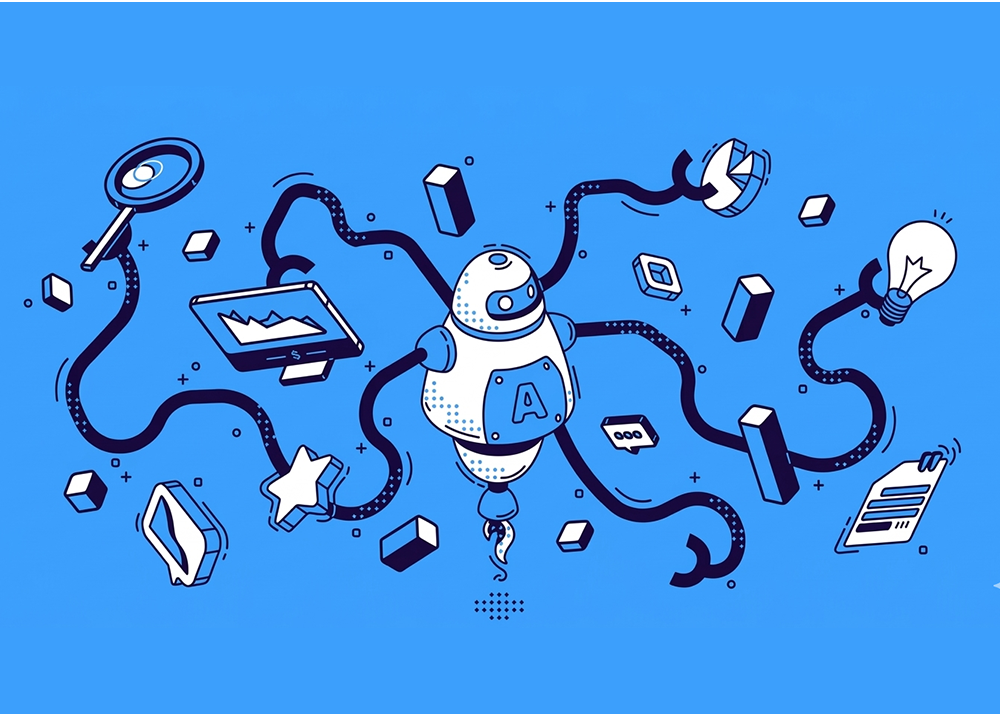
AI this and AI that, at some point it all becomes a bunch of word soup. But beneath all the jargon and complexity sits a fairly simple reality: not all AI is the same, and not every tool deserves a place in your workflow.
So before you download your fifth “game-changing” app of the week or decide to learn a brand new AI tool, here’s a clearer way to understand how the ecosystem actually fits together – and where each tool earns its keep.
The five stages to AI
Think of AI less as one thing, and more as a ladder – each step adding more autonomy, complexity and, occasionally, confusion.
Starting with the basics. There are five stages to AI.
- The Large Language Model (LLMs)
This is the most common form of AI and where most of us live day-to-day. Tools like ChatGPT, Claude, Gemini fall into this category and the model is as simple as – You ask, it answers.
These tools write, summaries, brainstorm and translate. They are the default starting point for any tasks that begins with a blank page.
2. Agentic AI
This is where AI stops talking, and starts taking action.
Instead of simply answering your questions, and generating text, these tools execute tasks, i.e. they do the job for you. Agentic AI can perform multi-step tasks autonomously, this can range from building presentations, generating images, editing videos and so on.
These tools are tools are action-oriented and output-focused.
3. Multi-agent
This the part where all interfaces work together, there isn’t just one agent, there’s multiple. One researches, one creates, one published. These agents delegate to each other and work together
Tools and ecosystems are emerging around this idea, often built using open or commercial models like Llama or DeepSeek.
4. Artificial General Intelligence (AGI)
This is when AI can match or exceed human cognition. It can strategies like a CEO, create like an artist and so on. And it does so out of its own learning.
It is the buzzword that refuses to leave the group chat – widely debated and often overstated.
According to experts we’re not there yet. While today’s AI tools are powerful, senior leaders across the industry argue that these tools rely heavily on human direction, taste and context – three things that no model is able to fully replicate. Thus, as it stands AGI is currently theoretical.
5. Super Intelligence
This is the “let’s not panic just yet” category. AI that surpasses human intelligence across all domains. It’s theoretical, heavily debated, and not something you need for your next campaign pitch.
The AI ecosystem, simplified
We treat everything like separate tools – when most of them are actually features inside bigger platforms.
These are your daily AI workspaces i.e the brain. This is the place users type, think, brief, and refine.
- ChatGPT
- Gemini
- Claude
- Perplexity
- Grok
- DeepSeek
Inside the brain lives the integrated tools, you do not go to these tools seperately, they live within the interface.
| Ecosystem (Platform / Provider) |
The Brain (The Core Model) |
Integrated Tools (The “Departments”) | Why Marketers Care |
|---|---|---|---|
| Gemini 3 | Nano Banana (Images), Veo (Video), NotebookLM (Research) | The best for connected workflows. You can research a brief in Notebook, then generate the visual assets in the same place.
As it describes itself: I’m an adaptive, multi-modal collaborator that helps you think, create, and refine across text, image, and video. I’m the “invisible partner” that turns your rough ideas into polished, technically precise reality. |
|
| OpenAI | GPT-5 / o1 | DALL-E 3 (Images), Canvas (Writing/Coding), SearchGPT (Web) | The all-rounder. It’s for drafting strategies and generating quick, high-quality visuals.
As it describes itself: I’m ChatGPT, an AI built by OpenAI to help with writing, research, and problem-solving. I generate responses by recognising patterns in language to give useful, relevant answers. |
| Anthropic | Claude 4 | Artifacts (Real-time Previews), Computer Use (Agents) | The human-centric writer. It’s better at following a brand’s specific tone of voice and building mini-apps for internal team use. |
| X (Twitter) | Grok-3 | DeepSearch (Live Facts), Image generation via external models like Flux | The real-time engine. If a trend starts in Dubai at 10 AM, Grok knows by 10:01 AM. Best for staying “on-trend” and viral news. |
| Perplexity | Perplexity AI models (Sonar) | Pages (Instant Articles), Collections (Data Folders) | The fact-checker. It doesn’t just guess; it reads the live web and cites its sources. Perfect for finding accurate market data and statistics. |
| DeepSeek | R1 / V3 | API access, open-weight models (often embedded in third-party tools) | The efficient operator: A low-cost, high-performance alternative for analysis, automation, and building private AI systems at scale.
Agencies use it to build Private AIs because it’s much cheaper than GPT but just as smart at analysing 100s of media reports. The outlier: Unlike Google or OpenAI, it isn’t a full ecosystem. It’s a model-first player – used to power custom tools, not replace them. |
The “Specialist” Freelancers (no ecosystem)
These don’t have a “General Brain” for talking or planning. They are highly skilled “Freelancers” that do one technical job perfectly.
| Specialist Tool (The App) | The “Engine” (The Model) | What it Actually Does (The Job) | Why Marketers Care |
|---|---|---|---|
| Canva AI | Magic Studio 2026 (Integrated) | Content Factory: Automatically generates on-brand carousels, presentations, and resizing assets for every platform in one click. | Speed at scale: It’s the “Brand Guardian.” It ensures 50 different social tiles all use the exact same brand red and logo placement. |
| Luma | Ray 3 (Reasoning Video) | Cinematic Motion: Generates 4K HDR video that understands “physics” | Is leading in arabic signage, can create high-end video ads and Reels.
It has a Character Reference feature that keeps brand ambassador’s face and clothes identical across 10 different video clips. |
| Adobe Firefly | Firefly Video & Image 5 | It lives inside Photoshop. It’s for expanding your grid, fixing backgrounds, and pixel-perfect editing. | The precision editor: “Generative Fill” and “Generative Extend” let you add 2 seconds to a clip or change a model’s outfit without reshooting. |
| Midjourney | v8 Alpha (High-Def) | Artistic Vision: Produces native 2K resolution images with 3D spatial logic that look like professional photography or high-end digital art. | It produces lighting, textures, and compositions that look like a $50k photo shoot.
Marketers use it for hero assets – magazine covers, high-end billboards. |
To summarise:
AI isn’t a collection of tools anymore. It’s a layered ecosystem – where the interface you choose determines everything that follows. Which raises a more useful question for marketers: not “Which AI tool should I try next?” But: “Which ecosystem do I actually want to build my workflow around?”
The Ecosystems are better for workflows, but the Specialists are better for artistry.
If you need a viral video that understands real-world physics, you want the Ray 3 engine inside Luma. If you need 100 Instagram posts that follow your brand book perfectly, you want the Magic Studio engine inside Canva. Want to generate a realistic image, use Gemini’s Nano Banana.
Okay class has come to a conclusion, stay tuned for the next session where we further breakdown the AI ecosystem and make it all finally make sense.