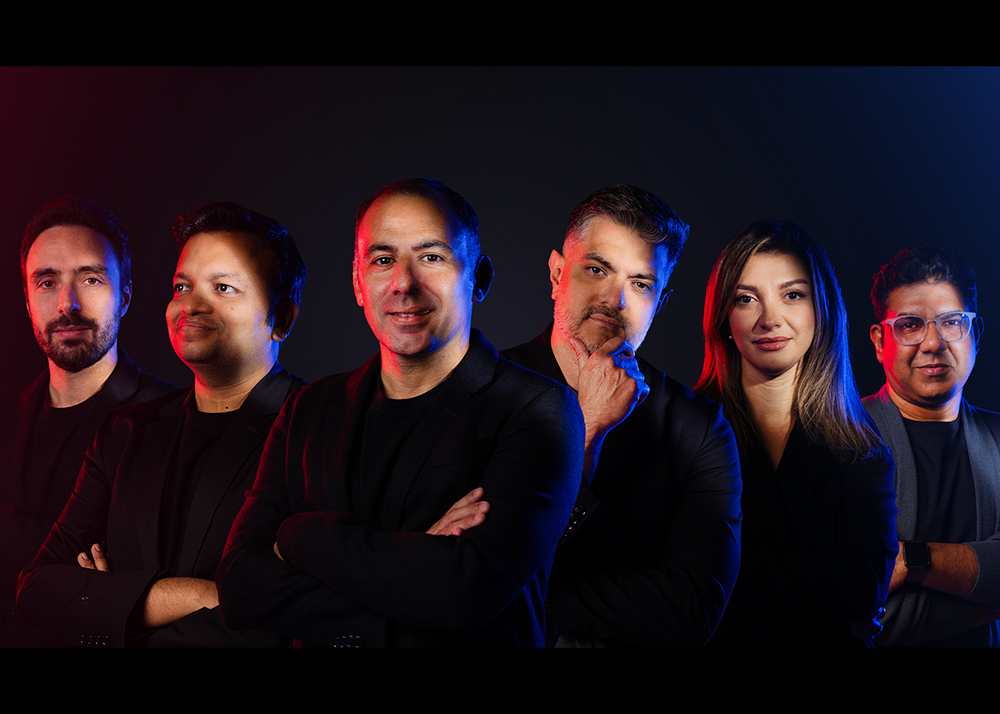
 From left: Lucas Rodrigues, Client Partnership Director; Rahul Datta, Director of Media; Ahmed El Sherbini, CEO; Tiago Bastos, Creative Director; Anastasia Younes, Director of Strategy; and Kartik Aiyar, Creative Director, Think Human.
Across strategy, creative and client partnerships and most importantly culture, artificial intelligence (AI) seems to be deeply embedded into the way Think Human works. The fully integrated communications consultancy considers itself far more than an agency; it is built, and chooses to operate with a people-first mentality as partners, collaborators and consultants committed to client growth.
So, where does AI fit in? Not to replace thinking, the leaders clarify in conversation with Campaign Middle East, but to remove friction, challenge the obvious, and create more space for human judgement, perspective and debate.
Strategy: Testing the obvious
At Think Human, AI is used to accelerate research, analyse competitive landscapes and surface patterns at scale. But insight doesn’t come from the output alone. “AI is the best ‘worst strategist’ I’ve ever worked with,” says Anastasia Younes, Strategy Director, Think Human. “It can generate a hundred insights in seconds. Most of them are predictable. But a few force you to stop and rethink whether what you assumed was true.”
What once took weeks of research, analysis and synthesis can now be generated in a single day, using the right tools and the right prompts. The harder part, the team says, isn’t access to information. It’s uncovering the insights, tensions and human truths that no machine can surface on its own.“
AI helps us stress-test the obvious,” Younes explains.“ It challenges the brief, exposes bias and removes ego from the room. But the final leap still comes from gut instinct, experience, expertise, empathy, and understanding human behaviour and nuance. That’s not something you can automate.” Strategy, she adds, still relies on human synthesis. Connecting culture, context and brand truth is where ideas are shaped. AI simply creates the space to ask better questions, faster.
Creative: Expanding imagination, not replacing vision
For the creative team, AI has changed speed, not authorship. “People assume AI threatens art direction,” says Tiago Bastos, Creative Director, Think Human. “But art direction is about intent. It’s knowing why one image feels right for this brand, in this market, at this moment. AI can generate options. It can’t feel.”
At Think Human, AI is used to expand creative exploration, visualise ideas earlier, and bring territories to life faster. Where teams once explored a handful of directions, they now explore dozens. Yet, the filtering is entirely human.
“The idea always starts with a person,” Bastos adds. “A human prompt, a human perspective, a human decision. AI accelerates the journey. It doesn’t define the destination.” Speed, he notes, has become a creative advantage.
Faster iteration means more learning, more refinement and more opportunities to land on work that feels culturally relevant rather than generically impressive.
Client partnerships: More time for humans, less spent on admin work
AI’s impact is perhaps most visible behind the scenes. In client partnerships, Think Human uses AI to automate repetitive tasks, streamline workflows and remove operational drag.
The result is not efficiency for efficiency’s sake. “AI gives our teams back time,” says Lucas Rodrigues, Client Partnerships Lead, Think Human.
“Time to think, to build relationships, to have better conversations with clients, and to focus on the bigger picture rather than daily admin.”
“By reducing noise, AI allows client teams to do what matters most: understand clients as people, not just projects, and act as strategic partners rather than task managers,” he adds.
Different perspectives still make a difference
Across every department, one belief is shared: AI doesn’t create differentiation. People do.
“What makes the work travel isn’t the tool,” Younes says. “It’s the discussion. The disagreement. The different perspectives in the room. AI helps us get there faster, but it doesn’t replace the thinking that makes the idea meaningful.”
“At Think Human, AI is treated as a tool. A powerful one. But still just a tool. The moment you mistake the tool for the craft, you lose the plot,” Younes adds. “Our job isn’t to compete with AI. It’s to use it to become more human.”
All in all, the irony isn’t lost on the team: Although Think Human has gone all in on AI, they still believe that in a world of shared tools, it’s human perspective that will always make the difference.
Think Human operates in Dubai, Abu Dhabi and Cairo. To get in touch with the team you can dial +971 50 692 2316 or visit thinkhuman.ae