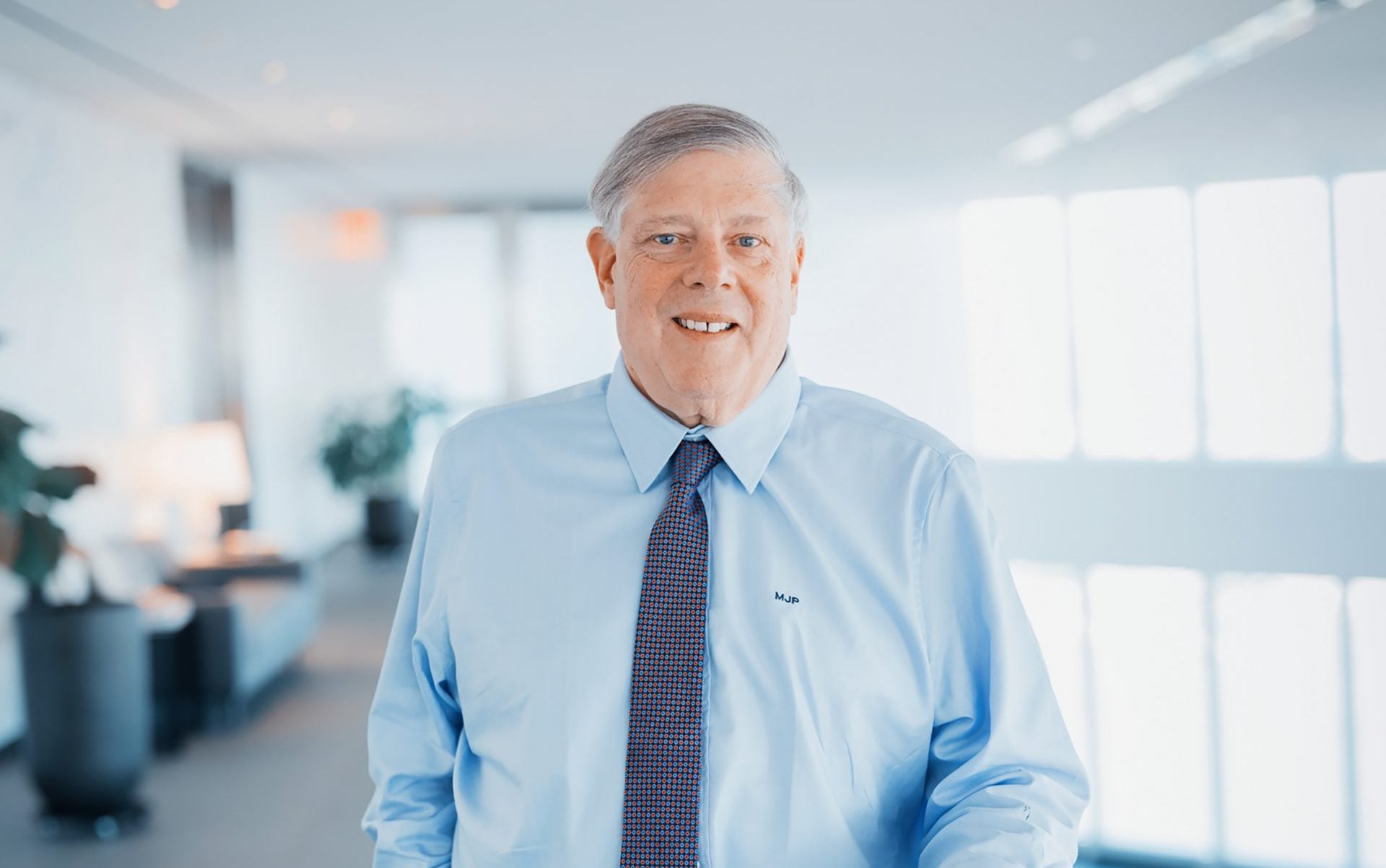
 Mark Penn, Chairman and CEO, Stagwell.
Over the past 12 months, top headlines in the global brand and marketing industry have revolved around massive mergers, C-suite churn, cut-throat competition and global accounts awarded – and lost. All of this was amidst trade and tariff tensions, geopolitical undercurrents and inflationary pressures, highlighting an inflection point in the advertising landscape.
Few holding companies and networks have held their own and sailed smoothly over the stormy seas, and fewer leaders have remained optimistic and bullish on growth.
Finding one that ticked both those boxes, Campaign Middle East sat down with Mark Penn, Chairman and CEO of Stagwell – a NASDAQ-listed holding company with more than 13,000 employees – shortly after the company reported an 8 per cent uptick in net revenue, year on year, to $598m in the second quarter of 2025.
Reflecting on growth and expansion
Apart from the chatter around recent client wins – including Samsung, New Balance, Volkswagen and ServiceNow, which spearheaded its 104 per cent year-on-year increase in total client wins in Q2 2025 – Stagwell also made waves in the Middle East following its acquisition of Create. Group, a strategic digital communications group in the region.
This move added a feather to Stagwell’s cap of strategic acquisitions, which include pan-MENA agencies such as social and influencer marketing agency LEADERS, and government and corporate advisory agency Consulum, as well as other global names such as Business Traveller (Global), JetFuel (US), Team Epiphany (US), BERA (US), Luxine Relations Publiques (Canada), UNICEPTA (Germany), PROS (Brazil), What’s Next Partners (France) and Sidekick (UK).
When asked what sets Stagwell apart, Mark Penn, who has more than 40 years of experience in market research, advertising, public relations, polling and consulting, said, “I built Stagwell to be a challenger holding company that’s nimble, digital-first, and focused on delivering transformative work for our clients. Our competitors are getting bigger, but clients aren’t looking for another behemoth. They’re looking for top-shelf creative agencies with tech-savvy capabilities and holistic marketing services. Brands see this in Stagwell and are excited to work with us. The market is ripe for penetration, and it is a great time to be a challenger.”
Clearly, Stagwell is far from done. Through the conversation, Penn alluded to the holding companies long-term ‘5 x 5 plan’, which looks to achieve $5bn in annual revenue by the end of 2029 while increasing international revenue outside of North America.
Penn said, “We’re laser-focused on growing our offering, scaling around the globe and innovating at the frontier of AI and technology. The Middle East is a key part of our long-term plan. We have outstanding agencies in the region already and are focused on expanding our physical footprint and offering in the Middle East and North Africa (MENA) region to compete for larger global creative and media opportunities.”
Stagwell MENA’s regional footprint now includes strategic digital communications company Create. Group, government and corporate advisory agency Consulum, creative collective Forsman & Bodenfors, omnichannel media agency Assembly and influencer marketing agency LEADERS .
Penn added, “We’re investing in our leadership in the region to drive regional growth initiatives. We’re continuing to pursue public and private sector opportunities both in the Middle East and more broadly across our network as we build toward more multi-year, multimillion dollar contracts. And we’re growing our footprint – expanding our presence in the Middle East from fewer than 50 employees less than three years ago to more than 600 today.”
FUN FACTS
For six years, Mark Penn served as a White House pollster to then-US President Bill Clinton and was chief strategist of Bill Clinton’s 1996 re-election campaign. He is widely acklowedged for developing the concept behind ‘Soccer Moms’. Penn also served as chief strategist to Hillary Clinton throughout her Senate campaigns and 2008 presidential bid.
An ounce of optimism and a sprinkle of ‘magic’
The conversation circled back to global geopolitical volatility and economic pressures – specifically at a time when several economists have voiced muted growth expectations – and how this will reflect on the upward trajectory of the Middle East brand and marketing industry.
Pouring more than an ounce of optimism into the conversation, Penn said, “I remain bullish on growth in the Middle East. MENA is one of the fastest-growing regions in our portfolio and a key strategic region for global marketers. Marketers who are not investing in MENA, especially given its more than 200 million digitally savvy young people, will miss out on one of the biggest consumer growth stories in the world. The MENA marketing landscape is ripe for disruption. We’re taking steps to build a robust portfolio of challenger agencies who are collaborating to transform the marketing services industry in the region.”
He added, “Of course, if there’s a global economic downturn that would affect our business; it would affect every business. However, based on what we’re seeing so far, I remain optimistic about our growth and believe we are well-positioned to take advantage of changes in the industry, especially in the Middle East.”
When cross-questioned about what specific changes he’s excited about in the industry, Penn pointed to sports – a $600bn industry in the Middle East that is projected to grow by approximately 9 per cent by 2030.
Penn said, “From F1 races to the FIFA World Cup, the region presents an immense opportunity for marketers – that’s why we recently launched Maydan Sports, a global sports engagement collective aimed at combining world-class marketing and immersive tech to help brands elevate their presence in the region.”
“Maydan Sports draws on the collective strength of several award-winning Stagwell agencies, including Consulum, ARound, Assembly, Code and Theory and Gold Rabbit Sports,” he added.
“Marketers who are not advertising in the news are missing out on a key quarter of the population who check the news five or more times a day.”
Quick-fire wisdom from the Stagwell Chairman & CEO
While we still had him on the hot seat for a final few minutes, Campaign Middle East picked Penn’s brains with a quickfire round of questions:
Should advertisers get back to linear TV and traditional channels such as news?
“Misinformation and disinformation are definitely valid concerns. But the whole brand safety notion has been blown completely out of proportion to the point where marketers are not placing ads in news,” Penn said.
He suggested that marketers pay closer heed to in-depth reports such as Stagwell’s 50,000 -respondent study Future of News research, which showed that it makes no difference to the consumer whether an ad is placed next to news, sports or entertainment.
“The same study in the UK had similar findings,” Penn added. “In fact, marketers who are not advertising in the news are missing out on a key quarter of the population who check the news five or more times a day – a cohort I like to call ‘news junkies’. So, I think advertisers need to take a look at their ad spend and run tests in news – not only to support quality journalism and combat misinformation and disinformation but to support their business goals and reach a really premium, engaged audience.”
What are your top take aways from Cannes Lions 2025?
“My top takeaway from Cannes this year is that people are hungry for next-level creativity. With AI everywhere, there’s a premium for human-led creativity, with creatives now having access to cutting-edge tools at record-low costs. All across the Croisette, brands talked about connection to communities and authenticity,” Penn said.
This notion echoed campaigns highlighted at Stagwell’s SPORT BEACH at Cannes Lions. This included 72andSunny’s ‘Somebody’ campaign for the NFL, which featured NFL players mentoring children in hyperlocal communities through the NFL’s partnerships with Big Brothers Big Sisters of America, Special Olympics and the InSide Out Initiative. The ad was ranked in the top three in The New York Times’ roundup.
“People are really craving those memorable ads and innovative creativity,” Penn added, citing another example – ‘Frank’s RedHot’ Super Bowl campaign featuring Paris Hilton from another of Stagwell’s creative agencies, Colle McVoy, which encouraged consumers to interact with the hot sauce brand by sharing pictures and videos of their custom-made, personalised recipes.
Concluding the fascinating conversation with the best-selling author of a pair of marketing insights books, Microtrends: The Small Forces Driving the Big Disruptions Today and Microtrends Squared: Small Forces Driving Today’s Big Disruptions, we asked:
What recent trends have stood out?
“There has been a surge of experiential and personalisation,” Penn said, “Agentic AI has now advanced to become hands-free, with brands presenting demos of their immersive AI-powered worlds and try-on wearables.”
“However, even with all the talk of AI, creative remains the foundation of consumer experiences, and experiential is an extension of that. It’s when AI pushes the bounds of creativity that the real magic happens,” he concluded.