Forty-one students have their eyes-fixed on course instructor David Ford at the CNN Academy Abu Dhabi as he outlines the agenda for the three weeks of intensive journalism training they are about to embark on. From daily assignments, to planning news programming, the Academy, hosted in partnership with Abu Dhabi’s Creative Media Authority, sets out to train these budding storytellers into broadcast-ready reporters.
I’m watching from a seat in the far corner of the room, as an embedded journalist, to observe how these students listen, take in, interact and apply their learnings to tackle everyday journalism tasks and enhance their reporter-required skills.
The real win? One of them who exemplifies their learnings from the Academy the best, will be offered the opportunity to return to CNN for a six-month-long internship at the news network.
The CNN Academy launched in Abu Dhabi in 2021 with a clear intention: train regional storytellers to meet global standards of news reporting in a world filled with citizen journalism and content creators. Since then, 165 participants – 95 of whom are Emirati – have been upskilled by internationally seasoned journalists to what Aysha Al Jneibi, Director of Talent Management at the Creative Media Authority, calls “the CNN standard.”
Al Jneibi adds, “This investment strengthens the region’s communication infrastructure, ensuring that media professionals are not only technically skilled, but also culturally aware and globally competitive.”
Back to my corner in the classroom, I’m told that the fifth edition of the CNN Academy will bear the theme: ‘Community Storytelling’, with a goal to create a new generation of storytellers who reflect the UAE’s values and tell stories that resonate globally.
As the weeks go by, I discover exactly how the CNN Academy is designed to achieve this, how much of its training sticks, and how it all comes together in a grand finale known as ‘Simulation Week’.
Week One: Unlearning and relearning
During Week One of the Academy, Ford explains how a daily morning news beat is laid out. He tells the students they’re in a CNN-style editorial meeting and asks them to place 10 stories in order of newsworthiness on the rundown ahead of the daily broadcast.
Sarah Satari, a PR professional and student at the Academy, listens intently and raises her hand to voice her opinion among the chorus that follows. When the session concludes, she tells me that it opened her eyes to what traditional journalists value in a story – truth, context and public interest – which differs greatly from her experience of how PR professionals categorise or order the value of stories based on the likelihood of engagement and reach.
“From my experience in PR, if you’re getting the content views, it doesn’t matter what the context is. When it comes to journalism, storytelling has a lot more layers to it,” Satari says. “It’s more about the value and purpose behind the story and what you can do with it in terms of context for the public.”
When I nudge her for another key take away through her lens, she adds that she picked up on the elements of newsworthiness that matter to different sets of mass audiences, and how to position these stories in ways that are honest while maintaining integrity for the public interest.
Through the rest of Week One, students learn how to write scripts, interview civilians in the field, and report on stories that reflect several different communities.
View this post on Instagram
Week Two: Hands-on skills training
In Week Two, the decks, presentations and fascinating conversations translate into on-ground action. The Academy’s curriculum unfolds like that of a highly condensed, yet a lot more hands-on version of a university degree in journalism.
Students are taken through intensive training and workshops on ethical frameworks, interviewing techniques, video editing, on-camera reporting and fact-checking protocols.
These sessions are presented to the young cohort by veterans in the broadcast media landscape, including Becky Anderson, Eleni Giokos, Luke Henderson, Glen Mulcahy, Alireza Hajihosseini and Laura Ford. Some of CNN Academy’s alumni also take the stage to share from experience how storytelling can shape realities.
“Right now, anyone with a phone in their pocket is a content creator,” says Hajihosseini, the Academy’s Director. “The barriers to entry are gone. We’re no longer the traditional gatekeepers of information.”
He explains that the CNN Academy’s purpose is to teach students how to frame a story before the camera turns on. Whether these students go on to become celebrated broadcast journalists or social media content creators, Hajihosseini reiterates the importance of truth-telling, trust and credibility across the information landscape.
“As long as that content is factual, follows an acceptable set of reporting guidelines that producers, storytellers and journalists both on-air and off-air agree on – that’s our job done,” he says.
In today’s global and regional media landscape, where everyone has an opinion and shares these opinions across traditional, digital and social media channels, these frameworks matter more than ever. This comes into sharper focus in an era when the amount of slop generated by artificial intelligence (AI) is ever increasing.
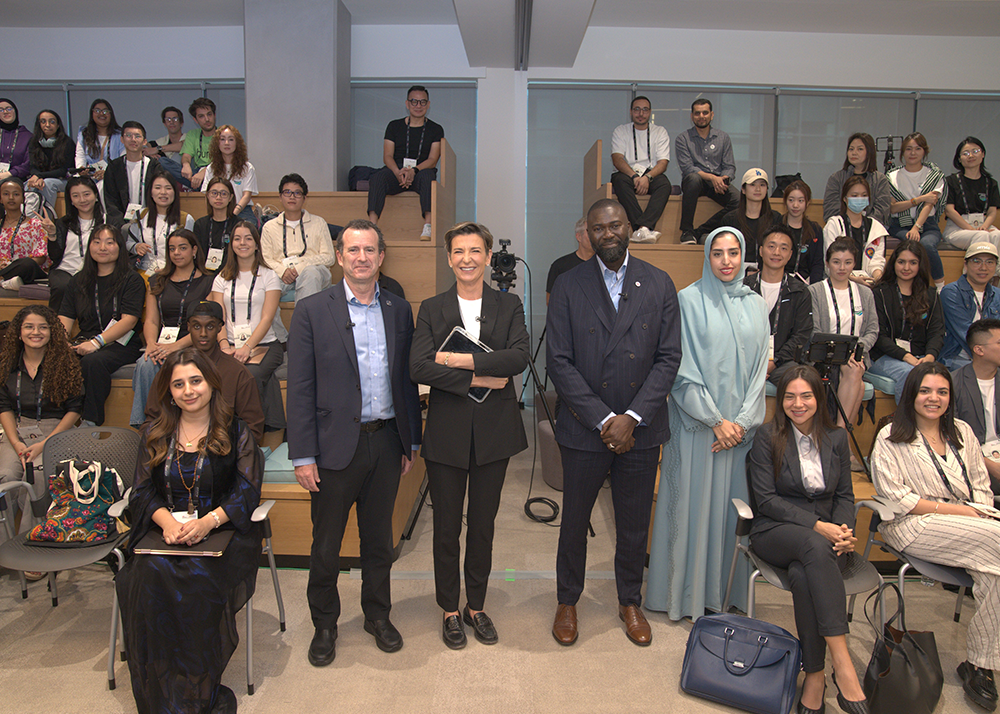
Becky Anderson, Managing Editor of CNN Abu Dhabi, explains, “AI has exploded the amount of content available. There’s a tsunami of content out there. The real question is: Can we trust it?”
Now, 30 years into her broadcast journalism career, Anderson tells students at the Academy that everything has changed, and yet nothing has changed.
In her words: “The tools evolved. The fundamentals didn’t.” It takes a second, but let that sink in. “When it comes to the basic tenets of journalism, they still are – and have always been – trust, truth, empathy and compassion.”
Those fundamentals resonate deeply with the cohort’s students.
For Muhamad Hani, an Emirati student at the Academy, a key takeaway from Week Two is how media literacy is essential for even the regular, everyday citizen – not just for journalists and independent media professionals.
“The facts within the news are very important, and how you receive and share this news matters,” he says. “But to reach that stage, everyone must know the difference between real news and ‘news that’s just for clicks’.”
By the end of week two, the class is adept at not only differentiating real news from fake news and sensationalised news, but has also learned how to ‘go straight to the source’, conduct interviews on camera, read from a teleprompter, write scripts for news packages, edit videos and conduct themselves professionally in a live broadcast setting.
While the sessions are extremely informative – almost overwhelmingly so – the real lessons often took place in the fringes; the real takeaways are gathered in moments when instructors imparted feedback on students’ work.
Week 3: Simulating skills on set
The adage ‘true learning lies outside one’s comfort zone’ is put to the test during Week 3, when students are taken outside the confines of steady walls and shown a world where the walls are almost crumbling around them.
This happens in ‘Brynania’ – a fictional country created by political science professor Rex Brynen along with thousands of his students – that teaches future journalists the complexity of reporting on-ground in the midst of an ongoing civil crisis.
“You can sit down in a classroom and learn an awful lot about journalism,” says Brynen. “But until you’re really under pressure in a chaotic, tense, complex environment, you’re not really testing those skills.”
Unsurprisngly, and true to the name of the ‘simulation week’, students are thrown into situations where they have to think and act on their feet, including a mock live press conference, reporting amid the carnage of live civil demonstrations, and figuring out how to keep themselves safe in a chaotic environment.
Above all, they must find trusted sources of information – separating fact from misinformation, disinformation and sensationalised, emotional viewpoints – and share their findings in live reportage amid the tense and constantly evolving landscape.
Carrying their preparation from CNN and the Johns Hopkins Center for Humanitarian Health, and their camera equipment, students set out to navigate the crisis environment of Brynania safely, reporting on their surroundings ethically and truthfully.
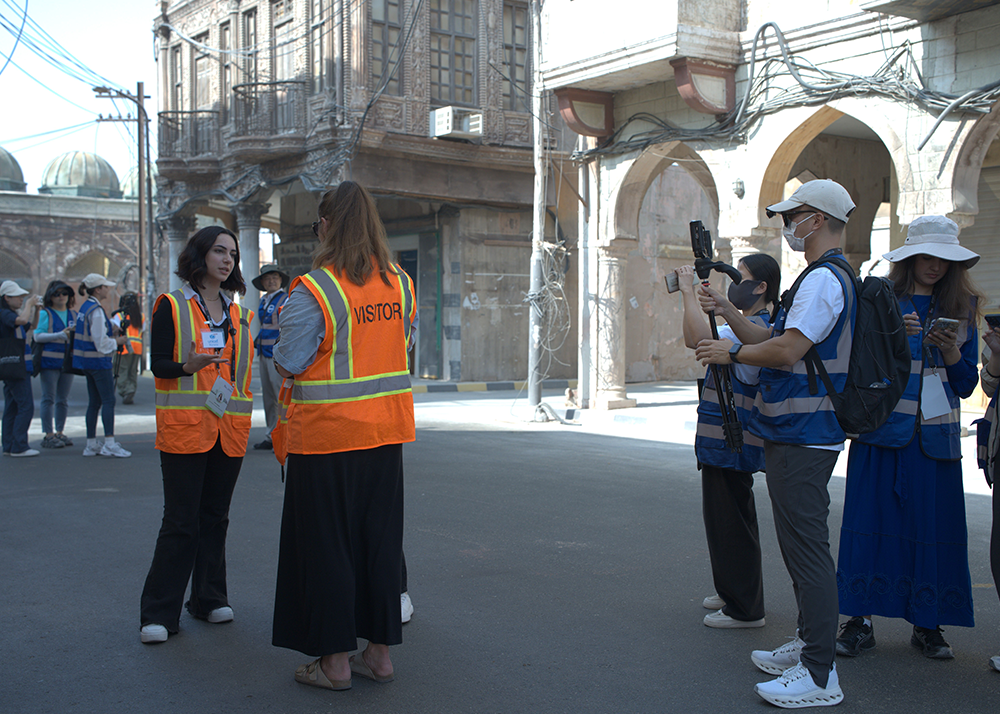
The students have an opportunity to let their learnings from the past week seep in rather than letting their natural, and often unknowingly biased, instincts kick in. The ‘CNN standard’ is reiterated to ensure all sides of a given crisis are shared irrespective of ‘feelings’ and ‘raised emotions’ at the scene of an ongoing incident.
From the outside looking in, Brynania took me by surprise. Misinformation was flying left, right and centre; the ‘press’ was everywhere; facts and opinions were merged inextricably; and the crisis kept evolving based on every conceivable form of a socio-economic or geo-political emergency.
From the eyes of a veteran, Brynen – who has watched hundreds of students cycle through Brynania over the years – identifies a pattern.
“Sometimes young journalism students are subject to what I call the ‘squirrel effect’,” he says. He shares how students and inexperienced reporters in high-stress environments react if someone were to yell ‘squirrel!’ Brynen says, “They can get distracted and completely lose track of what their story is about, the accuracy of their story, and how their story resonates. This is exactly why we throw a lot of ‘squirrels’ and distractions at them to see how they react in such situations.”
“What makes it great is that this is a ‘safe-to-fail’ environment – students are allowed to make mistakes, which in real life could possibly get them fired or killed,” he explains. “But at CNN Academy those consequences doesn’t exist. There’s nothing quite like it.”
As an observer, I find myself recognising certain patterns as the cohort canvasses Brynania, as well. Students who stand out to me are those that go against the grain; take the harder path to report on stories that aren’t easily accessible; make the effort to find the human, community-led story. They speak to the wailing widow on
the side of the road, the stragglers on the. outskirts as well as the authorities on site such as a police officer. They interview humanitarian representatives who have spent a lot more time on-ground to capture a holistic viewpoint with all possible ‘truths’ of Brynania’s current state of crisis.
Having that discipline and staying focused under pressure is exactly what CNN’s Anderson calls the defining factor of the Academy.
“Ethical reporting is really important,” says Anderson. “Our students get a really good deep dive on the ethics of journalism, media law, and places that you might go for stories.”
She advises, “At the end of the day, it is absolutely crucial that our students understand that you have to source, re-source, double source and triple source information that you might use in your story.”
Departing reflections and advice to future cohorts
As the next edition of the CNN Academy comes calling, here are a few pointers that might help you along the way.
1. Make your application stand out:
When you submit your application to the CNN Academy, you’ll be among hundreds from the region doing so. Salma Arafa, an Academy alumnus, who currently works on the CNN team, recommends applicants to “think like a storyteller and be authentic.”
“I really hate the whole ‘Hi my name is X and I’m 25-years-old’; it’s so boring,” she says. “Instead, tell a story that is personal and authentic. One that shows why we should choose you.”
A stand-out application, she reveals, tells CNN why they should care about your journey in storytelling. What is the fuel that fires up your passion to tell the stories of people around you? The answer to that question could set your application apart.
2. Read through all the theoretical material:
Thoroughly read through every single resource and packet of information provided before the in-person sessions within the Academy begin, so that you can make the most of your time with the instructors present.
The reason for this is simple. You have extremely limited time with these instructors – who are industry veterans. Leverage your access to these resources wisely.
3. Network with everyone
It’s easy to get caught up with all the celebrities at the CNN Academy. While yes, it’s extremely important to develop a network of contacts among renowned reporters and instructors; it’s equally important to connect with fellow students in the cohort. After all, they could prove to be valuable contacts and sources of information in the near future.
4. Always evaluate the impact of your storytelling
Eleni Giokos, CNN Anchor and Correspondent, and host of Connecting Africa and Marketplace Middle East wraps up one of the key takeaways, telling students to remember the weight of their platform. She says that professional storytelling is one of the most fulfilling careers you could possible have. “When you’re a journalist you can change someone’s life,” she says, advising students to think about the impact that they want to make.
In her words, a true storyteller “never takes no for an answer. Whether it’s an institution you want to work for or an interview you want, don’t take no for an answer. Keep pushing and keep persisting.”
A total of 165 students have graduated from CNN Academy Abu Dhabi, with 41 more added to that number from the latest cohort. They won’t all become journalists.
But they’ll all know the difference between the truth and a version of it; the difference between a human story that serves the public interest and another created for clicks – and that will make all the difference.
To know more about the upcoming editions of CNN Academy, visit academy.cnn.com or the CNN Academy LinkedIn page.