Mohit Lodha, Founder of Takumi AI.
Everyone is asking whether AI will ruin advertising. I think that is the wrong question. Bad advertising was already everywhere. AI just made it faster. That is why the debate around AI-generated ads has become so emotional.
The industry has turned it into another binary argument: human versus machine, craft versus automation, soul versus scale. But advertising has never been that simple.
Coca-Cola’s AI-generated Holidays Are Coming work became the perfect lightning rod. Some viewers felt it lacked warmth. Others called it soulless. But I don’t think the reaction was really about AI. It was about memory. Coke was not just remaking an ad. It was touching a cultural ritual. And when a brand enters that emotional territory, people are not judging pixels. They are judging feeling. That is the first lesson.
People do not reject AI because it is AI. They reject it when it breaks the feeling they expect from a brand.
The easy take is to say, “AI ads are slop.” But that is too lazy. Research is starting to tell a more complicated story. System1 and Jellyfish found that AI-assisted ads in their study scored 3.4 stars on average, versus 2.3 stars across System1’s wider database of more than 123,000 video ads.
In other words, the evidence does not support the simplistic idea that AI creative is automatically weaker. Kantar’s work adds a useful nuance. GenAI ads can create stronger emotional reactions, but those reactions are not always positive.
Kantar’s facial coding research found that AI-generated ads are more likely to make people feel something, but not always the emotion the brand intended. That is the real issue.
The job of advertising is not just to make people feel. It is to make people feel the right thing, about the right brand, for the right reason. That is where human judgment becomes more important, not less.
AI can generate, scale, test, localize and optimize faster than any traditional creative process. But AI does not understand brand memory. It does not understand cultural tension. It does not know when something is technically impressive but emotionally wrong. That is still human territory.
At Takumi, we use a simple lens for this: the Soul × Scale Matrix. Every advertising decision should start with two questions: Does this need soul? And does this need scale? If it has low soul and low scale, automate it. Not every asset deserves a creative war room. If it has low soul and high scale, be careful.
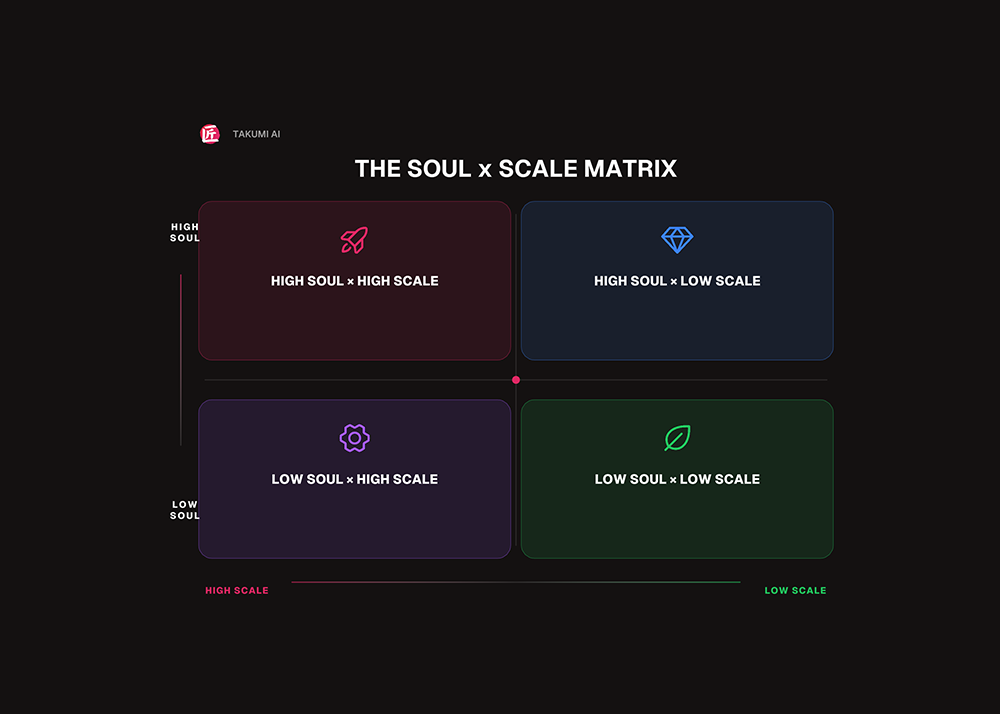
That is where AI slop lives. Lots of content. Very little meaning. If it has high soul and low scale, humans should lead. Brand films, cultural moments, founder stories, emotional campaigns – these need taste, judgment and nuance. But the real opportunity is high soul and high scale.
That is where advertising is heading. Human-led meaning. AI-powered momentum. The goal is not more AI advertising. The goal is more scaled soul. This is the part many marketers are missing. The best use of AI is not cheaper ads. That is the least interesting use case.
The real opportunity is collapsing the gap between craft and speed. For years, brands had to choose. Beautiful work took time. Scaled work often became generic.
AI gives us a chance to challenge that trade-off. But only if we stop treating it like a production shortcut and start treating it like a creative operating model. Kantar’s research makes this point clearly: GenAI performs better when it is used seamlessly, not distractingly. Ads where GenAI was integrated more naturally performed better, with over 40% landing in the top tier for branded cut-through. Ads with obvious or unnatural AI visuals tended to perform worse. That is exactly the point.
The question is not: “Was this made by AI?” The better question is: “Should AI have led this, supported this, or stayed out of the way?” That is the judgment CMOs, agencies and creative leaders now need to build. Because AI will not kill advertising. But it will expose it.
It will expose weak ideas. It will expose lazy strategy. It will expose brands that confuse output with impact. The brands that win will not be the ones that use the most AI. They will be the ones that know where not to use it. AI ads are not automatically slop. They are not automatically a superpower either. AI is a multiplier. If your brand has no soul, AI will scale the emptiness. But if the idea is strong, the brand is clear, and the human intent is sharp, AI can do something advertising has always wanted to do: Make meaning move faster. And that may be the real superpower.
By Mohit Lodha, Founder of Takumi AI.