Mastercard brand’s elevation to Official Naming Partner of the McLaren Formula 1 Team from 2026 marks one of the most significant commercial developments in modern F1. The move follows only a year of collaboration as a principal partner, yet the brand’s internal metrics delivered such strong results that the company accelerated its investment.
“Our partnership with McLaren is just one year old. We launched it last year in Las Vegas. And this is our 27th race that we are in right now. Not only are the numbers coming so good for us, we upgraded our partnership from being a principal partner to a title sponsor,” says, Raja Rajamannar, Chief Marketing & Communications Officer and President, Healthcare, Mastercard.
The shift reflects Mastercard’s confidence not only in McLaren’s trajectory, but in the sport’s global growth and the unique role fans play in shaping its commercial impact.
On the sidelines of Formula 1’s season finale in Abu Dhabi Grand Prix, Rajamannar outlined how the sponsorship model is rooted in fan-first, fan engagement and keeping the fan at the forefront of it all during a briefing.
What emerged is a partnership designed around engagement rather than exposure – a 24-race, fully activated programme that includes global experiential marketing, data-driven creativity and the launch of Team Priceless, Mastercard’s first integrated Formula 1 fan-participation platform.
A meeting of minds, momentum and fan culture
Before entering F1, Mastercard evaluated the entire grid. The brand explored multiple routes – league-level partnership, drivers, or teams – but the decision ultimately finalised around McLaren.
Rajamannar explains the process clearly. “We found that the biggest amount of passion comes from the teams. They say, I’m a McLaren fan, I’m a so-and-so team’s fan. So, it’s good to be with teams. Literally, we’ve met with all the top teams in the world.”
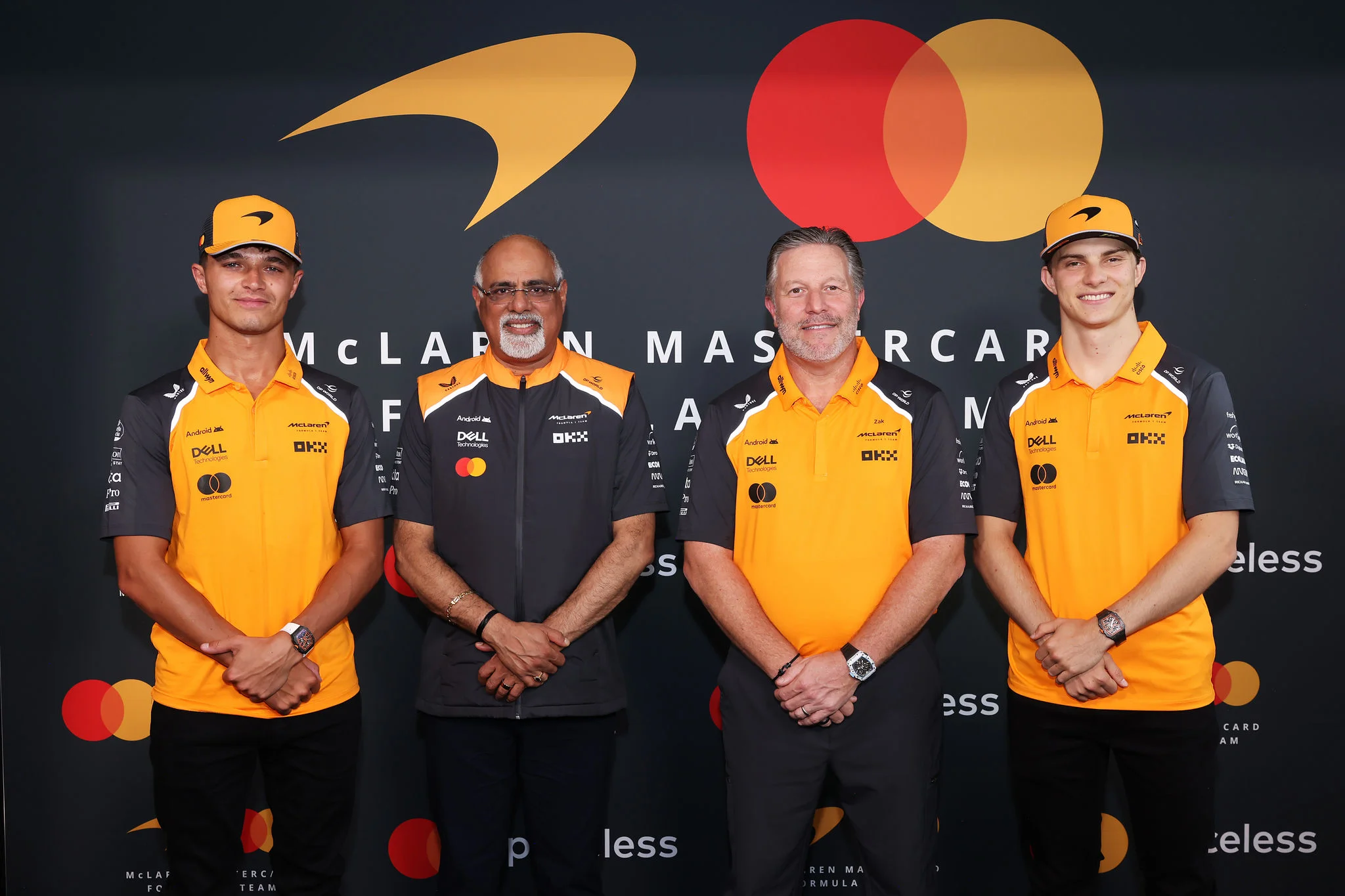
Across those conversations, McLarens’ values stood apart aligning strongly with the Mastercard brand. “There are some teams which are superb in aerodynamics. There are some teams which are superb in technology. There are some teams which are fantastic in engineering. McLaren was fantastic in fan engagement. So, we said McLaren is the one.”
The two organisations also share a marketing-led mindset. “Interestingly, Zak Brown is also a marketing person. He ran a marketing agency before he became the CEO of McLaren. So, there was instant connection at the meeting of the minds.”
Mastercard also factored in McLaren’s potential. The drivers were part of the equation.
“For most women, McLaren was the number one team. They have two drivers who are young, extremely light, super clean, and they have a long run ahead of them – Lando and Oscar. They’re a dream team.” This aligns with Mastercard’s goal of speaking to younger and more diverse fans.
Momentum also played a role. “When we shook hands, McLaren was at number four. By the end of the year, they became number one in constructors. So, I keep joking with Zak –‘Zak, you should pay us, not the other way around’.”
That alignment: creatively, strategically and culturally has become the foundation for the expanded partnership.
Mastercard’s strategic bet on a global, youth-driven sport
For Mastercard, selecting F1 was far from incidental. Rajamannar lays out the reasoning with data-driven clarity: “Firstly, Formula 1 is the fastest-growing sport in the world of sports. Secondly and uniquely, 42 per cent of all McLaren fans are women. And women are a critical, critical target audience for every company, but even more so for us to cover.”
Demographics were equally compelling. “It has got a humongous growth in terms of audience, from the Millennials and the Gen Zs and so on, which is extraordinary.”
And in terms of reach, very few sports compare. “Geographically, there is probably only one or two other sports which have as much of a global coverage as Formula 1 has.”
Once Mastercard saw the numbers, the decision became obvious. “When I looked at the statistics together with my team, it was very clear that this was a space we absolutely have to be in.”
Team Priceless and the fan-first formula
If the title sponsorship marks a commercial milestone, its purpose aligns with Mastercard’s long-built strategy: placing fans at the heart of every engagement.
“We look at them as people. People with passion are our fans. See what their fans are, what their passions are. And if you help them get experiences from their own passion, that’s where the magic happens. They start loving the brand. They start preferring the brand. They start using more of the brand.”
This philosophy has driven Mastercard’s global shift from advertising to experiential marketing. Since 2013, the brand has focused on curating experiences anchored in what it calls “passion points” – ten areas including music, sports, culinary, arts, travel and film.
“When we divided people’s lives into these various areas of interest, we decided to focus on 10 areas. Each one of these areas is part of a passion point and we started focusing on each one of these areas to curate experiences through extraordinary partnerships.”
Touching upon how the brand is targeting everyday people and beyond fans, Rajamannar says, “When you look at everyday people, they are fans of something. They may not be a fan of a particular sport, they may be a fan of TV. Culinary is one such passion point.”
Sharing an example of an experience that the brand created to tap into this passion point, Rajamannar said, “We understood, particularly during the COVID-19 pandemic, that people are staying at home. Their families are getting closer. And we know that people love eating and making special things. We started doing online sessions with celebrity chefs, who will teach you how to make cheese, or how to make a particular cake, or how to make a signature dish. It’s all done online. Each one of these consumers are people, are fans.”
He went onto share how the experience created a memorable occasion for the whole family – in turn creating excitement that is associated with Mastercard itself. Calling upon another occasion where they brought this to life for fans of music, Rajamannar shared how the brand identified 30 Lady Gaga superfans and created a surprise experience that involved an invite to learn from the star’s choreographer and a surprise appearance from the singer herself.
“This generated more than a billion social media views, which is massive. These weren’t just any views. They were branded Mastercard moments, amplified through Lady Gaga’s fandom. So, the number of people in the room was only 30. But then there were the rest of the billion people who watched the videos. They were going through this whole experience through them. This is something you can do day in and day out. Across the world.”
These examples support Mastercard’s belief that experiences, whether digital or physical, fuel long-term brand preference.
Fan engagement at global scale
Rajamannar emphasises that F1’s power lies not only in race-day spectacle, but in the vast majority of fans who never attend in person.
“Very few people actually experience all the work in person. But what about the hundreds of millions of fans who don’t get the experience in person? Their primary engagement is through television or through some websites. They’re connected with those fans all over the world. We are going to bring some cool things to the table.”
View this post on Instagram
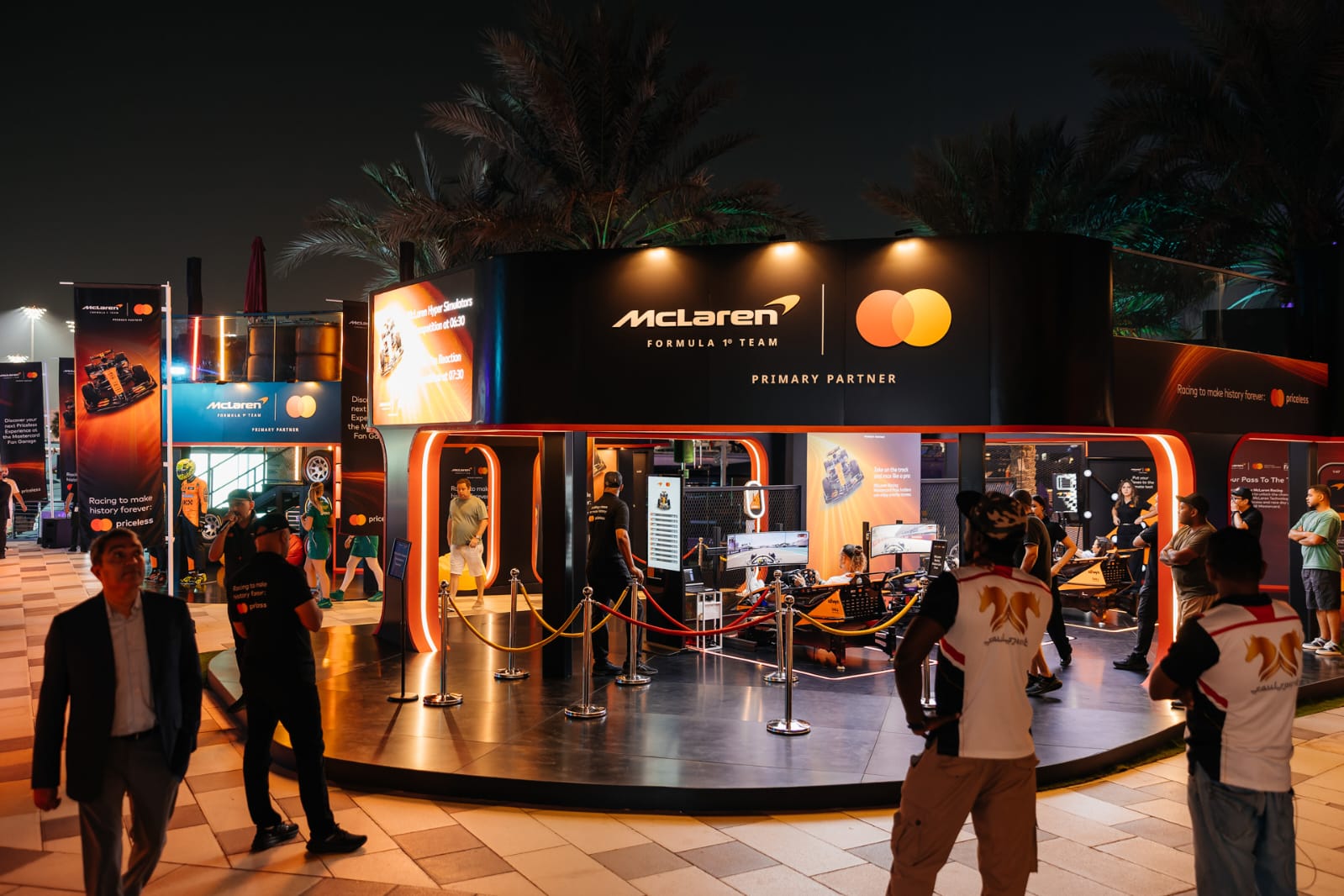
This is where Team Priceless – Mastercard’s new fan-focused initiative – fits in. The programme will give selected fans access to behind-the-scenes experiences across race weekends, from hot laps to city-specific cultural activities. It extends Mastercard’s long-held belief that memorable moments drive loyalty.
View this post on Instagram
Rajamannar also places the McLaren partnership in the context of Mastercard’s broader marketing transformation. “So, as Mastercard, we used to be predominantly advertising-led in our marketing strategies. But in 2013, we pivoted a lot away from advertising and more to experiential marketing.
Brand truth, business growth and competitive moats
While the experiences appear emotional, Mastercard applies strict measurement frameworks to gauge the effectiveness of the sponsorships.
“We measure what we do on three dimensions. Number one: brand truth. Is it helping our brand become better? Become bigger? Become more loved? Become more preferred? And we got very solid methodologies of how we track it.”
Performance and business outcomes are equally fundamental, according to Rajamannar, “Number two. Does it help our business grow? Are we making a new deal? Are consumers spending more using my card than somebody else’s card? Are people renewing my offerings more? Are people buying more and more Mastercards and putting it in their market? Or are brands choosing me over everybody else? And so, we look at how the business is growing. And is it a profitable business?”
And then comes differentiation. “Number three. We look at what we do is competitive advantage. We build a board around it. Meaning it’s difficult for somebody else to replicate. So, through priceless and affordable platforms like Mastercard Design Studio. Mastercard Innovation Challenge. We’ve got Mastercard Sonic Studio. We’ve got Priceless.com. Priceless means. Priceless questions. Priceless process.”
These same criteria apply directly to McLaren.
Consistency across regions
With Mastercard activating its McLaren partnership across multiple markets, coherence mattered. “We spent time defining a clear strategy so everyone understood exactly what we were trying to achieve and how we would achieve it consistently around the world. The nuances needed to ensure local relevance are led by the local marketing teams, but there is close collaboration between global and local teams.”
He notes that global and regional sponsorships teams work closely together to activate the partnerships in the different regions.
“Wherever races are taking place, regional teams are fully engaged, aligning closely with the global strategy while ensuring the execution resonates with local audiences.”
“Globally, the strategy and guidelines are set. Locally, the adaptation and execution gets done.” This federated model ensures every race activation shares one Mastercard voice, while respecting local cultural nuance.
Rajamannar closed with a perspective that underpins Mastercard’s global strategy, whether in sports, music, culinary or film. “The world is totally diverse. The single biggest truth is: people are people. They are the same everywhere in the world. They want to be happy. They want to succeed. They want to have families. They want to raise good kids. They have the same fears, the same insecurities, the same aspirations and the same ambitions. Globally, we are so similar. Almost identical. I think that if people realise this – global consistency will come.”