Consumer behaviour has long been a mystery for brands, marketers, and especially advertising agencies’ professionals; this is due to their inability to comprehend the reality of this complex human behavior fully.
For many years this marketing area has remained obscure and difficult to predict. It’s challenging to grasp the different dynamics that go into purchasing decisions. Among the questions that have puzzled marketing professionals are those related to how to draw targeted audiences to become customers or clients, how to reach and maintain a top-of-mind status, and the decision-making process that leads to these two results.
What attracts buyers to a product?
What puts a brand at the top of their choices?
Is buying a conscious choice or a brain-driven impulse?
Traditional marketing research techniques are normally conducted by surveying potential prospects and asking them questions related to the product and its category.
The issue with this is that the prospects aren’t living in the actual mental state where they consider a product or make a purchasing decision about one. To elicit insights into how purchasing decisions are made, it’s only logical to put the prospect in an environment (simulated/real) where they consider a product (copy/ad/store shopping/online shopping) or make a buying choice.
Neuromarketing enables the measurement of various key marketing constructs, including emotional engagement, memory retention, purchase intent, novelty, brand awareness, and consumer attention.
In this environment, the prospect is going through the experience of considering/buying a product or service, and while that is happening their brain functions are monitored to deduce insights and conclusions that go beyond conscious rational answers to a questionnaire/survey to the unconscious decisions normally made by buyers. Neuromarketing embodies the essence of this practice.
The brain behind the buy
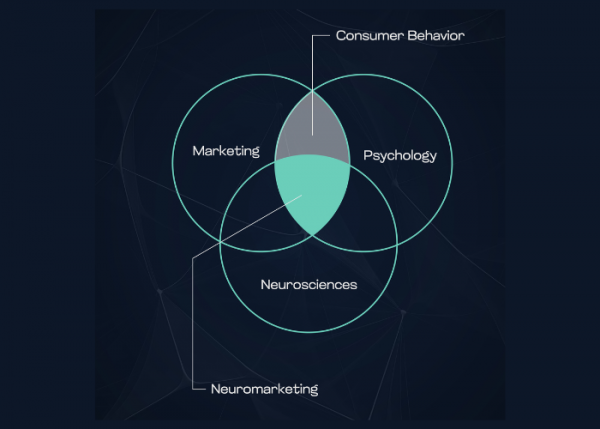
Neuromarketing is a multidisciplinary field that integrates marketing, psychology, and neuroscience to study consumer behavior in an effort to optimise marketing activities at strategic and tactical levels.
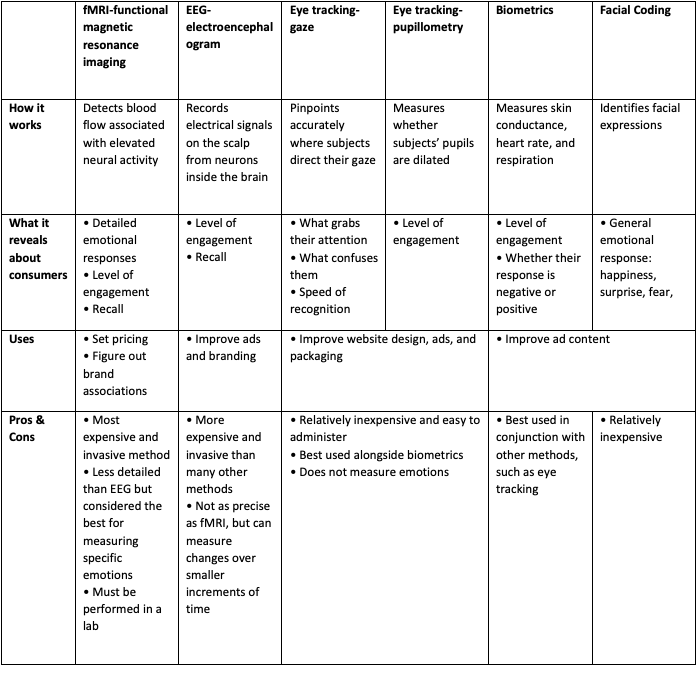
This field employs a group of measurement techniques including eye tracking, biometrics, facial expression coding, different forms of electroencephalography (EEG), and functional magnetic resonance imaging (fMRI). These various methods are used to track consumers’ attention and emotional responses without the need to explicitly ask prospects to describe what they are thinking about.
How do our brains make decisions?
To understand how the human mind makes purchasing decisions, we must first explore the components of the nervous system. This requires the help of anatomy—the science concerned with studying the body’s organs, their structure, locations, and internal connections.
Anatomists believe that the human brain is the most complex structure in human history. It’s no surprise, then, that studying it systematically is a daunting task, especially considering that it contains around 100 billion neurons (or nerve cells), interconnected by an enormous number of potential and reciprocal links.
When marketing professionals are looking to engage suppliers of neuromarketing services, they should understand the most important features and nuances of different neuromarketing techniques.
There is a consensus among anatomists that the human brain is the most complex of structures in the human body with billions of neurons’ links. It’ll be merely scientific and medicine-oriented to try and tie different regions and parts of the brain to decision-making, hence, let’s approach it from an observed human behavior perspective.
Some may say the subconscious is naive or childish, but in reality, it is very intelligent
Although the subconscious mind is always trying to separate itself from any stimulation of awareness or attention of the conscious mind, more often than not it fails to do so. Research and medical studies have demonstrated that many of our concerns and issues are processed unconsciously. The subconscious performs a type of signaling manifesting through intuition, recollection, or even daydreams.
We’ve all experienced reaching a dead end while trying to solve a problem and then being struck by lighting with inspiration in a moment of relaxation or when we’ve completely stopped thinking about it. What we don’t realise is that during the process of attempting to solve the problem up until the moment we gave up, the subconscious was working on the problem and never threw the white towel. The moment it finds a suitable solution it hits us as inspiration.
It’s interesting to wonder why buyers aren’t truthful about their purchasing choices and feelings towards different brands, the answer to that is that they are driven by subconscious urges, the most influential of which is emotion.
The subconscious mind secretly employs its energy to serve the conscious mind. It regularly and tirelessly trains itself to handle mental activities processing them and sometimes taking actions such as storing them in long-term memory or manifesting them into our awareness in different ways.
The difference between the conscious and subconscious mind lies in the fact that we cannot subconsciously perceive anything independently we’re unable to see, hear, taste, touch, or smell without the involvement of our conscious mind. Our subconscious functions through deeply embedded knowledge that is consciously accumulated in memory.
In essence, the subconscious mind functions through memories stored in emotional experiences. Some may say the subconscious is naive or childish, but in reality, it is highly intelligent and its intelligence is derived from a large number of experiences accumulated over time. The subconscious learns from our successes and failures, it evolves through a lifetime of experiences and gains the ability to make decisions that it believes are beneficial for us.
Since the subconscious is always on, it’s only logical that we trust it and rely on it. We can define intuition as the ability to understand instinctively without a need for conscious reasoning. Trusting our subconscious is trusting our intuition. This idea in its entirety materialises in any buying decision that we make, we can sense which products we would buy even with the absence of a rational reason. The reason we buy what we buy is based on rooted emotional cues or signals initiated by the subconscious mind and always ready to rise to the surface when stimulated.
Neuromarketing and the subconscious
In the introduction of this paper, we posed several questions: What attracts buyers to a product? What puts a brand at the top of their choices? Is buying a conscious choice or a brain-driven impulse? According to Harvard Business School professor Gerald Zaltman, the answer to these questions is related to the subconscious mind.
Opposite to popular belief, consumers aren’t as astute as they think they are. Many consumers say that they compare several products before they make a purchase, nonetheless, observation of these consumers uncovers that they don’t even glance at alternatives to the brand they choose to purchase.
It’s interesting to wonder why buyers aren’t truthful about their purchasing choices and feelings towards different brands, the answer to that is that they are driven by subconscious urges, the most influential of which is emotion.
The idea that human beings aren’t as logical as we might believe has direct resonance and implications in the field of marketing, advertising, and branding. To elaborate, if a product is only marketed by utilising and highlighting its attributes without incorporating human and emotional factors it will struggle to perform (sell) and this is due to communications completely missing the subconscious prime factor in the decision-making process.
If a brand is aiming to be among consumers’ top choices, it should focus on invoking human feelings, and engage the customer on a subconscious level. Great marketing professionals utilise this idea religiously. If we seriously study what great brands are marketing in their campaigns, it will be crystal clear that they are trying to generate emotions that click with their targeted audience.
Luxury brands target emotions of status, acceptance, and self-worth. Athletic brands emphasise inspiration and achievement, and beauty brands focus on self-esteem and empowerment.
If a brand is aiming to be among consumers’ top choices, it should focus on invoking human feelings, and engage the customer on a subconscious level.
Application areas of neuromarketing
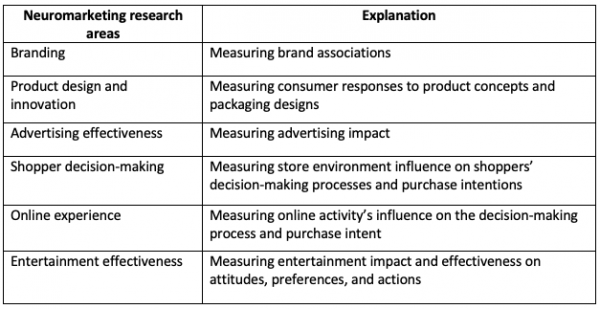
Neuromarketing enables the measurement of various key marketing constructs, including emotional engagement, memory retention, purchase intent, novelty, brand awareness, and consumer attention.
To begin with, it provides effective methods for evaluating brand associations. In addition, it helps assess consumer reactions to product concepts and packaging, reactions that are often instinctive, and emotional, and occur beneath conscious awareness. Moreover, neuromarketing uncovers how advertising influences us, even when those effects are not consciously registered.
The retail environment also plays a significant role, as neuromarketing reveals how store settings directly shape shopper decisions and purchasing behavior. Beyond physical spaces, these techniques can be applied to analyse online consumer behaviour as well.
Lastly, neuromarketing explores how entertainment creates immersive experiences that shape attitudes, preferences, and behaviours—offering insights into the psychological effects of being transported into fictional or imagined worlds.
Neuromarketing techniques
Neuromarketing requires specialised equipment and know-how that are beyond the reach of most companies. When marketing professionals are looking to engage suppliers of neuromarketing services, they should understand the most important features and nuances of different neuromarketing techniques.
Neuromarketing in action
James Breeze, CEO of Objective Experience conducted a study where 106 people were exposed to two baby product hypothetical ads (images 1 and 2) while wearing an eye-tracking device, all the participants were shown the ads in random order.
After exposure to the two ads, heat maps were generated to identify points of eye focus (gaze) as illustrated below (images 3 and 4). As we can clearly see in the heat maps’ images, when the baby was looking directly into the camera, most subjects focused their gaze on the baby’s face with little attention to the ad heading and the brand. On the other hand, when the baby in the ad was made to look at the text, viewers followed the baby in looking at the ad heading and then the brand name.
We can see here how effective Eye Tracking was in determining which ad version to use to generate more attention to the message in the ad and the brand behind it.

Valuable questions neuromarketing can answer
Neuromarketing offers brands validation of any hypothesis by testing communications, design, and visuals across different touchpoints. Below we list several questions that can be answered by utilising neuromarketing techniques.
Branding
- What emotional reaction does a brand logo evoke in consumers?
- To what degree do customers associate certain values (e.g. status, happiness, innovation) with a brand?
- What emotional links do consumers have with competing brands?
- How do consumers neurologically respond to a brand’s storytelling?
Product Design & Packaging
- Which product packaging design creates the highest positive emotional reaction?
- Which elements of packaging grab the most attention?
- How do the shape and color of a product/packaging influence the perception of quality?
- Do consumers experience cognitive overload when viewing multiple product options?
- How quickly can customers recognize a product on a shelf?
Advertising
- Which parts of an ad are engaging at a neurological level?
- Does the music in an ad improve emotional impact or distract?
- Are potential buyers more engaged with visual or verbal messaging?
- What are the reasons that cause viewers to stop watching or skip a video ad?
Website Design & Experience
- Which sections of a website draw the most attention?
- Do users experience negative feelings or frustration throughout the user journey?
- Are call-to-action buttons properly placed for engagement and conversion?
- Does my web design promote positive feelings? And what are they?
- How does website loading speed impact emotional and attentional reactions?
Consumer Behavior & Decision-Making
- How can we end “decision paralysis” and get the customer to buy quicker?
- What motivates consumers to choose one product instead of another?
- How does in-store music or lighting affect shopper attention and mood?
- What triggers impulse purchases in a retail setting?
Pricing & Value Perception
- How do consumers perceive a product’s value in light of price? Is the product worth the price from a customer’s point of view?
- How do different pricing tactics affect brain responses?
- What is the subconscious reaction to promotions or discounts?
- Which framings of price have a higher engagement with buyers, “savings” or “gains”?
Generally speaking, neuromarketing is a fast-moving field of marketing research and is becoming important to the industry of marketing as it offers insights that can’t be achieved with conventional research techniques. Many of the individual neuromarketing methods can answer specific questions to help optimise marketing practices in the pursuit of achieving strategic marketing objectives.
Nevertheless, individual neuromarketing techniques have limitations when used as siloed tools since each of them answers specific questions accurately but can’t produce the generalisations that can be deduced from traditional social and behavioral research methods.
While neuromarketing’s appeal lies in its direct connection to the subconscious mind, its intrinsic value is often realised when used as part of a holistic, 360-degree approach to market research.
By Yazeed Al Ramahi, Strategy Director, Nurum