What happens when consumers stop listening to what brands say and start watching what they do? How many brands will meet expectations and how many will be exposed for being performative?
As audiences across MENA become increasingly attentive to how brands behave during moments of uncertainty, the conversation is shifting beyond purpose-led messaging towards something more behaviour-driven. A campaign is no longer evidence of meaningful responsibility. As trust becomes harder to earn and easier to lose, marketers are facing a new reality.
In this evolving landscape, what does meaningful responsibility now look like for brands? Is ‘doing good’ evolving from a messaging exercise into a broader expectation around conduct, responsibility and accountability?
The bar for ‘doing good’
“Uncertainty has definitely changed the relationship people have with brands. Consumers today are paying much closer attention to what brands actually do, not just what they say,” says Jonathan Bannister, Head of Marketing – GCC, PUMA Middle East.

Times of crisis have fundamentally recalibrated what consumers in MENA now expect from brands, with the focus moving away from visibility or a statement of solidarity and more towards meaningful behaviour.
Compounding this shift is the fact that audiences across the region have become increasingly sophisticated and culturally attuned to sincerity. Leaders agree that consumers can quickly distinguish between brands that show up because they have something meaningful to contribute and those that participate simply because silence feels commercially risky. As a result, the bar for ‘doing good’ and what constitutes responsible brand behaviour has risen.
“In periods of uncertainty, audiences are not just evaluating what brands communicate, but how appropriately they respond to context, sentiment and timing. This requires brands to move beyond reactive communication and into a deeper understanding of audience emotion, needs, cultural sensitivity and situational awareness,” says Hagar Mahmoud, Head of Social, SOCIALEYEZ.
Increasingly, consumers and the media are asking harder questions: How does this brand treat its partners? How does it respond when it makes a mistake? Does the leadership speak in a way that reflects the brand’s stated values?
According to Mark Anthony Haddad, Regional Head of Brand Strategy, House of Comms, “Consumers across MENA are more sophisticated than ever; they’ve watched too many brands retrofit purpose on to existing campaigns, release a statement on a cultural moment and then disappear, or build an entire platform around a position they can’t actually stand behind under pressure.”
The real shift is in what brands are willing to say publicly. From silence to courage, that’s a real movement.
He adds, “Brands that used to hedge everything, that would release carefully worded statements designed to offend no one and stand for nothing, are finding that neutrality is increasingly indistinguishable from complicity. Audiences want to know where you actually stand, and they’re willing to reward or punish brands accordingly.”

Leaders agree that it is no longer enough to launch a corporate social responsibility (CSR) programme, publish a sustainability report, align creative work to a cultural moment, or stand in neutrality. Audiences are increasingly adept at identifying performative behaviour, messaging and commitments that lack long-term follow-through.
As expectations evolve, consumers are no longer judging brands by participation alone. Instead, they are scrutinising whether a brand’s actions align with its stated values, looking for evidence of intent, consistency and credibility. The challenge for brands is not defining their values, but consistently translating them into action.
Values under pressure
Periods of uncertainty do not create brand values. They reveal them.
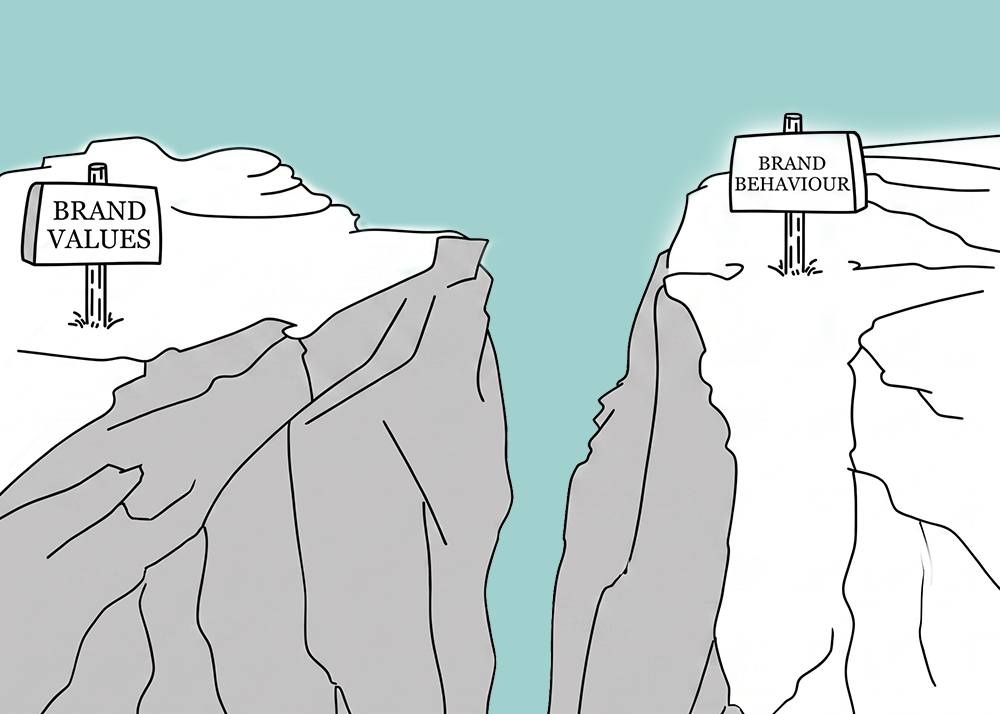
“The expectation is no longer simply that a brand shows up with a campaign or a statement of solidarity. People want to see whether the decisions a brand makes during difficult moments are consistent with the values it claims the rest of the time. That gap between stated values and actual conduct is where trust is either built or permanently eroded,” says Claudia Schmidt, Senior Director of Brand MENA, talabat.
Leaders agree that the gap is becoming harder to ignore. Consumers are no longer impressed by brands that appear during moments of cultural relevance only to disappear once attention shifts elsewhere. Instead, they are looking for evidence that commitments and values are upheld beyond the campaign cycle. And when the evidence is lacking, the gap becomes the story.

“Performative purpose tends to be episodic; it appears during key cultural or social moments, whereas genuine trust is built through sustained action, internal alignment, and accountability,” says Mahmoud.
Adding to her point, Bannister says, “More than ever, consumers expect brands to show up with purpose, but also with sincerity. People can tell the difference between a brand that genuinely cares about an issue and one that’s simply responding to a trend. For me, trust comes down to consistency. Are you still talking about and supporting that cause six months later? Does it influence how you operate as a business? The brands that build lasting trust are the ones whose actions match their words, even when nobody is watching.”
Puma has long invested in community-building, from supporting local running clubs to partnering with homegrown brands and cultural initiatives. Campaigns such as ‘Play The City’ to celebrate the unsung heroes of street cricket, and its collaboration with social club LFG, reflect a sustained commitment to local culture rather than one-off participation. These initiatives made its recent ‘Proud of UAE’ campaign feel less like a reactive response to the recent conflict and more like a continuation of an established ethos.
Puma’s approach also reveals another layer. Consistency alone does not guarantee cultural relevance and sincerity. For brands to express their values meaningfully, they need cultural awareness and emotional intelligence to understand when, how and why they should show up.
The role of emotional intelligence as infrastructure
According to leaders, emotional intelligence has always mattered in brand-building, but it used to be something marketers could layer on top of strategy. Now, it is foundational.
“Emotional intelligence is about knowing when to speak, when to listen and when action matters more than communication. In a region as diverse as MENA, emotional intelligence also means understanding local culture, language, social context and the different expectations that exist across markets,” says Schmidt.
As a result, marketers need to understand these nuances and the varying expectations across different markets. Consumers want to see how brand values and commitments are translated into daily decisions, products, partnerships, policies and customer experiences in ways that feel credible, authentic and deeply resonant.
Schmidt notes that responsibility requires greater cultural intelligence. “MENA is not one single audience, and brands need to respect the differences between markets while staying true to a clear regional identity.”

She adds, “Our role remains deeply connected to people’s daily lives. That requires us to communicate with care, relevance, and humility. They are the ones that understand the room, act responsibly, and build trust through consistency.”
This philosophy is central to talabat and its brand across eight countries. When the brand launched its initiative to offer 100 rent-free cloud kitchen spaces to homegrown UAE restaurant brands, the decision was rooted in a straightforward observation: margins across the industry are under pressure, and the businesses that define the character of this country’s food scene needed practical support, not a campaign.
“The most effective brands are those that can interpret the emotional climate in real time and respond with authenticity, restraint when needed, and clarity when it matters most. It is no longer about speaking louder; it is about speaking more appropriately,” says Mahmoud.
Ultimately, moments of uncertainty act as a litmus test. They expose the gap between what a brand says and what it does. The strongest brands are not necessarily the loudest, but the ones that can consistently align their values, behaviour and communications with genuine cultural understanding and emotional intelligence.
And when all these factors do not align, the gap becomes visible, and the inconsistencies revealed will no longer be considered a blind spot, but a signal of performatism to audiences.
Accountability, transparency and internal mechanics
If emotional intelligence and values are not extended to internal operations – i.e. what consumers do not have visibility on – brands risk performative behaviour. Responsibility has moved into the operating model; into how decisions are made, how systems function and how organisations behave when no campaign is running.
Leaders suggest this is where the distinction between performative and meaningful responsibility becomes most visible.
According to Haddad, in the MENA context specifically, behaviour matters because consumers and audiences are culturally attuned to authenticity in a way that’s particularly unforgiving of performative gestures. Brands that are genuinely embedded in the community through employment, local partnership, and long-term presence carry a credibility that campaign-led purpose simply cannot buy.
Echoing his sentiment, Bannister adds, “Having strong values is still important, but consumers increasingly want to see those values in action. They’re looking at how brands treat their employees, the partnerships they choose, and how they respond when challenges arise. In many ways, responsibility has become less about what sits on a brand manifesto and more about the behaviours people experience every day. That shift is pushing all of us to be more accountable and more transparent.”
For talabat, this means improving its platform experiences to support local businesses, empowering trusted partners and strengthening the wider ecosystem around customers, partners and riders.
Schmidt says, “Our brand is closely tied to utility and everyday relevance. That means our responsibility must show up in practical ways. It could be through how we support restaurant partners, how we design more seamless customer experiences, how we create opportunities for communities to contribute to causes, or how we continue to enhance care and support across the wider delivery ecosystem. Behaviour is where brand meaning becomes real.”
Leaders agree that as responsibility shifts into the operating model, it becomes embedded in how decisions are made, how employees are treated, and how businesses respond in moments of pressure.
“What’s emerging is a shift from corporate social responsibility to operational responsibility. If it doesn’t influence procurement, hiring, supply chains, and product decisions, it is not purposeful. The uncomfortable truth for brands is this: responsibility cannot be announced any more. It has to be proven in the mechanics of the business. Anything less will be treated as optics,” says Mahmoud.
The brands that will lead on responsibility in this region over the next decade will be those that no longer treat CSR as separate from business operations, but embed it across product development, customer experience and organisational culture – shifting it from a communications strategy into a founding principle.
Moving towards meaningful responsibility
The dominant model of the last decade was value-led positioning: define what you stand for, build campaigns around it, and let messaging carry the weight. According to leaders, that model is exhausted and what is replacing traditional responsibility is something more architectural.

Haddad explains that in a market where culture moves faster, AI accelerates sameness, and attention is increasingly fragmented, advantage no longer sits with the loudest brands, but with the most purpose-forward ones. They’re the ones with genuine conviction. The ones willing to take a position and hold it even when it’s uncomfortable.
“In the age of uncertainty, the most differentiated thing a brand can be is honest,” says Haddad.
He adds, “One of the most important shifts in brand strategy right now is the move from silence to courage. In a world of intense scrutiny and fast-moving cultural conversation, the temptation is to say less, hedge more, and offend no one. But that posture creates brands that stand for nothing, and audiences increasingly see through it.”
The shift is already visible across regional brands such as Puma, talabat, Careem and Huda Beauty, where more unfiltered communication has been met positively by audiences. Rather than avoiding controversy or political context, these brands are increasingly willing to show up with a clear point of view, turning honesty from a stated value into a lived behaviour.
For Bannister, meaningful responsibility is about proof over positioning.
He says, “For me, meaningful responsibility is about being willing to back up your commitments with action. Consumers are less interested in hearing what brands aspire to do and more interested in seeing tangible progress. That means being transparent about successes, honest about challenges and committed to continuous improvement. Brands don’t need to be perfect, but they do need to be genuine. People respect organisations that are making a sincere effort and showing real accountability along the way.”
Looking ahead, leaders agree that responsibility will no longer be something brands ‘claim’. It will be something they continuously have to justify through accountability, courage, proof and honesty.
The road ahead
For Schmidt, the kind of intervention – structural, operational, directly tied to what partners actually need – is what the responsibility conversation is moving toward.
She says, “These are not communications questions in the traditional sense. They are organisational and behavioural questions that communications professionals now have to navigate, which makes the role considerably more complex and considerably more important.”
Leaders agree that what is emerging is a clearer expectation set that sits at the intersection of culture, behaviour and operations. Consistency, emotional intelligence, accountability, transparency and courage are no longer communication principles; they are operating conditions from which brands can achieve meaningful responsibility.
Schmidt suggests that while standalone initiatives will continue to play a role, particularly when addressing specific needs or moments, they are no longer sufficient on their own. “The stronger opportunity is to embed responsibility into the way brands operate every day, so it becomes part of decision-making rather than a separate workstream.”
In that context, consistency is no longer about repetition, but alignment – between what brands say, what they do and how they operate. Consistency will determine whether values survive beyond campaign cycles, reflected across every touchpoint rather than selectively during moments of visibility.
Accountability and transparency then define how that alignment is made visible. This will mean owning outcomes publicly, taking a stance, and showing how those learnings shape future decisions. A shift from storytelling to evidence showing how decisions are made, not just what results they produce. Integration will define whether responsibility is embedded into the operating model itself or simply layered onto it. It shows responsibility in the product, operations, culture and leadership – and not just in the marketing.
“Brands will need to show their results through data, behaviour and transparent reporting. The brands that will define responsibility in this region and globally are the ones building systems, not just campaigns,” says Haddad.
Together, they reflect a move from narrative to proof and leaders suggest this will become increasingly critical as audiences expect clarity not just on outcomes, but on process and intent.
And courage will separate those who participate in cultural moments from those who are willing to take a position and hold it. In an environment of scrutiny and constant visibility, neutrality increasingly reads as performative and absence.
Taken together, these shifts point to a single direction of travel: responsibility is moving from expression to infrastructure. From something communicated to something structurally built into how a brand operates. The brands that stand out will be those that accept this shift early and embed responsibility into how they operate, not how they describe themselves.
“The implication for how we build brand strategy is significant. We’re increasingly being asked not just to define a positioning, but to help clients build platforms and territories that can stretch across culture, content and commerce. Ones that are defined more by behaviour than by broadcast,” says Haddad.
Leaders agree that the tools to measure long-term brand health already exist, but are often underused because incentive structures still prioritise short-term performance. The issue is not measurement, but prioritisation.
To shift this, brand metrics like equity, sentiment and loyalty need to be embedded into the start of campaign planning and decision-making, not reviewed retrospectively. Ultimately, it requires a broader commercial and cultural shift in how clients and agencies measure and reward long-term brand building.
“If we’re serious about building brands for the long term, we need to look beyond short-term performance and understand how people actually feel about us over time. Trust, loyalty, advocacy and cultural relevance are much harder to measure, but they’re often the indicators that matter most. Those are the metrics that show whether a brand is truly earning its place in people’s lives,” says Bannister.
The uncomfortable truth for brands is this: responsibility cannot be announced anymore. It has to be proven in the mechanics of the business. Anything less will be treated as optics.