

Ramadan has always been the Middle East’s most commercially significant season. For decades, brands have leaned on high-budget TVCs, celebrity tie-ins, and large-format storytelling to capture attention across the GCC. But 2026 is revealing a fundamental shift. The conversation is moving away from broadcast channels and into the hands of the consumer, literally.
Recent insights from Infobip reveal that WhatsApp traffic across GCC markets surged by roughly 140 per cent during Ramadan, signalling a structural transformation in how consumers expect to engage with brands. Supporting this trend, proprietary Middle East data shows that 94 per cent of Ramadan shoppers now demand two-way conversations, seeking real-time information rather than static promotional messages. Consumers are no longer passive observers; they want to interact, ask questions, and personalise their shopping experience.
Understanding the Ramadan shopper
The behavioural insights tell the story behind the numbers. Globally, 72 per cent of shoppers explore different product categories during Ramadan than at other times of the year, while 80 per cent emphasise financial planning to optimise their purchases.
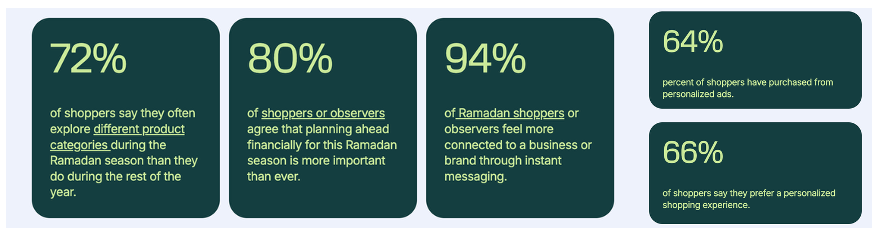
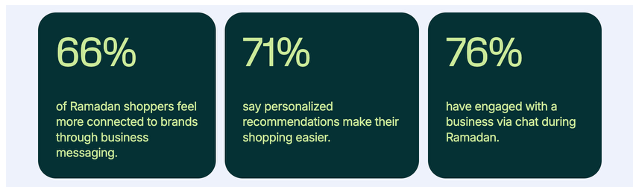
Regional surveys confirm that 66–76 per cent of shoppers feel more connected to brands via instant messaging or have engaged with a business through chat, and 71 per cent say personalised recommendations make shopping easier.
Meanwhile, 64 per cent have purchased from personalised ads, demonstrating that relevance and context now directly influence transactions.
The convergence of cultural, operational, and technological factors drives this evolution of instant messaging. Ramadan is inherently communal. Families gather, communities connect, and shared experiences dominate daily routines.
Consumers now expect these values, connection, generosity, and responsiveness to be reflected in how brands communicate with them. Generic blasts and static catalogues no longer suffice; convenience, visual engagement, and hyper-relevance are now table stakes.
Middle East messaging shift
Regional and country-level data show how this shift plays out in practice. In the UAE, conversational messaging interactions grew by 117.4 per cent during Ramadan. Qatar and Kuwait each saw a 54 per cent increase, while Saudi Arabia recorded a 40 per cent rise. WhatsApp has become the backbone of engagement: 142 per cent growth in Qatar, 116 per cent in the UAE, 109 per cent in Bahrain, 66 per cent in Kuwait, and 50 per cent in Saudi Arabia.
These figures highlight that chat platforms are no longer supplementary; they are central to the purchase journey, enabling brands to answer queries, provide real-time recommendations, and manage last-minute delivery requests.
Owned ecosystems are also gaining importance. Mobile App Messaging in the UAE surged by 270 per cent, showing that consumers are more likely to stay within apps that offer seamless conversational support. Email, too, has experienced a resurgence, a 32X increase in Saudi Arabia and a 133 per cent increase in the UAE, used for long-form storytelling, detailed promotions, and cultural content like Iftar schedules and charitable initiatives. Meanwhile, SMS remains vital for transactional alerts, such as OTPs or delivery confirmations, ensuring operational reliability alongside engagement.
Channels and personalisation: The new hierarchy
These patterns suggest a clear hierarchy of engagement for Ramadan 2026: instant messaging for immediacy, apps for ecosystem depth, and email for rich storytelling. Across channels, personalisation is key. Consumers now expect brands to tailor offers, recommendations, and content to their needs, preferences, and shopping behaviours. Real-time engagement, combined with contextually relevant messaging, drives both conversion and brand loyalty.
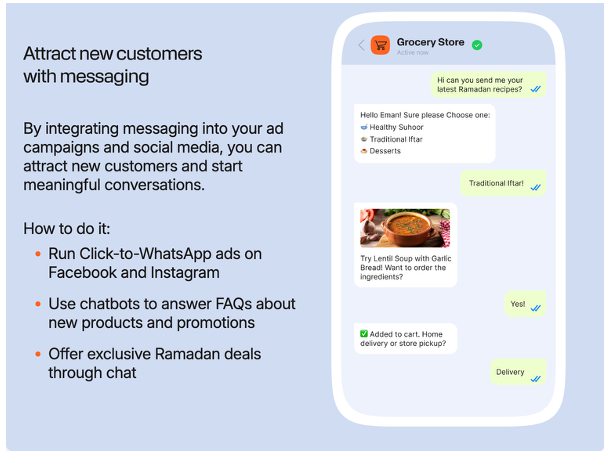
Conversational marketing is no longer experimental; it is operationally critical. By integrating messaging into ad campaigns, social media, and apps, brands can move shoppers efficiently through discovery, consideration, purchase, and retention, while respecting cultural nuances.
For example, Meta’s research shows that Ramadan shoppers who receive personalised messaging are more likely to engage and convert, proving that data-driven, conversation-first campaigns deliver measurable results.
Strategic implications for brands in Ramadan
For marketers, this shift is profound. The traditional campaign playbook, heavy media spend, linear funnels, and static content, is insufficient. Creative must now anticipate dialogue. Offers must be flexible and dynamic.
Customer experience and marketing teams must work in lockstep to manage response flows at scale. AI-powered automation and customer engagement platforms are no longer optional efficiencies; they are the engines enabling real-time relevance during a compressed, high-intent shopping window.
Cultural awareness is equally critical. Ramadan demands sensitivity to fasting hours, charitable initiatives, and community values. Campaigns should emphasise togetherness, generosity, and CSR activities rather than aggressive sales tactics. Brands that respect these norms while meeting conversational expectations strengthen loyalty and credibility in measurable, lasting ways.
The competitive advantage for Ramadan
Media budgets, production quality, and emotional storytelling remain important, but responsiveness and personalisation have become the true differentiators.
A brand that can provide a personalised product recommendation via WhatsApp at 11:30 PM before Suhoor, confirm a delivery slot in-app, and follow up with a contextual email is creating a multi-channel ecosystem where the consumer is firmly in control. This is the type of frictionless engagement that will define winners in Ramadan 2026.

The Middle East’s Ramadan reset is clear. Consumers are exploring more categories, planning more carefully, and connecting more deeply through conversational experiences than ever before. Marketing that ignores this trend risks irrelevance; marketing that embraces it can convert engagement into loyalty, loyalty into advocacy, and advocacy into long-term growth.
The era of one-way broadcast marketing is coming to an end. The era of conversation has begun.
By Rasha Abdo – Head of Enterprise Verticals – GCC & Levant, Infobip.