Let’s be real: every marketing channel is following the law of diminishing returns – we know it but won’t talk about it.
Above-the-line (ATL) advertising doesn’t move organic traffic, as such. Rather, it creates a mirage of sorts because your digital guys are scaling paid to support the brand campaigns to get you non-repeatable visitors. Unless there is a significant change in product features or user experience, you are likely to get nanoseconds of attention from new users.

Influencer marketing has become more about taking a hero, getting a spike in engagement and zero conversions. Die a villain with micro creators featuring data sleuths for code tracking, validations, return windows, fake followers, affiliate frauds and micromanagement.
SEO takes forever. Google’s shifting goalposts with constant algorithm updates are disappointing. AI-generated content is everywhere now – helpful, but risky if you’re not careful. Competition is wild. So, quality content, strong user experience (UX), and legit backlinks are table stakes – among listicles, Reddit threads, and maybe AI one-boxes that’ll wipe your traffic next year anyway. Core web vitals? Mobile-first? Non-negotiable. Lastly, if you’re not tracking performance religiously, you’re flying blind. SEO is a grind, and it’s only getting more complex – adapt or get buried.
CRM and first-party marketing
First-party data validation? Check. Sanitising more than 90-day inactive customers? Also, check. But wait; what if existing customers are not responding to five promos in a row? Boom, Gmail throws you straight into the spam folder.
WhatsApp? Crazy expensive on a cost per thousand impressions (CPM) basis. Performance ads are cheaper, hands down. Building a high-quality first-party (1P) data pipeline is a grind – and no, less than 30 per cent open rates and less than 1 per cent clickthrough rates (CTRs) aren’t going to cut it. Measurement? Don’t even get me started. Last-click makes zero sense here. People check emails in the morning, ignore them, then see your ad mid-lunch, recall the email, and click that. Ever thought about looking at CRM through the lens of first-click attribution or click-assist ratios in Google Analytics (GA)? You should.
Affiliate marketing? Fraud is everywhere. It’s still cannibalising your paid marketing as much as 35 per cent – only disguised. And most people won’t care enough to share anyway.
Social media marketing
Somewhere out there, someone’s entire job is to make sure that just when you’ve cracked the latest reel algorithm, it gets nerfed – all in the name of ‘a brand handle isn’t the same as a creator’s handle’.
So, you boost the post, get a tiny lift and a few hours later, it’s gone. Rinse, repeat and welcome to the never-ending hunt for the next algorithm hack. The wheel of time continues, and so does the misery of budget allocation. Every channel is now mature. We’re living in the post-hype phase of a long-tech cycle. When a marketing strategy works, everyone jumps on it. Then it stops working. Customers tune out. Prices go up. ROI nosedives. It’s just supply and demand.
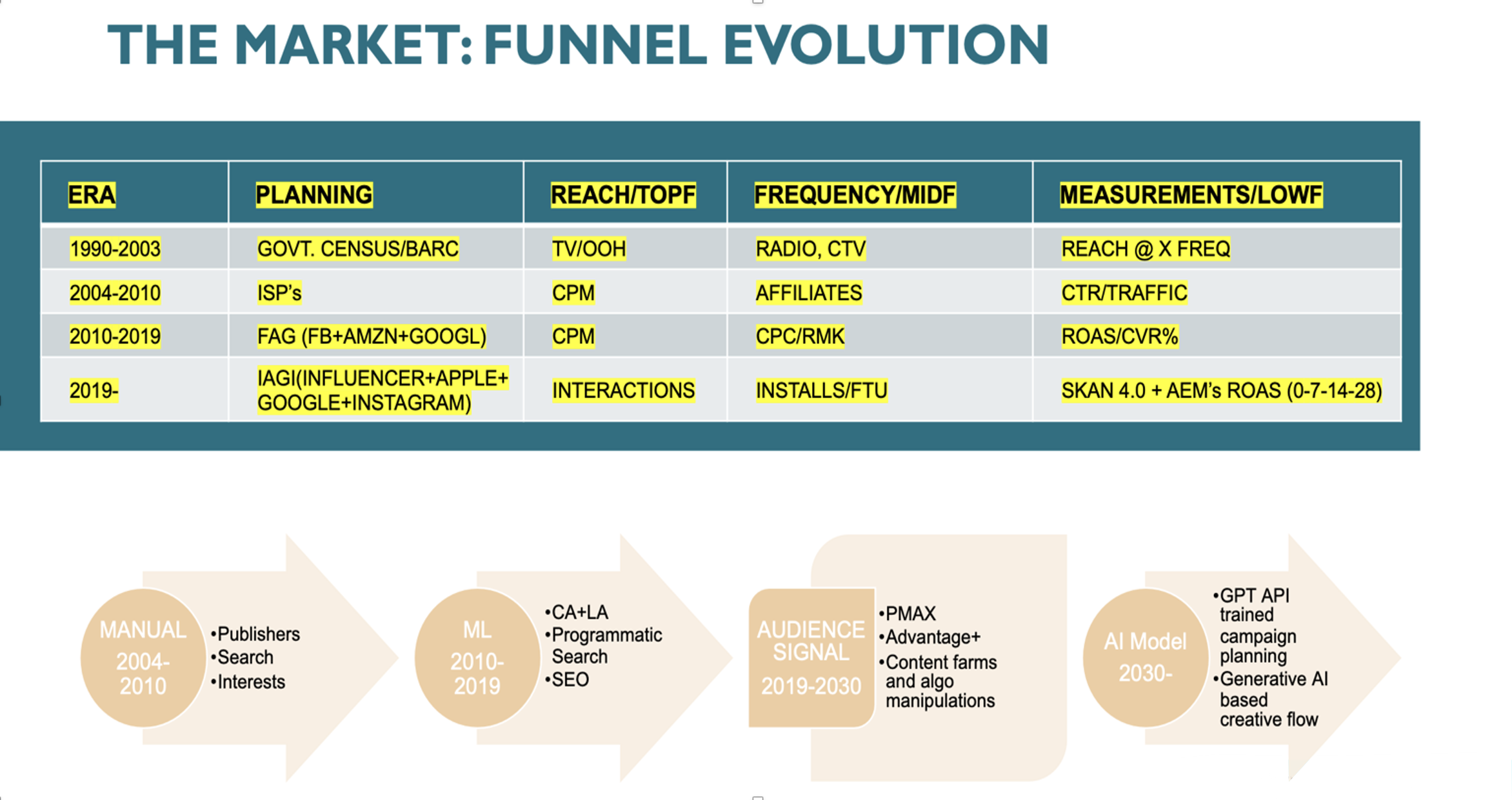
This is the funnel we learnt over the last two decades (Refer to graphic 1 below).
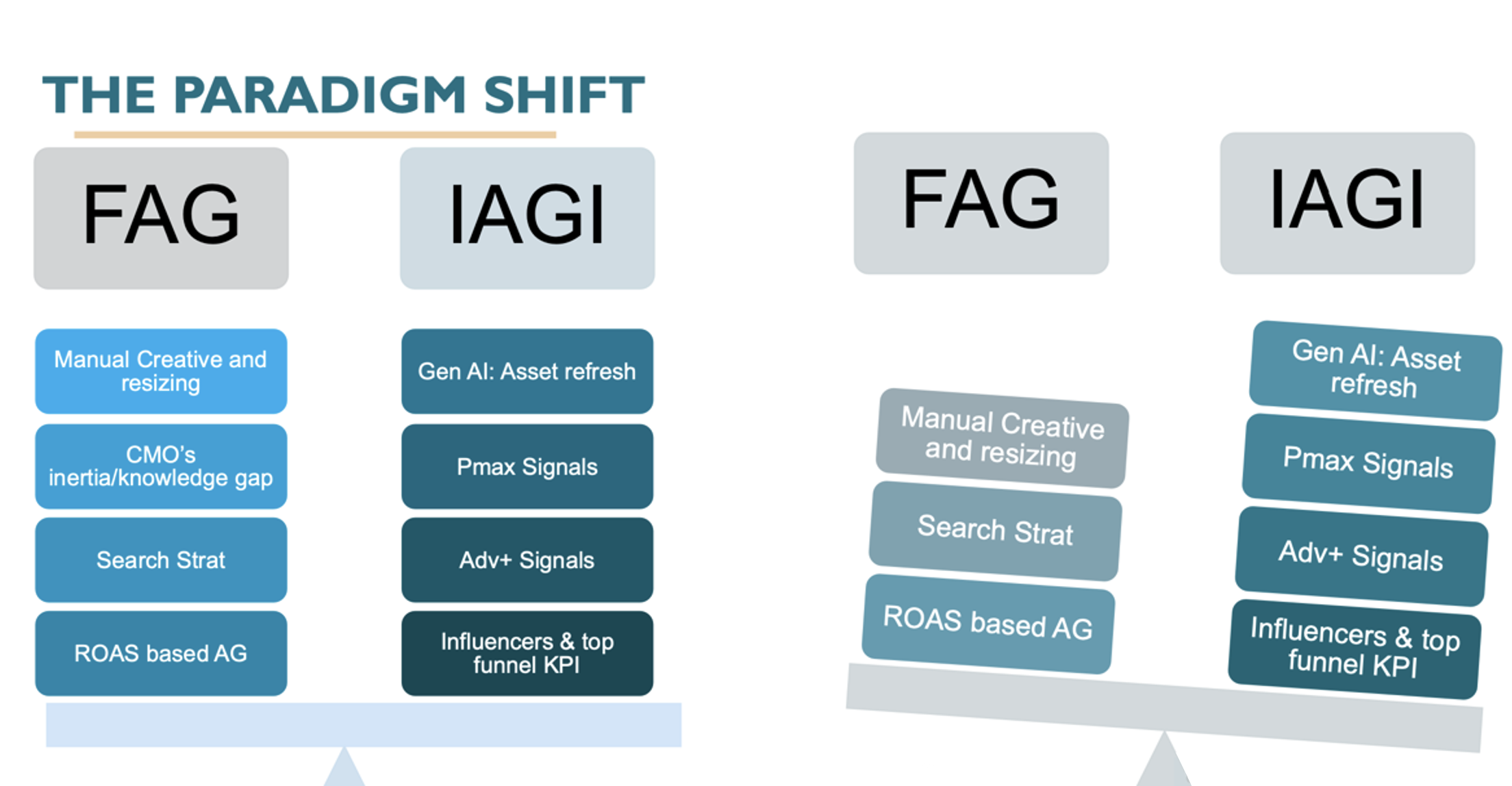
If you are a startup, you can’t play the sacred games. Look at the shift. (Refer to graphic 2 below)
What next? Gen AI at scale is your weapon
Customers are numb to the same polished, corporate-sounding noise from big brands. You? You get to show up weird, fresh and unfiltered – and that flash of novelty actually matters.
Tools today make it extremely easy: spin up avatar-led TikTok videos with Symphony, drop your product catalogue into GPT prompts, get that ‘too cool to care’ vibe using Midjourney or Leonardo, upscale it to look pro with Magnific, toss it into Runway or Videoleap and – boom – you get 100 videos in 100 minutes.
No agency. No brief. Just vibes, speed and attention. Lastly, get your own tracks on suno.ai. No intellectual property (IP) infringements and no Gen Z bashing.
Avoiding the classic ‘spray and pray’ trap

Balance your budget. On the left of Graphic 3, we’ve got your typical channel breakdown. Performance Max (PMAX) and Advantage+ (ADV+) are eating up 70 per cent of your budget. But look at their funnel position: lower funnel (LF); their signal strength: poor to very poor; and what you’re getting in return: low return on ad spend (ROAS), high cost per order (CPO).
Now peek at the 3D plot. We’re mapping three key dimensions here:
– X-axis: Time
– Y-axis: Business profitability or ROAS
– Z-axis: Funnel position.
What this shows is pretty simple: if you’re overly reliant on low-funnel, short-term tactics (hello, red dots), you might be profitable right now, but you’re likely stuck in a crowded, expensive part of the map. You’re not building for the long term. The sweet spot? It’s where time, funnel diversification and profitability meet – that nice cluster in the middle. That’s where the green squares (combined focus) live. Top of the funnel (TF) or mid funnel (MF) channels such as search or shopping and Reels or Stories have controllable signals. Even though they get less budget love, they punch above their weight over time.
TL;DR: don’t dump your budget into black-box lower-funnel automation just because it looks efficient today. Spread it out. Mix short-term wins with long-term bets. Invest in channels where you control the levers – and plot your way to sustainable ROI instead of short-lived spikes. The data’s telling you something. Stop ignoring it. Finally, yes, your product actually has to be good. Even the best marketing won’t save you if your product leaks users. Think of marketing as a multiplier. Multiply zero, and you still get zero. But if your product is strong, a little bit of smart, scrappy marketing can go a long way. In summary, most marketing is awful, but that’s just a sign that we need to get creative again. New products need new tactics. Stop copying the incumbents. Big channels are for big companies. You need to be faster, weirder and scrappier.