

The global advertising industry has agreed: Artificial intelligence (AI) is a tool. David Droga, Founder of Droga5, describes it as a “filter and accelerator”. Rob Reilly, WPP’s Global Chief Creative Officer, calls it “the greatest tool ever invented for creative people”. Arthur Sadoun, Chief Executive Officer of Publicis Groupe, has built 73 per cent of Publicis’ operating model on it. But I think the consensus is
missing something.
A few weeks ago, while scrolling LinkedIn between an elevator and my Uber, a line stopped me: “What if we see AI not as tool but as material?” I put my phone away, got in the car and kept thinking about it for the entire ride. Which, if you know Riyadh traffic, means I had plenty of time.
Here is why that reframe matters: a tool does what you tell it. AI doesn’t just execute – it disrupts business models and rewires how we create. Calling it a tool is like calling electricity a lamp. AI is a material – raw, abundant and endlessly shapeable. And like any material, it does not find its form on its own; it needs a sculptor. It needs human creativity, guided by empathy, cultural intelligence and judgement in a way that no algorithm can replicate.
This distinction matters everywhere, but it matters most in Saudi Arabia right now. The Kingdom is building one of the most ambitious AI ecosystems on earth – aiming to be among the top 15 AI nations by 2030, training 20,000 specialists and attracting $20bn in foreign investment. Saudi has formally introduced 2026 as the ‘Year of Artificial Intelligence’. It is not experimenting with AI; it is engineering a future around it. Simultaneously, this country is building something equally rare: a creative industry with its own voice. Five years ago, most Saudi advertising was adapted from elsewhere. Today, ideas are born here, winning at the Athar Festival with unapologetically local work. And this is not just cultural confidence; the creative industries are a pillar of Vision 2030’s economic diversification. This is a movement with an economic engine behind it.
These two forces – AI ambition and creative emergence – are converging. How we manage that will determine whether Saudi creativity leads or gets lost in the noise.
Here is the uncomfortable truth: AI can produce 1,000 ad variations in minutes – technically flawless. Much of that automation creates real value in media, production and operations. Nobody should slow that down. But when it comes to work that shapes how people feel about a brand, a place or a country, audiences sense the difference.
Not because the pixels are wrong, but because the meaning is missing. The sculptor’s skill is knowing where the human hand matters most – disrupting patterns and creating something unexpected.
In Saudi Arabia, where cultural authenticity is existential, this risk is amplified. AI doesn’t know the humour of a Riyadh living room, the pride of a first Diriyah Season or why a reference lands in Jeddah but not in Al Khobar. These things require something AI cannot download: empathy.
The late Indian adman Piyush Pandey put it bluntly: “Data must help me but data cannot be my boss.” His ideas – as a colleague observed – would never fit a large language model because popular culture lives in the heart, not in computers. Where culture evolves as fast as it does here, that truth has teeth.
So what do we do about it?
First, we reframe. The creative industry should see itself not as a consumer of AI but as its sculptor – giving raw capability form, voice and purpose. That is not a defensive position; it is the most valuable one in the room.Second, we invest in human infrastructure as urgently as in technology. The gap is not in people who can operate AI – it is in people who can think alongside it with empathy, cultural fluency and creative courage. Give young talent a brief, room to fail and another attempt to come up with something no machine would have conceived. That is how empathy and creative courage are built. Mentorship, training and permission to experiment: the infrastructure nobody budgets for but everyone needs. Third, we prove our value differently. When everyone has the same AI, efficiency is no longer a differentiator. What commands a premium is work that changes behaviour – a campaign that turns a destination into a must-visit or a launch that earns a place in national conversation.
The brands that understand this will choose partners not for their speed of output but for their depth of understanding. We need growth drivers, not a production line.
Droga said something else that stays with me: when everyone uses the same tools, taste becomes the differentiator. In Saudi Arabia, it is not just taste; it is understanding – the deep, sometimes irrational, understanding of what makes a culture tick. AI will never have that. That’s our job.
The countries that lead the next era of creativity and growth will not be those that adopted AI fastest but those that kept the human hand on the material longest. Saudi Arabia has every reason to be one of them.
The marble is here. Who is ready to sculpt?
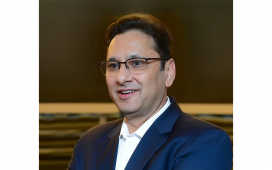
By Pascal Vrinssen, CEO, Extend Experience.