Publicist Inc., a leading communications and publicity agency in the MENA region, has released its third annual Ramadan 2026 report, delivering insights on one of the region’s most competitive entertainment seasons.
Traditionally rooted in television, Ramadan has transformed into the most competitive and influential entertainment season of the year. Streaming platforms lead the charge, investing in high-stakes original productions, anticipated sequels, and exclusive premieres to capture peak audience attention.
Based on extensive cross-platform monitoring, the report captures shifts in audience behavior, engagement patterns, and content performance, revealing a season defined as much by external disruption as by creative evolution.
The 2026 definers:
- Regional expansion
- AI integration
- Rise of true stories
- Fresh talent
- Social drama takeover
- Dominance of the 15-episode format: A clear shift toward shorter, more concise storytelling that prioritises narrative efficiency over traditional length.
- Geopolitical influence: entertainment conversations remained highly sensitive to external global events, significantly impacting audience engagement patterns.
-
Subtle promotions, strong backlash: audiences pushed back on irrelevant marketing

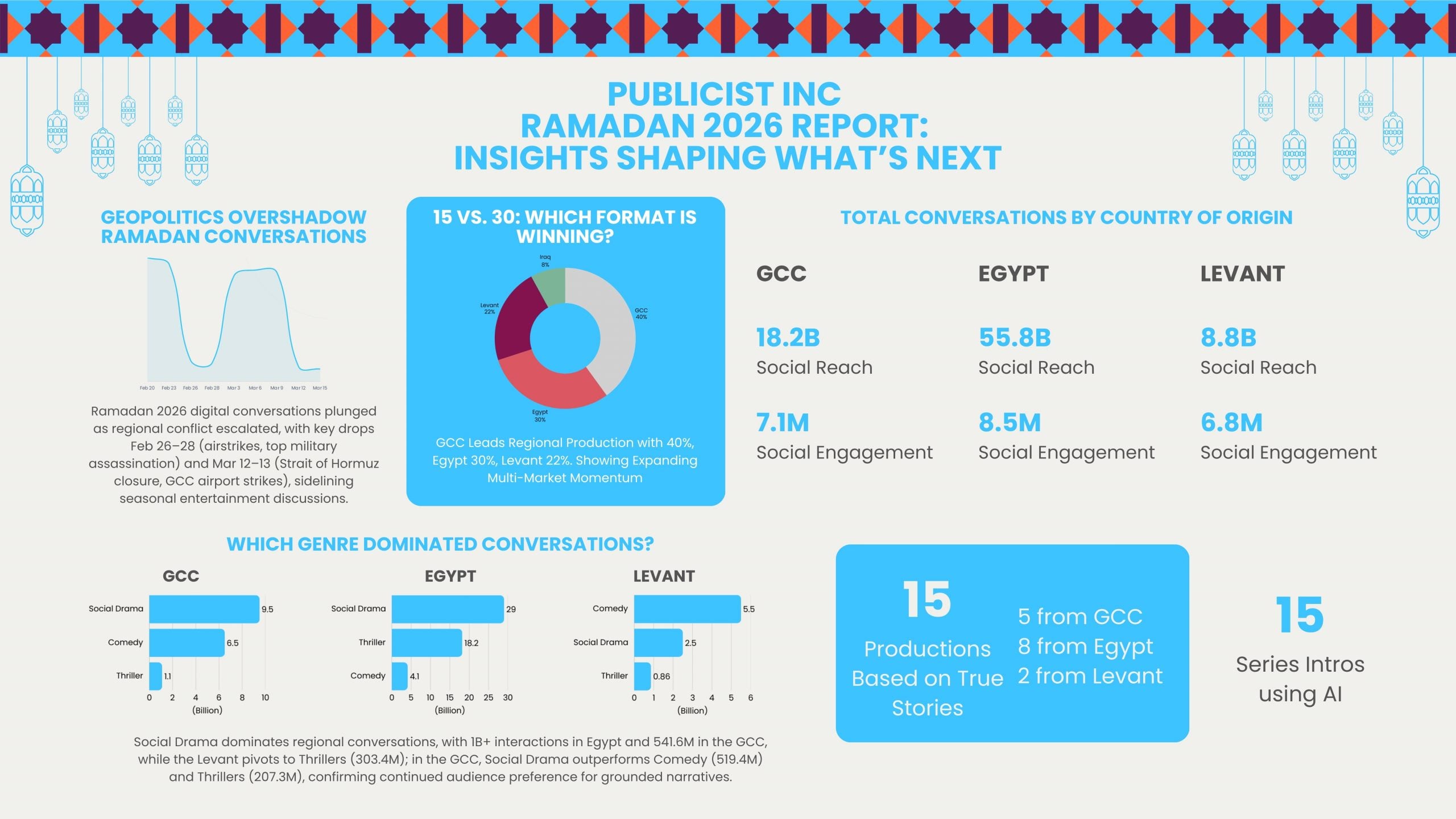
This year, Ramadan 2026 saw a notable shift as external events directly influenced audience engagement. Digital conversations experienced sharp declines during February 26–28 following airstrikes, and again on March 12–13 during the closure of the Strait of Hormuz, creating a “hollow” engagement pattern where real-world developments temporarily overshadowed traditional Ramadan content discussions.
Diversified production landscape
The production landscape showed increasing diversification. The GCC led production with 40 per cent of total output, followed by Egypt (30 per cent) and the Levant (22 per cent). A notable highlight was the growth in Kuwaiti and Syrian productions, which captured a larger share of the regional conversation.
Egyptian dramas maintained a massive 55.8 billion social reach, while Levant productions, bolstered by the Syrian surge, proved most efficient, converting an 8.8 billion reach into 6.8 million interactions. The GCC also demonstrated strong performance and high audience loyalty, achieving an 18.2 billion reach with a conversion of 7.1 million engagements.

The 2026 season confirmed that streaming platforms are now the primary “battleground” for Ramadan entertainment, with a clear divide between local specialists and regional diversifiers.
Watch IT maintained its position as a dedicated Egyptian specialist, while Shahid operated as the ultimate regional diversifier, balancing content from the GCC (37 per cent), Egypt (33 per cent), and the Levant (18 per cent).
Newer players also made significant impacts:
- Yango Play rapidly expanded its footprint, using Egyptian drama as its primary content engine (54 per cent –66 per cent).
- Shasha implemented a disruptive “Day 1” full-series drop model, catering to binge-watching habits and focusing on psychological horror and true crime.
- Dubai+, launched by the Dubai Media Council, successfully debuted as a family-focused platform with a diverse Khaleeji and Emirati slate.

Our analysis shows that Social Drama remains the region’s powerhouse, surpassing 1 billion interactions in Egypt and leading the GCC with 541.6 million.
While the Levant pivoted toward Thrillers (303.4 million interactions), the GCC maintained a distinct preference for grounded narratives, where Social Drama significantly outperformed both Comedy (519.4 million) and Thrillers (207.3 million).
Beyond pure entertainment, Ramadan 2026 saw a surge in “purpose-driven” storytelling, with approximately 15 productions rooted in true stories. Many creators used their platforms to drive social awareness:
- Violence Against Women & Child Safety: Shows like Etneen Gherna and Tawabea displayed support hotlines for victims of violence.
- Health & Social Support: Tawabea raised awareness for Spinal Muscular Atrophy (SMA), while Ab Wa Laken promoted free addiction treatment through national hotlines.
- Legal & Digital Literacy: Series like Had Aqsa highlighted the dangers of cyber-blackmail, providing direct contact details for Internet Crimes Units
AI, microdramas, and emerging formats in Ramadan 2026
The game-changer of 2026 was the milestone integration of technology and short-form storytelling. Egypt dominated the AI landscape, implementing it in 15 series intros and launching the first-ever fully AI-produced show, Alf Leila w Leila.
Simultaneously, “microdramas” emerged as a serious contender for the youth audience, with shows like Tayar gaining traction on TikTok, YouTube, and Instagram. Additionally, the Saudi-based Seera App emerged as a major new player, launching a diverse lineup.
Commenting on the findings, Allaa Ramadan, Co-Founder of Publicist Inc., said, “Ramadan 2026 showed that drama in the region is evolving fast. It is becoming more culturally rooted, more socially driven, more fragmented across platforms, and more open to shorter formats and new technologies, reshaping not just what audiences watch, but how they connect with stories. For brands, the message is clear: staying relevant now means moving with culture, adapting to new viewing habits and showing up where audiences are most engaged.”
This report leverages data collected from February 18 to March 18, capturing the start of Ramadan and the initial surge in audience engagement. Utilising Mention Analytics, the report monitored conversations across traditional media, social platforms, and streaming services to provide a comprehensive analysis of audience sentiment and engagement throughout the Ramadan period.