Meta announced Muse Spark, the first in a new series of large language models built by Meta Superintelligence Labs.
Muse Spark marks another step in its push to reposition Meta AI as a more deeply embedded, context-aware assistant across its platforms. The core update is relatively straightforward: Meta has built a new AI model designed to make Meta AI faster, more capable of reasoning, and more tightly integrated into its apps – including Instagram, Facebook, WhatsApp, Messenger and its AI glasses. But beneath the product language sits a broader strategic direction: the move from standalone AI tools to platform-native intelligence.
A new model: Muse Spark
Muse Spark is described as the first in a new “Muse” series of models. It is designed to handle more complex reasoning tasks while remaining relatively lightweight and fast, with larger models already in development.
This initial model is small and fast by design, yet capable enough to reason through complex questions in science, maths and health. Muse Spark now powers the Meta AI assistant in the Meta AI app and meta.ai, built to support complex reasoning and multimodal tasks.
Meta also introduced new Instant and Thinking modes, allowing users to choose between faster responses or deeper reasoning depending on the task.
That means Meta AI is no longer positioned purely as a text-based assistant. It can now interpret images, respond to visual prompts, and combine different types of input to generate answers. In practical terms, a user could take a photo of a product, a sign, or even a food label and ask Meta AI to analyse or compare it – without needing to describe it in detail.
One of the more significant structural changes is Meta’s introduction of what it calls multi-agent task handling.
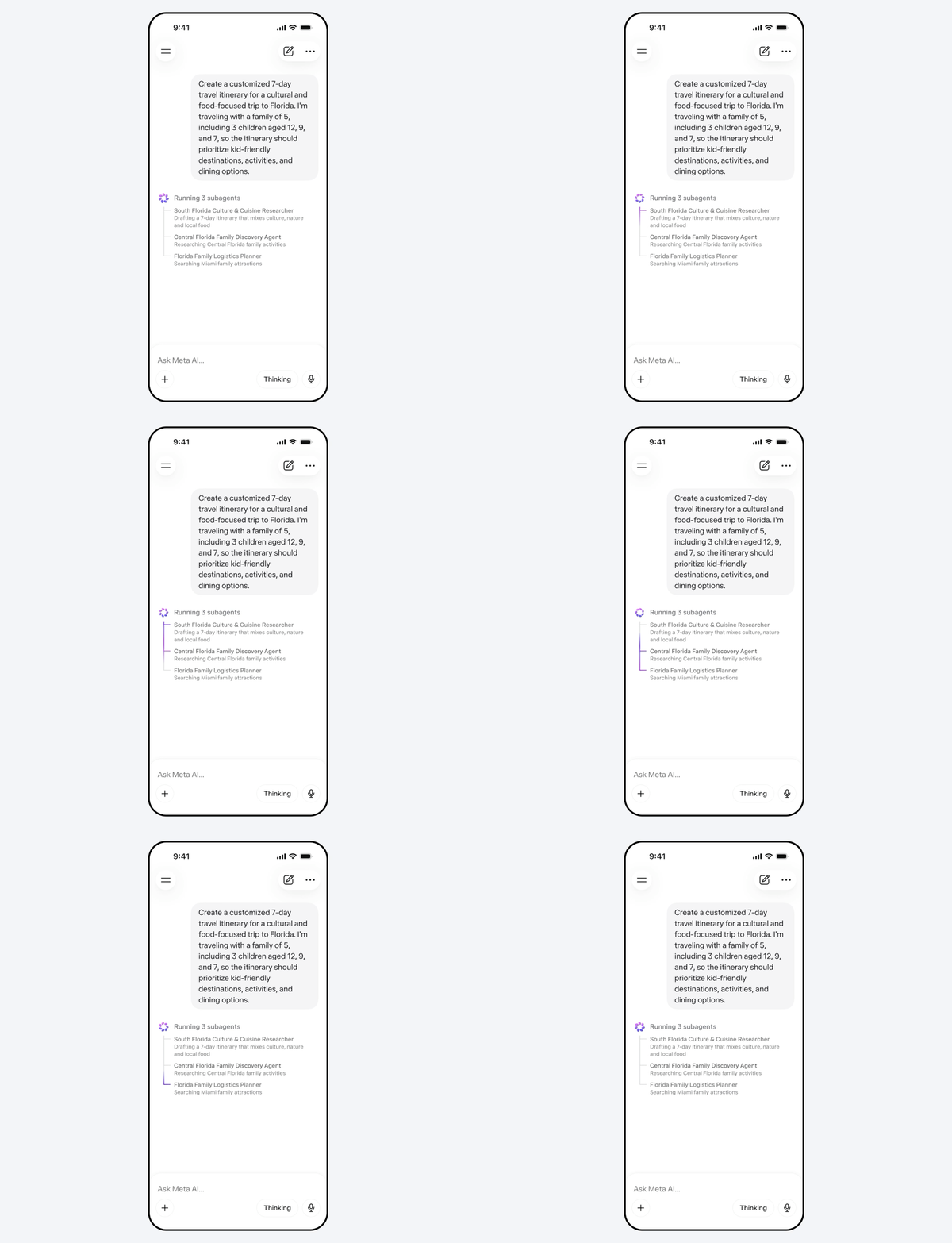
Instead of producing a single response, Meta AI can deploy multiple “sub-agents” to work on different parts of a query simultaneously. For example, planning a trip could involve one agent building an itinerary, another comparing destinations, and a third surfacing activity suggestions – all at once.
While the concept is not entirely new in AI development circles, its integration into a mainstream consumer product signals Meta’s intention to shift Meta AI from reactive assistant to something closer to an orchestrator of tasks.
Muse Spark also strengthens Meta AI’s multimodal capabilities, particularly in visual understanding. Meta says the model can better interpret images, charts and real-world scenes, with applications ranging from general queries to health-related questions.
Health is a key focus area, with Meta noting that it worked alongside physicians to improve the model’s ability to respond to common health concerns, including those involving visual inputs such as scans or images.
At the same time, the model is being positioned as a creative tool. Muse Spark can generate simple websites, dashboards and even mini-games from prompts, pushing Meta AI further into the territory of lightweight content creation.
Shopping, discovery and the attention loop
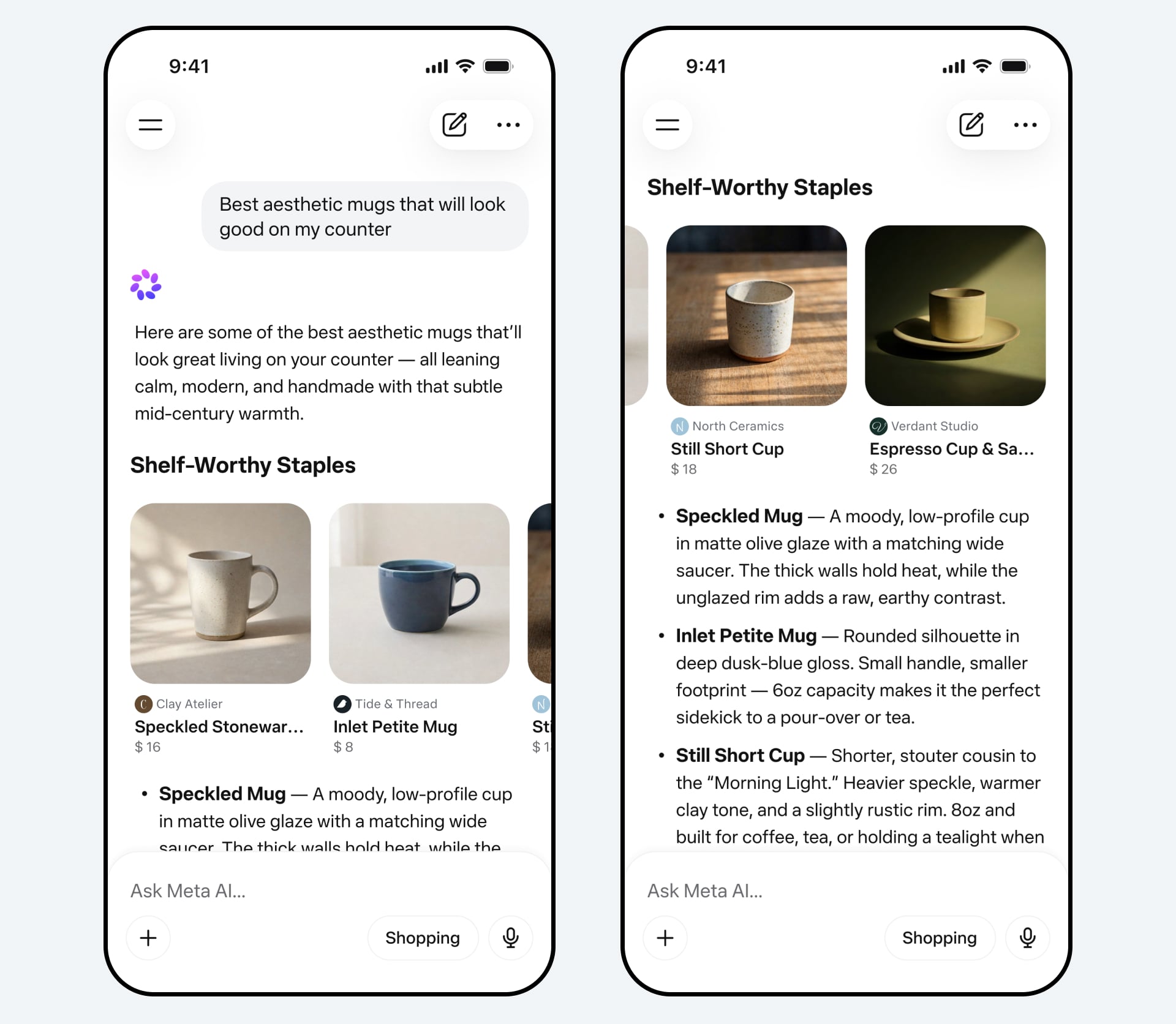
Meta AI can also help users discover what to wear, how to style a room, or what to buy for someone they know. Shopping mode draws from styling inspiration and brand storytelling already happening across Meta’s apps, surfacing ideas from creators and communities users already follow.
The shopping experience is launching in the US first, pulling styling ideas and product inspiration from creators and brand content across its platforms.
The positioning is subtle but important. Rather than functioning as a neutral search tool, Meta AI becomes a discovery engine that sits directly within the content ecosystem it already owns.
This creates a tighter loop between content consumption and commercial intent – where inspiration, recommendation and purchase pathways exist within the same environment.
When users are looking up a place to go or a topic that is trending, Meta AI surfaces relevant context alongside the conversation. Users can tap into a location and see public posts from locals who know the area, or explore what people are discussing through content and community posts.
Meta said future answers may also include Reels, photos and posts with credit back to creators, further tying AI discovery to its existing content ecosystem.
Muse Spark currently powers the Meta AI app and website, with wider rollout planned across WhatsApp, Instagram, Facebook, Messenger and Meta’s AI glasses in the coming weeks.