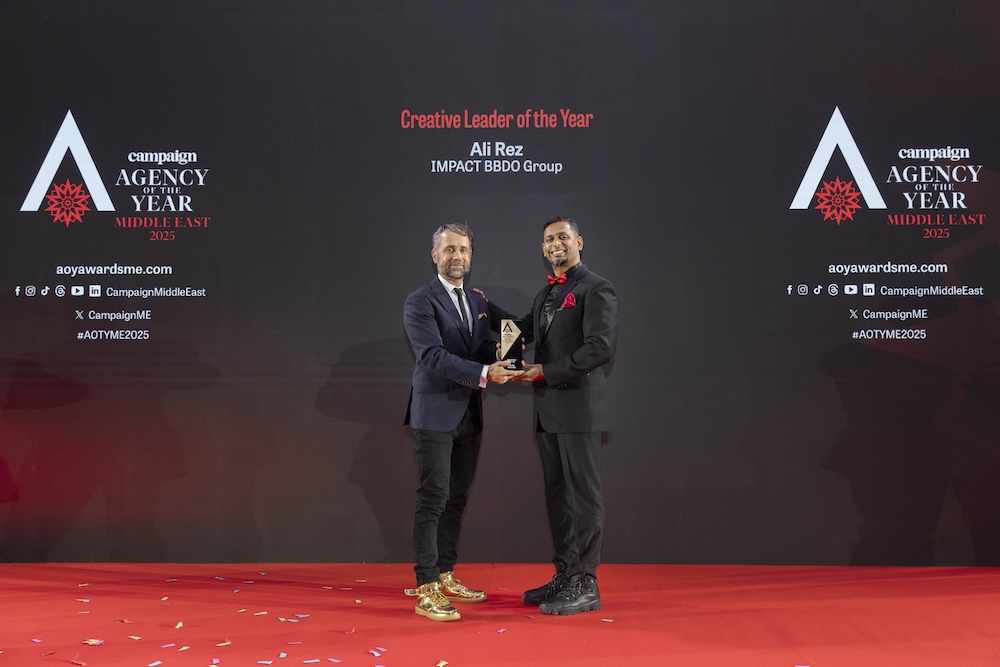
 Impact BBDO’s Regional Chief Creative Officer Ali Rez won the Creative Leader of the Year award for the third consecutive year at Campaign’s Agency of the Year Middle East awards.
Ali Rez, Regional Chief Creative Officer at Impact BBDO took home the Creative Leader of The Year at the 2025 Campaign Agency of the Year Middle East awards.
The jury deemed him as: “A rare creative who can bring together the art and a strong value set. Under his watch, the agency has grown and modernised. The numbers are strong, the ideas are global, and the cultural impact is undeniable. We are particularly impressed with his ongoing offers to mentor young creatives and his work around DEI while maintaining the creative output of his agency.”
In this interview, Ali Rez reflects on his win in conversation with Campaign Middle East.
How does this award reflect the way your leadership has developed over the past year?
Over the past year, besides learning a great deal from my team as I do every year, I’ve tried to shift more from simply directing creativity to building the right environment in order to enable it for everybody in the agency. This has meant focusing more on creating the conditions for great work to happen: having clarity of ambition, access to knowledge, giving everybody the tools they need, a culture of fearlessnes and trust in each other.
I’ve also learned to strike a balance between leading from the front by having a hands-on approach, and giving people the autonomy to create big things on their own. I feel both are now important given where the industry is headed. Creative excellence is a must, but alongside that, leadership now demands a more human, collaborative style that prioritises talent, culture and long-term impact.
What is your proudest moment from 2025 and what’s your key takeaway from it?
I doubt I can pick one moment, since there have been a number of times in 2025 where I have seen my team take creative leaps with confidence. Owning ideas that were bold, culturally relevant, and effective, even when the path wasn’t obvious or easy. The key takeaway has been that when people feel trusted and supported, they rise to the challenge and they deliver consistently. Success wasn’t a result of pressure, but of belief. These moments reinforced the notion that leadership isn’t about pushing harder; it’s about aligning people around a shared ambition and giving them the environment to deliver their best work.
How do you navigate the tension between short-term performance and long-term vision?
Mostly by a mental organisation exercise of being clear about what must be delivered now and what we’re building for later; these two things should never be confused. My notebook even follows an Eisenhower grid to organise things on similar lines. Short-term performance is necessary to keep the business healthy, but long-term vision keeps it relevant and consistent. The role here is to protect both. That means making disciplined choices, saying no when needed, and ensuring today’s decisions don’t compromise tomorrow’s ambition. When teams understand how immediate outputs ladder up to a bigger vision, performance and purpose stop competing and start reinforcing each other.
Where does bold or unconventional thinking fit into growth conversations today?
That’s a great question. I don’t think ‘bold’ is any longer a ‘nice to have’ in growth conversations; it’s a necessity. In a crowded, fast-moving market, incremental ideas don’t drive differentiation or value. Especially with an incoming flood of sameness driven by generative artificial intelligence (Gen AI), unconventional thinking will help brands cut through, build relevance, and create meaningful impact. Growth will come from ideas that challenge norms while remaining deeply rooted in business and culture, and take the bold step of being different. When creativity is treated as a growth driver rather than a risk, it becomes a powerful competitive advantage.
What responsibilities do leaders carry as the industry adapts to new tools, structures and expectations?
Leaders today must have a responsibility to be both curious and grounded. As new tools and structures, especially technologies such as AI, emerge, it’s our job to separate hype from value, and guide teams through change without fear. That means investing in skills, setting ethical standards, and ensuring technology enhances creativity rather than replaces it. Leaders must also protect culture during transformation by maintaining clarity, fairness, and humanity. Change is inevitable; how people experience it is a leadership choice.
What skills or mindsets will define effective leadership for 2026?
Effective leadership in 2026 will require adaptability, emotional intelligence, and strong decision-making, supported by real tech literacy. Leaders don’t need to code, but they must understand AI, data, and emerging tools well enough to ask the right questions and make informed choices. Command over AI will be essential to unlock efficiency, creativity, and scale responsibly. The most effective leaders will combine human judgement with technological fluency, using AI as a creative and strategic partner while keeping purpose, ethics, and people firmly at the centre.