The Gerety Awards 2026 – named after Mary Frances Gerety, the copywriter who in 1948 coined the slogan “A diamond is forever” and the only globally renowned awards programme with an all-female jury of respected leaders and subject matter experts – has revealed the completion of its MEA jury deliberations.
Sessions are held around the world, with international Executive Juries that comprise agency leaders and brand leaders, who determine a shortlist of finalists. This shortlist is then submitted to a Grand Jury of creative experts for a final evaluation, and their votes determine the Grand Prix, Gold, Silver and Bronze winners of the competition.
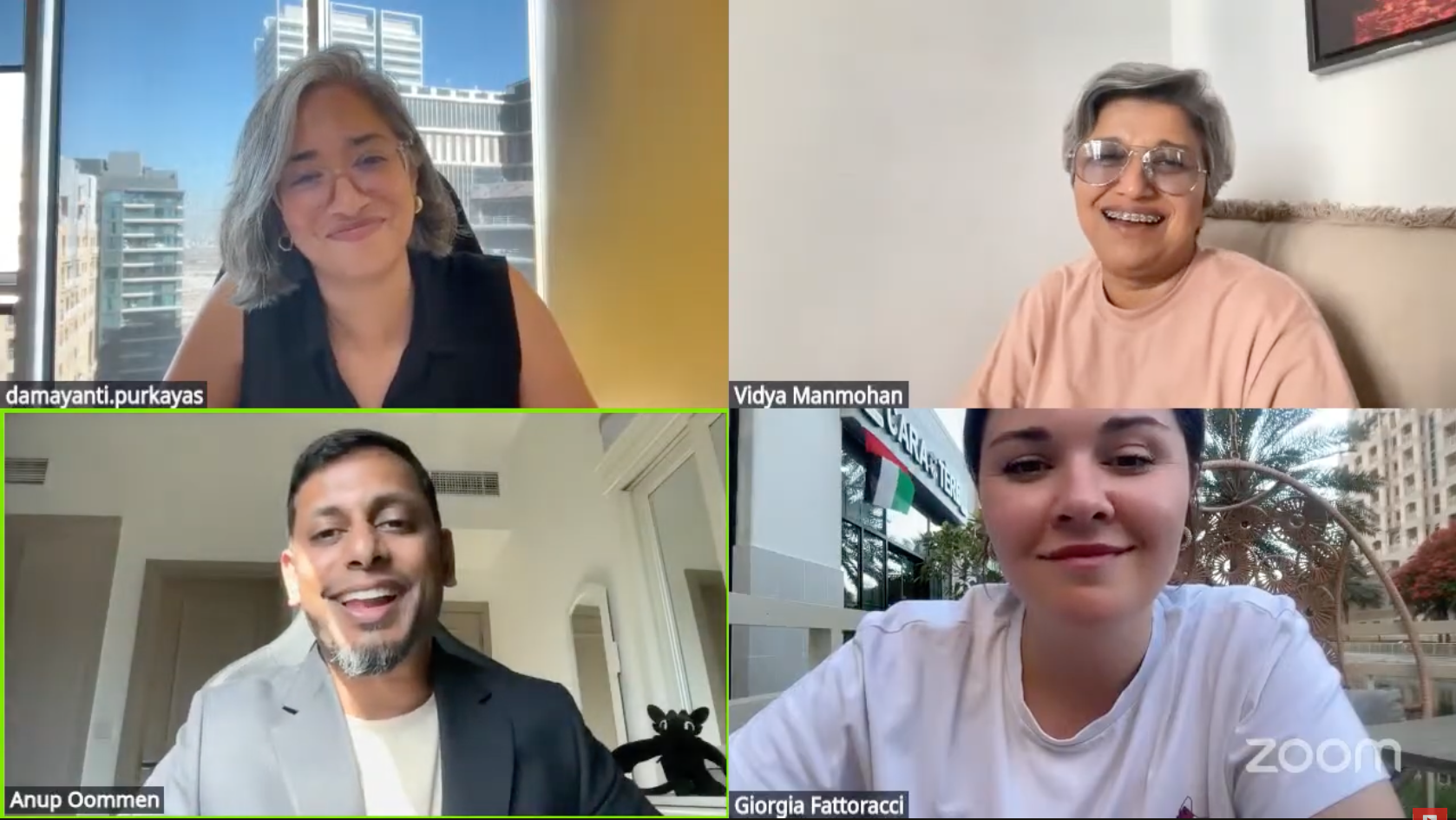
Following initial jury deliberations, three representatives from the larger pool of the Gerety Awards 2026 MEA Jury Panel shared insights from the jury room in conversation with Campaign Middle East. Leaders on this virtual round table included:
- Vidya Manmohan, Founder & Creative Chairwoman, V4GOOD,
- Damayanti Purkayastha, Head of Strategy, MullenLowe MENA, and
- Giorgia Fattoracci, Creative Director and Creative Strategist, Edelman.
At the outset, the senior industry leaders reflected on what they looked for in the work: not just creative originality, but intent, boldness, bravery, humour, rigour, relevance and the thin line connecting output and outcomes.
Their conversation revealed how much the judging process itself has changed. The strongest work is no longer the work that shouts the loudest; it is the work that has earned the right to be heard. The ideas that rose to the top were those with substance beneath the surface.
Bravery is not beautiful without the follow-through
The jury found itself drawn to ideas that did not merely disrupt for the sake of disruption. What mattered was whether a brand had taken a difficult path and stayed with it long enough to make the work count. In other words, courage had to be matched by consistency.
Damayanti Purkayastha, Head of Strategy, MullenLowe MENA, said, “On one hand, what excited us was the work that was brave for the client, whether because they were breaking category conventions, or whether they found a loophole in a very difficult market or category, or whether they went against the grain. On the other hand, it was also because they stuck with the idea. They saw it through, they closed the loop on it, and they took it as far as they could take it.”
Leaders also stated that the strongest work felt rooted in people and place. In an age where technology can generate surface-level polish quickly, they shared that the more enduring ideas were anchored in something recognisably real.
Vidya Manmohan, Founder and Creative Chairwoman, V4GOOD, said, “What went beyond and made the work beautiful was more rooted in human truth and the cultural relevance. We asked, ‘What’s the purpose?’ There were pieces of work that were interesting and brave, and made us say, ‘Let’s talk about this.’ But when we spoke about it, we realised that it didn’t go the distance.”
The jury agreed that strong work still needs to catch people off guard. But surprise alone is not enough anymore. Audiences, clients and juries have become more alert to work that feels manufactured purely for recognition.
“Good work needs to surprise you, and then it has to be believable,” said Giorgia Fattoracci, Creative Director and Creative Strategist, Edelman. “We’ve seen so much, so yes, the work has to capture our attention and feel extra smart to be seen and noticed but, at the same time, we don’t believe everything we see.”
That distinction between impact and emptiness became a key part of the discussion. The jury was cautious of work that looked bold but lacked a reason to exist. Loudness, they suggested, can often masquerade as bravery.
“There’s this fine line between being brave and being loud,” added Manmohan. “If it’s just loud for the sake of being loud, then we have to call it out and acknowledge that there’s no meaning in it.”
Purkayastha framed the issue as one of consequence. If an idea asks to be celebrated, it must also show what it risked, changed or solved.
“Is it coming at a cost to you, or are you really doing something meaningful?” asked Purkayastha. “Jury rooms have become so much more savvy and attuned to things that feel very much like award chasers compared with real work that moves the needle.”
Is the problem being solved actually a problem? Is work speaking clearly enough for the jury?
One of the clearest pieces of advice from the jury was around case building. Too often, entries assume that jurors will immediately understand the issue being addressed. But unless the challenge is framed with clarity and urgency, even a strong idea can lose force.
“For cases that had a bit more of a CSR angle, or maybe not a natural client brief, it was really important for us to understand the problem that they’re setting up,” said Purkayastha. “We questioned, ‘Is this really a problem, and are there other ways that we could have solved this better?’”
Her advice to strategists and creative teams is simple: make the jury care before asking them to admire the solution. The problem needs weight, tension and importance.
“You’ve got to show me the drama,” says Purkayastha. “You’ve got to show me that this problem is super important, it’s super hard to solve, and here’s why it’s hard to solve.”
Fattoracci added that, in categories such as innovation, juries need more than a compelling set-up. They need to understand the mechanics of what has actually been done. Otherwise, uncertainty can cloud judgement.
“When you enter in a category such as innovation, you need to make me understand the innovation that you’re bringing to the table,” says Fattoracci. “There were some cases where we got very excited and then there was a moment of silence, and someone said, ‘But how?’”
The jury also questioned whether agencies sometimes speak too much to themselves.
Case films can become thick with industry language, leaving the actual idea less accessible than it should be. A simple external test, Purkayastha suggested, can be useful.
“Should we show the case study videos to just a normal person who doesn’t live and breathe advertising?” asks Purkayastha. “Are they going to understand the case study and the crux of it, or is it just all in our language?”
Manmohan described a similar instinct in more personal terms. The point was not to oversimplify the work, but to check whether it travels outside the industry’s echo chamber.
“We used to call it the mum test,” says Manmohan. “That’s the perfect consumer to see whether it resonates.”
Category choice also became a recurring issue. Some work may be strong, but if it is entered in the wrong place, its strengths can be harder to recognise.
Fattoracci said teams should invest more thought in where the idea has the best chance of being properly understood.
“Make sure you enter it in a category that is sensible for the campaign and the problem it solves. Instead of entering into every category that the campaign vaguely fits into, focus the approach. Understand how perfectly a campaign fits within a category and then invest in it,” suggested Fattoracci.
Client belief changes the ceiling of the work
The discussion repeatedly returned to the role of clients. A great idea can begin inside an agency, but it usually needs client conviction to grow into something bigger. Without that partnership, the work may stop before it has had the chance to mature.
“The best ideas, those that win Grands Prix awards, are those where clients were involved, and were part of the team,” says Fattoracci. “Clients that are committed help take the work further.”
For Manmohan, timing is part of that relationship. Some work needs longer to settle, prove itself or build cultural relevance. There is no universal formula for when an idea is ready for awards.
“There is no one size fits all,” says Manmohan. “Give it the time. Let it brew, and when you’re ready, when the client is ready, go on the journey with them.”
Purkayastha brought it back to the fundamentals of partnership. Strong agency-client relationships allow teams to ask better questions, uncover deeper briefs and build work that has more room to breathe.
“You’ve got to understand the problem that the client is asking you to solve,” says Purkayastha. “Good relationships are going to lead to good work.”
A jury room that leaned heavily into active listening
The jury experience itself stood out because of its intimacy and openness. The group was smaller, the conversations were thoughtful, and each juror had space to contribute. That changed the energy of the process.
“It was definitely more intimate,” says Purkayastha. “Everyone had a voice, and we were naturally very respectful of each other.”
Manmohan felt that the all-women room did not change the criteria, but it did influence the lens through which ideas were discussed. Different experiences brought different kinds of work to the surface.
“The criteria is the same as any award show,” says Manmohan. “But the lens that we come from helps ideas rise differently across categories.”
Fattoracci said that the way the jury process was structured allowed jurors to share perspectives without being forced instantly into fixed positions.
For context, the Gerety Awards does not require jury members to take decisions or score entries immediately during jury deliberations. Instead, jury members get to reflect on the discussions and consider the different perspectives shared by fellow jury members for a day or two before they decide on their final scores.
This gave the decision-making more space and reduced the pressure to defend a view too quickly.
“When the jury room is about sharing perspective, sharing information and sharing opinions, and then you have one or two days to think about it, that’s when it’s more meaningful. It gives you space to think before you settle on a decision,” explained Fattoracci.
What the work revealed about the industry
Across the work, the jury saw fewer last-minute or obviously superficial entries than in previous years.
There were also disagreements in the jury room, particularly in categories such as humour, which tends to be more subjective and where cultural context matters deeply. But those disagreements were seen as part of a healthy jury process rather than a barrier.
The increasing presence of AI was also noted, not as a novelty but as a theme beginning to appear in different forms. Some work used AI to create more emotional experiences, while other entries tried to bring more structure to emerging questions around the technology.
Purkayastha’s own takeaway from the strongest work was straightforward. The ideas that stayed with her were not flat or generic; they understood their audience and completed the journey they began.
“Ultimately, don’t be dull,” said Purkayastha. “The work that wasn’t dull, that surprised me, that went there, and showed up for that particular brand’s audience, stood out.”
All in all, the conversation pointed to an industry growing more demanding of itself.
Creativity is still about imagination, but imagination now has to bring proof, patience and purpose with it. A great idea cannot simply sparkle in the room; it has to carry weight outside it.
For agencies and brands, the lesson is both simple and difficult: frame the problem clearly, choose the right arena, make the work understandable, bring the client with you, and give the idea enough time to become what it needs to be.
Awards may recognise the work at the end, but the real judgement begins much earlier, in the choices made long before the case film is cut.