Many brands are still failing to deliver on the basics of customer experience, especially within online shopping, reveals VML’s ninth annual Future Shopper report.
Surveying over 25,000 shoppers across 16 countries, including Saudi Arabia and the UAE, the 2025 edition exposes a gap between what consumers expect and what brands provide when it comes to value, speed, and trust.
The global study finds that despite years of digital acceleration, 45 per cent of global shoppers often abandon their online shopping cart because the digital experience is too frustrating.
“Future Shopper 2025 is a reminder for brands and retailers everywhere. The data is clear: consumers are continuing to raise the bar on what they expect – faster delivery, seamless experiences, and meaningful personalisation powered by technology like AI, whilst at the same time re-evaluating what they purchase and when,” said Jeff Gehab, Global CEO, VML Enterprise Solutions.
A lens on consumers in the Middle East
Out of the 16 countries surveyed, Saudi Arabia and the UAE have revealed key insights into consumer behaviour and shopping habits. both online and offline.
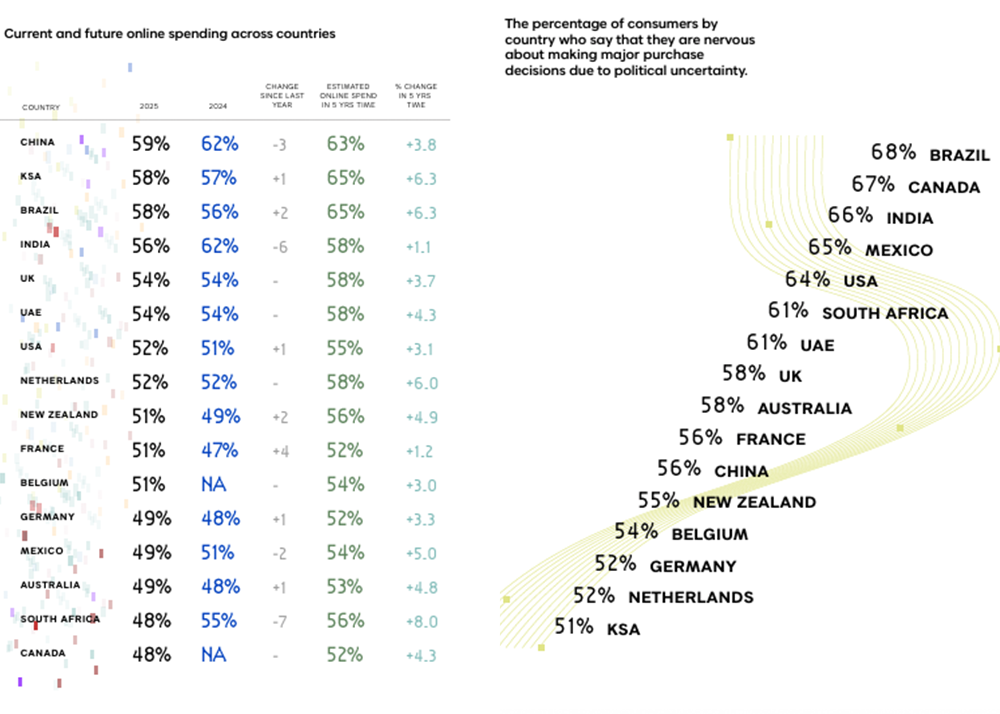
In a politically volatile world, consumers are delaying major decisions and looking for brands and retailers that align with their views, the report finds. 61 per cent of UAE consumers and 51 per cent of Saudi consumers claim that they are nervous about making major purchase decisions due to political uncertainty.
“In today’s risk-averse market, every purchase is a considered purchase. Consumers are demanding reassurance – on price, on speed, on trust – before they commit,” said Neil Dawson, Global Chief Strategy Officer, VML.
Furthermore, when it comes to online shopping, UAE (62 per cent) and Saudi (59 per cent) consumers state that they will not shop with a retailer, brand or marketplace that does not match their expectations of online shopping.
Brands must prioritise human-centric experiences and address consumer frustrations with current digital offerings, especially if they want to grow in an AI-first world the report suggests. “Many businesses are missing the mark on the fundamentals of customer experience,” Gehab said.
However, in terms of consumer trust in AI, 60 per cent of UAE shoppers say that it does not bother them that content is generated by AI with KSA shoppers trailing closely at 56 per cent.
Another key element shoppers in the region value is speed, leading to the concept of ‘compressed commerce’ – the idea of getting from inspiration to purchase as quickly as possible. In the UAE, 68 per cent of consumers back this claim, while the figure changes to 65 per cent in Saudi Arabia, suggesting that shoppers in the region want fast purchasing journeys online.
In terms of the shift in online spend, the UAE sees no change between 2024 and 2025, with results proving that 54 per cent of shopping spend is online and is projected to grow to 58 per cent in five years. In Saudi Arabia, the percentage sees a slight raise from 57 per cent in 2024 to 58 per cent and this spend is projected to grow to 65 per cent by 2030.
Global takeaways on online and offline shopping
On a global scale, VML’s study reveals that many brands are still failing to deliver on customer experience and that search is resurging thanks to AI.
“Neither the customer journey of the future, nor the consumer of the future will be the same as today, but retailers and brands must find a way of offering the best experience right now, while building the experience of the future in parallel,” said Gehab.
From the report, these are the top five takeaways on a global level:
- AI’s rapid emergence across the path to purchase: 68 per cent of consumers have used AI tools like ChatGPT to shop. 52 per cent are excited by the prospect of having their own AI agent to shop on their behalf.
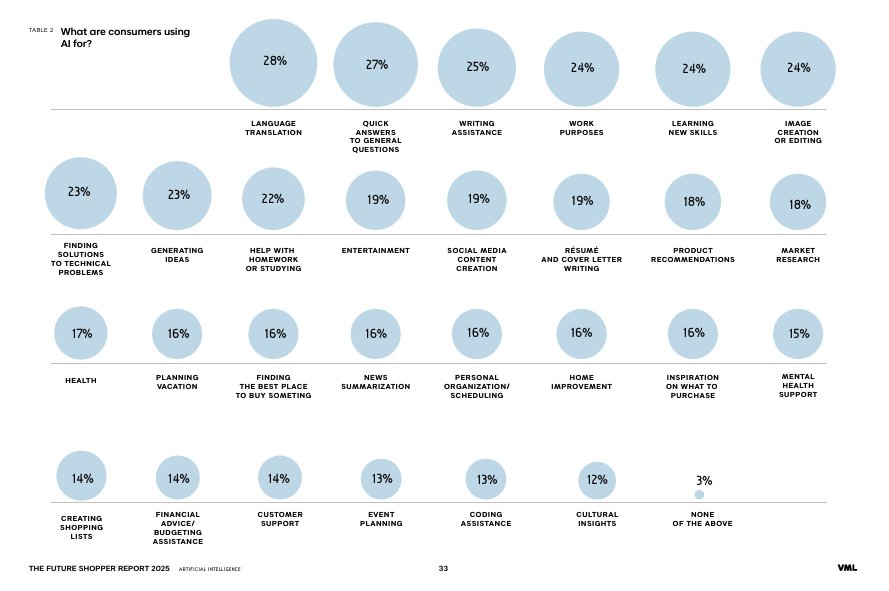
Image sourced from The Future Shopper report. - Personalisation powers discovery but falls short for some: 63 per cent say personalised recommendations help them discover new products. 45 per cent of consumers think most brands do a poor job of personalisation.
- Customer experience: 46 per cent are often amazed at the poor online shopping experience by major retailers. 50 per cent think businesses have no idea what customers want from their digital channels.
- “I want it right now or I don’t want it at all”: 32 per cent of shoppers expect delivery within two hours; 40 per cent will not order if same-day delivery or scheduled delivery isn’t available. 58 per cent want to move from inspiration to purchase as quickly as possible – a trend VML has coined “compressed commerce.”
- A shift toward true omnichannel retail: Marketplaces remain the dominant force throughout the shopper journey, with 22 per cent using the lead marketplace in the region for inspiration, 15 per cent using the secondary marketplace, and 9 per cent using other marketplaces. When it comes to search 17 per cent use the lead marketplace, 12 per cent the secondary and 7 per cent other marketplaces. However, marketplace share of wallet has slipped to 22 per cent, down from 29 per cent last year, signalling a shift toward true omnichannel retail.
“The Future Shopper 2025 makes it clear that commerce success now depends on delivering tangible value at every stage of the journey, from discovery to delivery,” Dawson concludes.
“That means personalising in ways that genuinely help, rethinking fulfillment for the two-hour economy, innovating for real-world value, and using AI to simplify rather than complicate.”
To download the full report, click here.