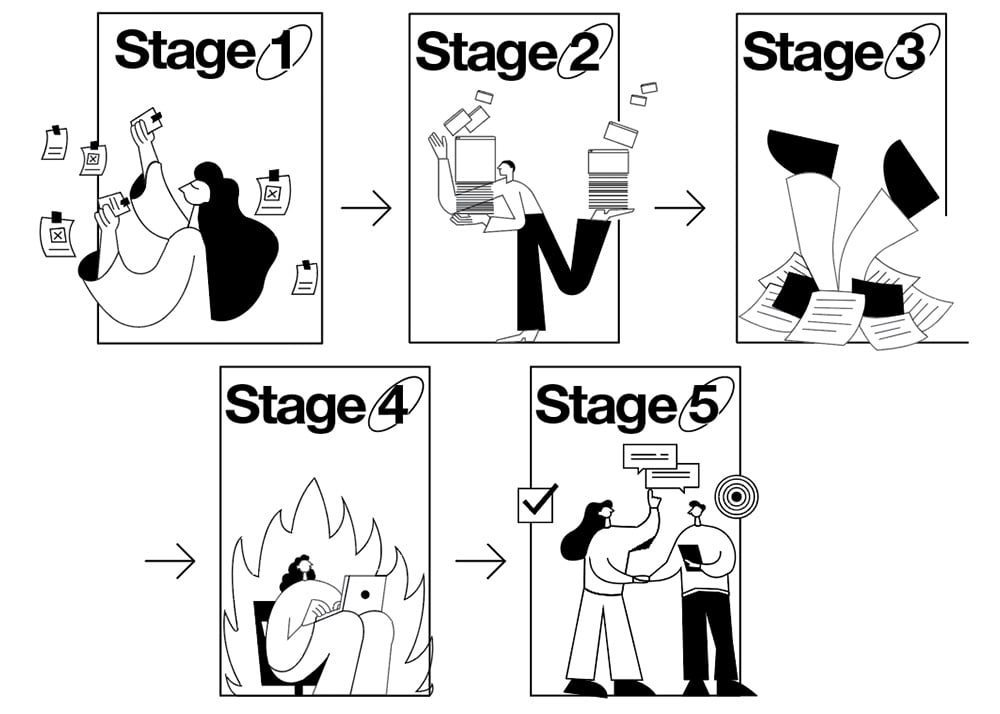
C&B team looks at the costs and the growing demands and challenges of maintaining an in-house team.
We are in the era of dual-gatekeeping.
Over the past decade, brands raced to set up creative teams as it was ‘cheaper, faster and closer to the data’.
But volume exploded, talent walked, and the ‘savings’ never quite materialised.
Now, the pendulum is swinging the other way.
Myth #1
“Content demand grows gradually so in-house teams can keep up.”
Fact #1
96 per cent of marketers have seen demand double in the last two years.
Myth #2
“Generative AI solves the high volume problem internally.”
Fact #2
99 per cent of creative professionals already use AI but 48 per cent of creative teams struggle.
Myth #1
“Influence peaks in teen years.”
Fact #1
60 per cent of marketers say their organisation has a marketing effectiveness skills gap.
The big picture
71%
of marketers expect demand for content to grow by up to five times in the next year.
76%
of marketers say production timelines have shortened, sometimes by more than 20 per cent.
94%
of chief marketing officers say that translating enterprise strategy into marketing plans is a challenge.
The in-house boomerang curve

Brands doing it right

Coca-Cola + WPP’s ‘Open X’
- Partnered to set up a bespoke ‘in-house’ model dedicated to Coca Cola’s 150+ brands.
- Pools data, creative, media, and production across agencies.
- Jointly invests in training and capabilities, strengthening both Coca-Cola and WPP.

Kraft Heinz ‘The Kitchen’
- Established a dedicated agency with 200 creatives across 9 markets for Heinz brands.
- Explicitly designed not to compete with rostered external agencies.
- Produces day-to-day assets efficiently, freeing agencies to focus on high-stakes campaigns.
Bottom line
So did the in-house experiment fail? Not quite. It delivered a lesson, not a revolution, and will always have a role. But it isn’t built to think at scale.
That comes from specialists who focus entirely on how to sell, so companies can focus on building what’s worth selling.