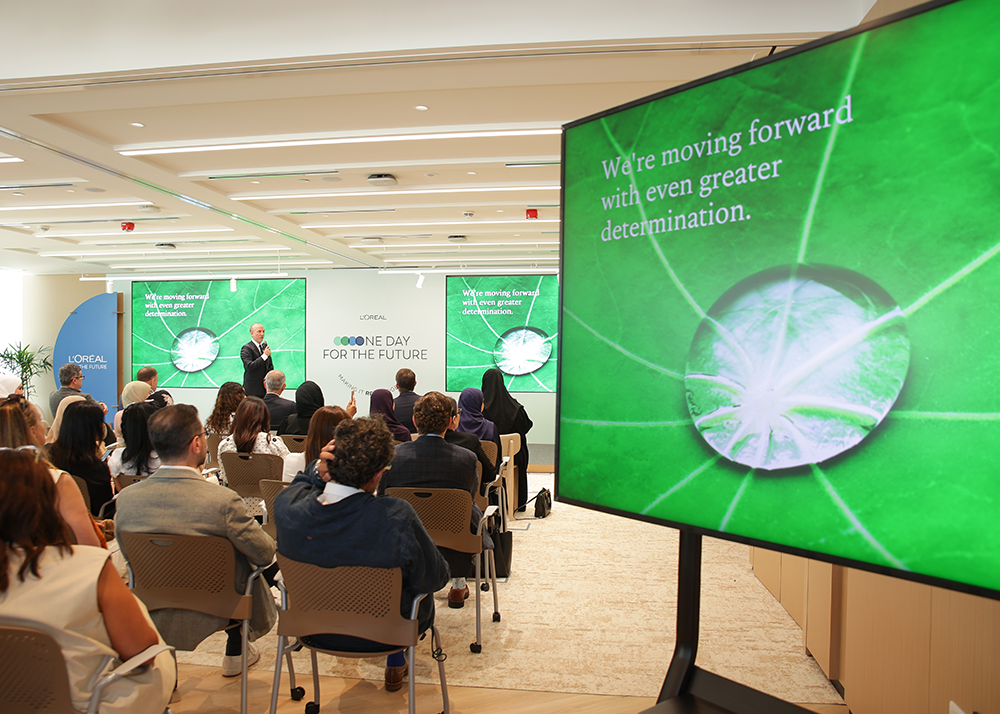
The third edition of the L’Oréal For the Future Summit in Dubai brought together government representatives, sustainability experts, retail partners and industry leaders to mark a decisive step in L’Oréal’s journey from ambition to accountability in the fight against climate change.
As home to the regional headquarters and a market at the forefront of the Gulf’s green transformation, the UAE is where L’Oréal is piloting and scaling its key environmental initiatives – proving that sustainable beauty can be accessible, impactful and commercially viable.
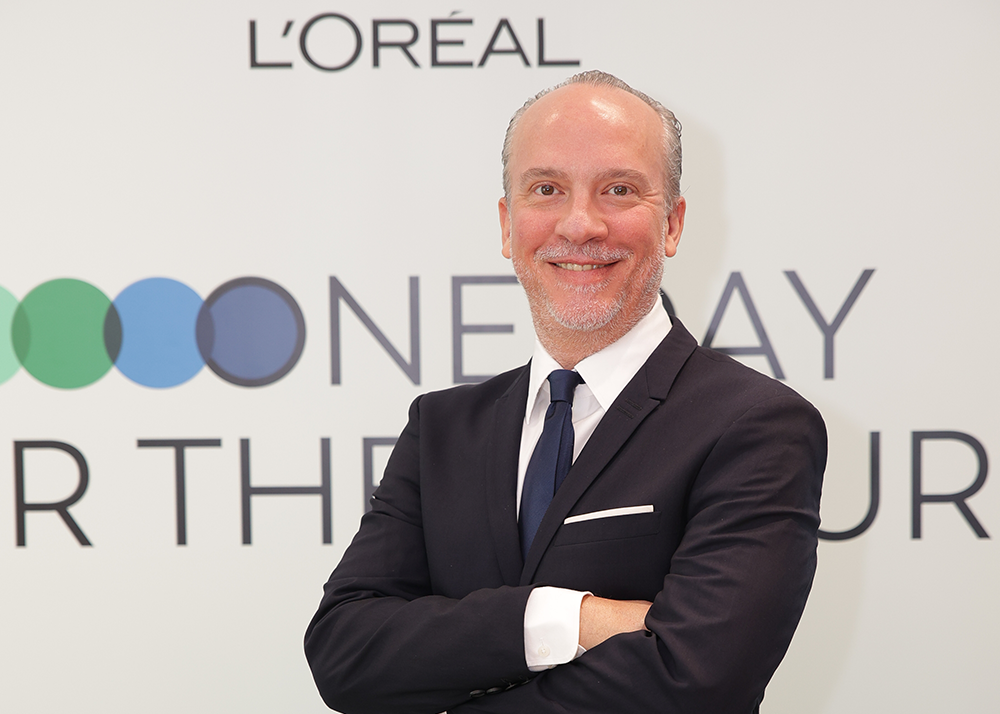
“Our mission is to create the beauty that moves the world. This means providing our consumers with the best products and experiences, while doing so responsibly, protecting our planet and supporting the communities around us,” said Laurent Duffier, Managing Director, L’Oréal Middle East.
At the Summit, the company announced the signing of the UAE Climate-Responsible Companies Pledge with the Ministry of Climate Change and Environment, ), in the presence of Eng. Aisha Mohamed Al Abdooli, Director of Green Development & Environmental Affairs Department at the Ministry.
“Sustainability here is not a trend. It is a living urgency. Which is why we have formalised our commitment by signing the UAE Climate-Responsible Companies Pledge with the Ministry of Climate Change and Environment,” he added.
Championing circular retail for beauty in the region
Putting the pledge into action, L’Oréal Middle East has expanded the availability of refill stations through strategic retail partnerships to reduce plastic waste and bring sustainable beauty to more consumers across the UAE.
These partnerships extend L’Oréal refillable solutions to select pharmacies in the UAE, highlighting the group’s ongoing efforts to embed circularity into the everyday routines of UAE consumers.
“Pharmacies are places that consumers already visit and trust for expert advice. By placing our refill stations and products in pharmacies, we are making sustainable choices part of the consumers’ everyday routine,” said Duffier.
“This isn’t a new mindset for us; we have been on this journey since 1979. As L’Oréal, the world’s largest beauty company, we know we have both a responsibility and an opportunity to help drive real, positive change,” he added.
Through these efforts, refillable beauty is now highly visible and accessible across all of L’Oréal’s categories – makeup, skincare, haircare, and fragrance.
The offering spans luxury brands such as Kiehl’s, Prada, and YSL Beauty; dermatological brands including La Roche-Posay and CeraVe; and professional ranges like Kérastase and L’Oréal Professionnel.
The environmental impact is measurable: the Prada Paradoxe refillable, for example, reduces material use by 44 per cent glass, 67 per cent plastic, 100 per cent metals, and 61 per cent cardboard compared to standard formats.
The inclusion of pharmacies as a sustainable retail touchpoint aims to integrate convenient and affordable solutions in places people trust the most.
“In the Middle East, pharmacies serve as genuine community hubs. This trusted channel allows us to make sustainable beauty accessible to a far wider audience than a flagship boutique ever could,” said Duffier, explaining that over time, this presence allows sustainable choices to “stop being the alternative,” and instead, “the default”.
To further reduce its footprint at the point of sale, the group claims that 100 per cent of L’Oréal’s Point-of-Sale Materials (POSM) are now eco-designed, with the company actively working with suppliers to measure, report, and optimise their CO2 emissions.
View this post on Instagram
Brand purpose that takes action
L’Oréal’s commitment to sustainability is rooted in action by innovation, across its business operations.
The group has signed the UAE Climate-Responsible Companies Pledge with the UAE Ministry of Climate Change and Environment to publicly aligning itself with the UAE’s Net Zero by 2050 agenda.
“This not a symbolic gesture. It means our targets are tracked, reported and open to scrutiny – which is exactly as it should be,” said Duffier.
On the ground, he explained that this accountability is already translating into action.
“We have partnered with Mohebi Logistics to transition our deliveries to electric vehicles, and with Aramex on biodiesel fuels because the way our products travel matters just as much as how they are made. We also work alongside industry peers through the Circular Packaging Association to develop smarter waste solutions not just for L’Oréal, but for the beauty industry as a whole,” he said.
“Partnerships and pledges are important starting points. But what ultimately builds trust is consistent action and results that can be measured. That is the standard we hold ourselves to and the standard we invite our partners, our consumers and the communities we serve to hold us to as well,” he added.
Looking ahead, L’Oréal Middle East aims to accelerate its sustainable offerings from ingredient sourcing to product packaging.
“To drive this forward, we are investing €100 million into our Sustainability Accelerator Programme providing dedicated funding for breakthroughs in responsible sourcing, sustainable science and next-generation packaging,” said Duffier.
“We are also deepening our commitment to people. Innovations like Lancôme’s HAPTA, an adaptive makeup tool designed for people with limited hand or arm mobility remind us that sustainable beauty must be for everyone. Inclusion isn’t a separate goal; it is at the very heart of everything we do,” he added.
This has been implemented in the region through a partnership with Al Noor Training Centre. The group has donated 30 units of the Lancôme HAPTA device – a handheld, computerised makeup applicator which helps those with hand-motion disorders, arthritis, Huntington’s Disease, and stroke-related motion challenges – to make self-expression through beauty more accessible, achievable, and easier than ever before.
Through these initiatives, L’Oréal has made circular, sustainable and accessible beauty a brand mandate in the region in an effort to accelerate the transition to a more responsible beauty industry in the UAE, and to demonstrate that environmental leadership and commercial ambition go hand in hand.