Your competitors spent previous Ramadans testing creators, formats and messages. They paid for all of it, and every post, view and comment is still public. Yet most Ramadan briefs are written from scratch.
Ramadan 2027 is expected to begin in early February, which leaves about ten weeks to get the creator plan right. At Swavy, the AI-native influencer marketing platform, we’ve built technology that turns the region’s creator content into market intelligence, so every campaign decision starts from data.
Start with what your competitors already tested
Swavy’s technology goes through every post about a brand and its competitors in three layers:
- Every video, frame by frame: the format, the hook and how the product
- Every creator, detail by detail: audience interests and location, past brand collaborations, median views and performance over time.
- Every comment, one by one: what people praised, what they asked for and what put them off.
With all of that in one place, you can answer the questions that are usually guessed: how much competitors spent, when and where, how many creators they booked and who was in the mix, how they briefed them, and which trends took off.
For example: How many more creators do you need?
We analysed over 400 brands, 18,500 creators and 145,000 posts across five industries in Saudi Arabia, the UAE and the wider GCC, and compared Ramadan 2025 with an average month in the year before. Brands worked on average with 2.6 times as many creators in Ramadan, from 1.7 times in telecom to 3.4 times in grocery.
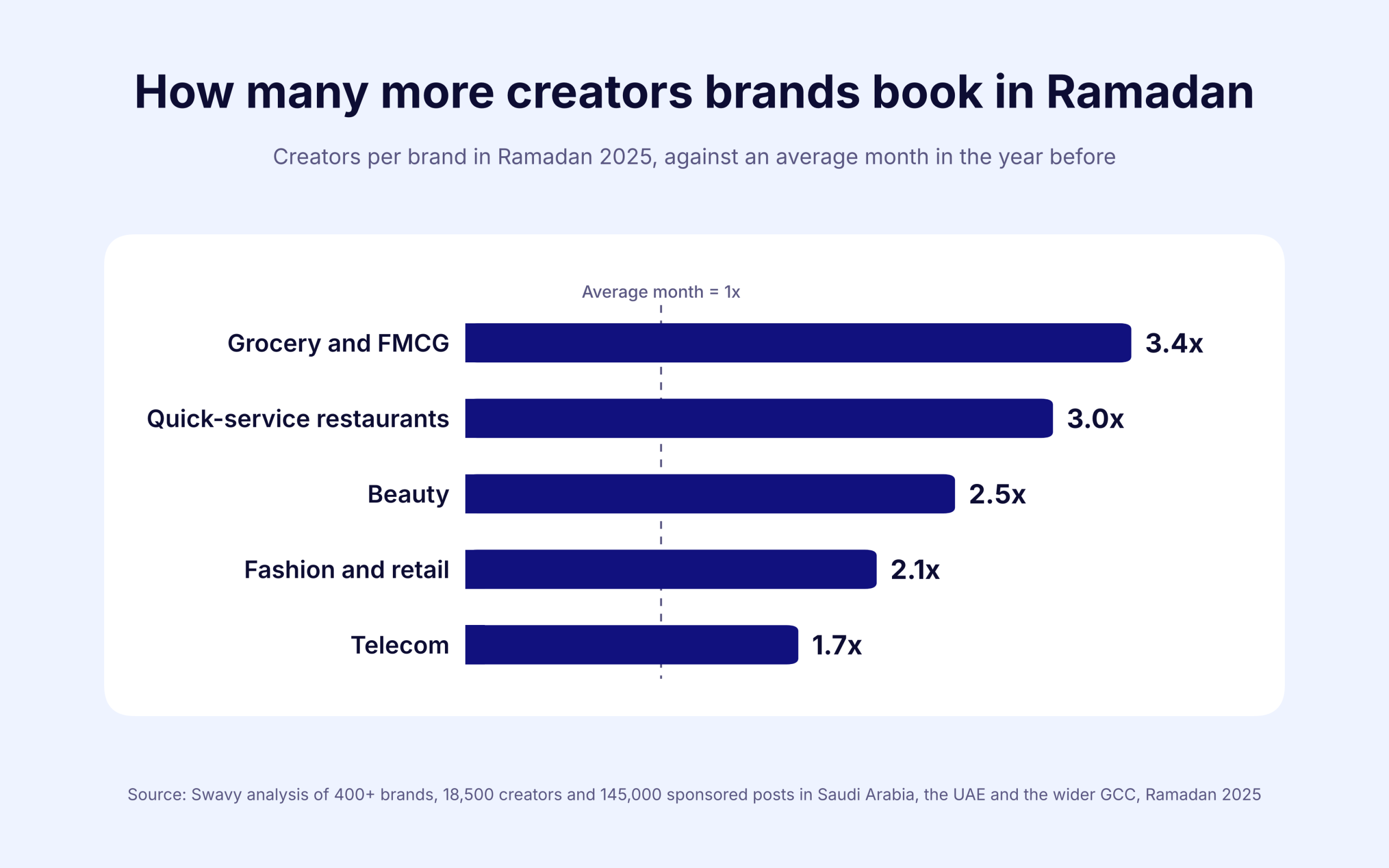
Saudi brands scaled much harder than UAE brands, at 3.2 times against 1.9, with the rest of the GCC in between. Creator fees also rose by about 20 per cent across our own Ramadan bookings, so a grocery brand keeping pace with its category would need roughly four times its usual monthly creator budget.
But knowing how many creators to book is only the start. When an entire industry scales at the same time, brands end up competing for the same creators and the same audience attention.
What the number leaves out
The busiest creators deliver the least. The typical creator in our sample more than doubled their sponsored posts in Ramadan, across all the brands they work with. Views held steady up to about five brand posts in the month. Beyond that, views per sponsored post fell by 38 per cent, and comments calling the post an ad became three times as common. In other words, the typical creator spent Ramadan well past the point where their posts start losing views.
The same faces sell your rivals. In grocery, 41 per cent of the creators a brand booked also promoted a direct competitor in the same Ramadan. Their posts earned 28 per cent less engagement than posts from creators who stayed with one brand.
The brands that looked elsewhere did better. Beauty brands that cast at least a quarter of their creators from outside beauty, mostly family, food and lifestyle creators, got 2.2 times the views per post of brands that stayed inside the category.
What to do about it
Check the load before you book. Ask how many brand posts a creator has lined up for Ramadan, and think twice above five.
Ask for category exclusivity for the month. It costs more, but a creator who also promotes your rival earns you less engagement.
Look outside your category. Start by casting a quarter of your creators from adjacent categories such as family, food and lifestyle.
Past Ramadan campaigns are over, but everything they can teach you is still public. The brands that stand out in 2027 will be the ones that studied it first.
By Jacques Saab, Co-Founder of Swavy, an AI-native influencer marketing agency based in Dubai, working with brands across the GCC and the MENA.