Recently I interviewed people in places that don’t exist.
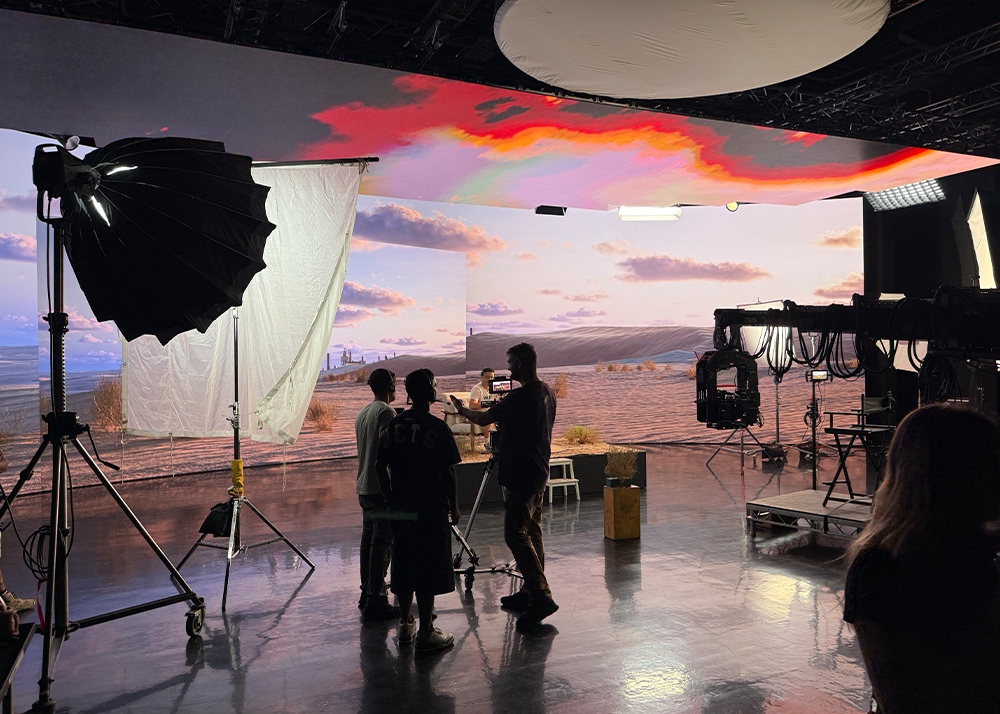
That wasn’t the plan. The plan was the normal one. Take the crew to site, stand each person in front of the thing they’re talking about, and let the place do half the work for you. Then the access didn’t come through in time, and we found ourselves in a studio with a very big LED wall and no real idea yet what to put on it.
I’ll be honest, a studio wasn’t where I wanted to be. I come from factual and documentary. You go to where the story is, that’s the whole job. The studio was the fallback, and the fallback version of this is usually a slightly worse copy of the real place that you hope nobody looks at too closely.
So I thought, if the wall can show anything, why copy somewhere we couldn’t get to? My idea was to build places you could never put a tripod in. Imagine trying to shoot an interview on a plinth floating in the middle of the ocean. Or on a dock that doesn’t exist, in the middle of a mangrove forest. And how long do you think a jib would actually last on the side of a sand dune before it started sinking? Nobody watching is going to think we were actually there, and I’m fine with that. We’re not trying to fool anyone.
I should say I couldn’t have done any of this on my own. I work with people who heard “let’s put an ocean on the wall” and said yes, which is not nothing. Then a team of artists worked very hard to turn something in my head into somewhere you’d believe a person was sitting.
I knew I’d enjoy that bit. What I didn’t see coming was what it did to the people. A couple of our contributors had never been on camera before. If you’ve done this for a while you know what that normally means. You add time to the schedule. You do the first answer three times. You tell them “you’re doing great, darling!” in the same voice you’d use to train a cat to use the litter box.
They were naturals. They forgot the lights, forgot the crew, forgot the massive glowing wall behind them. It stopped feeling like an interview and felt like a chat between friends over a brew. At one point I asked one of them something personal and she completely forgot where she was. She was visibly moved, took a second, and then answered from the bottom of her heart. If it makes the edit, it’ll be the moment people remember from the film.
I’d love to say that was all down to my interviewing. I think a fair bit of it was the air conditioning. Think about what we normally put someone through on a location interview out here. Stand here. Actually not there, the sun’s wrong. Sorry, can we go again, there was a truck. And again, wind on the mic. We’ve got about twenty minutes before we lose the light, so no pressure, but could you explain your life’s work in a nice relaxed way? Meanwhile there’s sand grinding inside a lens somewhere and the whole crew is quietly doing sums on the schedule.
Then we get to the edit and wonder why everyone looks like their passport photos. In the studio nobody was fighting anything. No wind, no trucks, no racing the sun. The crew were relaxed, so the room was relaxed, so whoever was in the chair was relaxed.
A set that calm doesn’t just happen, by the way. A lot of people worked hard to make that day feel easy, and I noticed. We could take our time, and it turns out people who are given time start sounding like themselves. The day ended up looking better than my storyboard, and I’m glad. My storyboards aren’t stick men any more, AI lends a hand these days, but it was still far better than what I’d imagined.
It’s left me with a question I probably should have asked years ago. Who is the location actually for? It’s not for the person being interviewed. They’d rather be comfortable. I think it’s for us. It’s proof. We went, we got the access, look, it’s real. And I do think that matters. I’m not saying documentary should move indoors. I’d hate that. I love going to the place to tell someone’s story, and I’d be gutted if that’s what anyone took from this. If the story is the place, you go to the place and you put up with the sand.
But plenty of interviews aren’t that. They’re someone explaining what they do and why they care about it, and the place behind them is mostly there to make it feel authentic. For those, I think I’ve been getting the trade wrong for years. I’ve been fussing over whether the background is real and not paying nearly enough attention to whether the person is.
She gave that answer sitting in front of somewhere that has never existed. And she meant every word. I haven’t got a rule out of this, and I don’t trust “always studio” any more than “always on site”. What’s changed is the first question I’ll ask next time. It used to be “where is this?” Now I think it’s “where is this person going to be most like themselves?” Sometimes that will still be on site at six in the morning.
I went in thinking we’d lost something by not being there. I’m not sure we did, and I’m a bit annoyed it took a locked gate to make me ask.
By Nerav Rao, Senior Creative Producer, Boomtown Productions