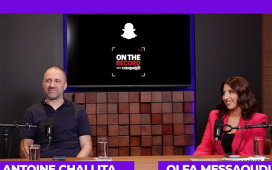
The Inhouse Agency’s Rasha Hamzeh outlines how creators and brands can stand out when everyone has a microphone.
Nearly three years ago, we started a podcast from scratch. Coming from a media background, we understood audiences, content and distribution. Yet, podcasting taught us something quickly: creating great conversations is only a small part of the equation. Getting those conversations discovered, consumed and remembered is an entirely different challenge.
Today, podcasting is more accessible than ever. New creators emerge daily, platforms continue to multiply, and listeners have an endless supply of content competing for their attention. While that’s exciting for the industry, it also creates a difficult question for creators and brands alike: How do you stand out when everyone has a microphone?
The answer isn’t louder production, bigger budgets, or chasing every trend. It’s about understanding the ecosystem, measuring the right things, finding your niche and showing up authentically.
Navigating the platform maze: Where should your voice live?
One of the biggest misconceptions in podcasting is that publishing an episode means your work is done. In reality, publishing is where the work begins.
Today’s podcasters have access to distribution hubs that can push content across multiple platforms, from Spotify and Apple Podcasts to YouTube and emerging players entering the space. While distribution has become easier, optimisation has become more complex.
Every platform has its own ecosystem. Many platforms focus on audio, Spotify has video content, YouTube operates as both a search engine and content platform. Different podcast platforms offer different discovery and monetisation opportunities. The differences may appear subtle, but they matter. A one-size-fits-all approach rarely works.
Successful podcasters understand that every platform requires its own optimisation strategy, from episode titles and descriptions to thumbnails, metadata, clips and searchability. Distribution gets you visibility. Optimisation gets you discovered.
Beyond downloads: what really counts as success?
Podcasting has an obsession with downloads. While downloads remain an important metric, they rarely tell the full story.
Not everyone will like your show, your style, or your format, and that’s perfectly fine. Success isn’t measured by universal approval. It’s measured by whether you’re creating value for the audience you intend to serve.
More meaningful metrics often include listener retention, completion rates, audience loyalty and referral behaviour. Are people returning for future episodes? Are they sharing your content with others?
Are they spending meaningful time with your content?
Then there are the soft metrics that rarely appear on dashboards but often create the greatest impact. Has the podcast opened doors to strategic partnerships? Has it attracted high-calibre guests? Has it strengthened your credibility within your industry? Has it created conversations and opportunities that wouldn’t otherwise exist?
Sometimes the true value of a podcast isn’t found in the analytics dashboard but in the relationships and trust it creates.
The power of niche: Finding your tribe in a crowded field
One of the most competitive categories in podcasting is ‘Society and Culture’. It’s also one of the most generic. The broader your positioning, the more competition you face. The narrower and more focused your niche becomes, the easier it is for audiences and algorithms to understand exactly what you offer.
To truly succeed, your niche must answer questions people are actively searching for. Audiences gravitate toward content that helps them solve problems, learn faster, or gain access to expertise they can’t easily find elsewhere.
By bringing in subject-matter experts and creating conversations around highly relevant topics, you become more than another podcast. You become a resource. And resources get discovered.
When listeners know they can consistently find answers, insights and expertise from your platform, trust grows. And trust remains one of the most valuable currencies in podcasting.
Authenticity cuts through: why real voices win
For years, content creators believed success came from polished perfection. Today, the opposite is increasingly true. Across social media and podcasting alike, audiences are gravitating toward authenticity. Genuine moments often outperform heavily scripted ones. Real stories create stronger connections than flawless production. That doesn’t mean quality no longer matters. It does. But authenticity matters more.
Podcasting gives creators a unique opportunity to showcase who they really are. Their perspectives, experiences, opinions and personality become part of the product itself.
The more comfortable creators become sharing their genuine voice, the easier it becomes for audiences to connect with them. People may discover a podcast because of a topic, but they often stay because of the person behind the microphone.
From noise to signal: practical steps to stand out
If there’s one lesson podcasting has reinforced for me, it’s that growth rarely comes from a single viral moment. It comes from consistency.
Treat your podcast like a media brand, not a piece of content. Every episode should have a distribution strategy attached to it.
Optimise relentlessly. Titles, descriptions, keywords, transcripts, clips, thumbnails and guest tagging all influence discoverability.
Leverage your guests strategically. Every guest brings credibility, networks and audiences. Make sharing easy by providing ready-made promotional assets.
Build an ecosystem rather than relying on a single platform. Newsletters, LinkedIn, YouTube, communities, events and partnerships create multiple audience touchpoints.
Most importantly, play the long game.
Podcasting remains one of the few content formats where trust compounds over time. Many creators stop before momentum arrives. The ones who ultimately succeed are often not the most talented or best funded; they’re the ones who remain consistent long enough to become impossible to ignore.
The podcasting landscape will continue to evolve. Platforms will change, monetisation models will mature and measurement will become more sophisticated. But the fundamentals remain remarkably simple: choose the right platforms, focus on meaningful metrics, own a clear niche, show up authentically and stay consistent.
Do that well enough, and eventually the noise starts turning into signal.
By Rasha Hamzeh, Managing Director, The Inhouse Agency.